
Table of Contents
- Are Premium Pet Accessories Worth It? The Honest Answer
- Budget vs. Premium Pet Products: What Actually Changes
- The Real Math: Cost Per Year, Not Cost Per Item
- Durable Pet Gear: Five Signs It Will Survive Your Household
- How to Choose a Pet Carrier That Actually Fits Your Life
- Best Pet Accessories for Everyday Use (and What to Skip)
- What Premium Gear Does Not Fix
- Conclusion: Buy the Middle, Replace Less
- Frequently Asked Questions
Last Updated: October 13, 2026
Are Premium Pet Accessories Worth It? The Honest Answer
The short answer: sometimes yes, often no, and it depends entirely on which part of the product you're paying more for. Price and quality don't move together as neatly as the marketing suggests.
So when people ask whether are premium pet accessories worth it, the honest response is that "premium" is a label, not a guarantee. What actually determines value is whether the extra money goes into materials, construction, and replaceable parts, or into branding and packaging.
This guide breaks down where spending more pays off, where it's wasted, and how to calculate the real cost of pet gear over a year rather than at checkout.
Budget vs. Premium Pet Products: What Actually Changes
The biggest difference between budget and premium pet products isn't the price tag. It's what the extra money buys you: stronger materials, better stitching, and hardware that won't fail under load.
A $15 harness and a $38 harness can look identical in a product photo. Up close, one uses nylon webbing rated for tension and the other uses webbing that frays. That gap shows up in month six, not week one.
Materials, Stitching, and Hardware
Three components separate gear that lasts from gear that doesn't:
- Fabric and webbing: Dense, tightly woven nylon resists stretching. Loose weaves sag and tear.
- Stitching: Bar-tacked seams at stress points (where the leash clips on, where straps meet) hold under pulling. Single-line stitching pops.
- Hardware: Metal D-rings and buckles outlast plastic ones, which crack in cold weather.
Where Budget Gear Still Makes Sense
Not everything needs to be premium. Items your pet outgrows, uses briefly, or destroys on purpose rarely justify the spend.
- Puppy gear bought during a growth spurt
- Seasonal novelty items like holiday bandanas
- Backup bowls for travel
- Toys you expect to be shredded
The Real Math: Cost Per Year, Not Cost Per Item
A $40 bed that lasts four years costs $10 per year. A $20 bed replaced every eight months costs $30 per year. The cheaper item is the more expensive purchase.
This is the calculation most pet owners skip. They compare shelf prices and stop there. A Consumer Reports guide to buying durable goods makes the same point about appliances and furniture: purchase price tells you almost nothing about lifetime cost.
Run the numbers before you decide:
| Item | Cheap Option | Premium Option | Better Value |
|---|---|---|---|
| Dog bed | $20, replaced yearly | $40, lasts 4 years | Premium |
| Harness | $15, replaced twice yearly | $38, lasts 3 years | Premium |
| Food bowl | $8, replaced yearly | $20, lasts 5 years | Premium |
| Seasonal bandana | $10, worn 2 months | $30, worn 2 months | Budget |
| Puppy collar | $12, outgrown in 3 months | $35, outgrown in 3 months | Budget |
The pattern is consistent: gear used daily and exposed to stress rewards spending more. Gear used briefly or outgrown quickly does not.
Durable Pet Gear: Five Signs It Will Survive Your Household
Durable pet gear shares five visible traits. Check for these before you buy, because they predict lifespan better than any marketing claim.
- Reinforced stress points. Look for double stitching or bar tacks where straps attach.
- Metal hardware. D-rings, buckles, and clips should be metal, not painted plastic.
- Washable covers. Machine-washable fabric survives years of mud and accidents; spot-clean-only fabric doesn't.
- Replaceable parts. A cover that zips off can be replaced without buying a whole new bed.
- Weight ratings. Gear rated for your pet's actual weight won't fail under load.
Chew Resistance, Washing, and Replacement Parts
Chew resistance is the hardest quality to fake. A standard fabric cover tears in minutes under a determined chewer. A bite-proof woven textile resists that wear, which is why products like our Bite-Proof Sofa Bed use a dedicated bite-proof and scratch-proof fabric rather than a standard cushion cover.
Washing matters just as much. Non-slip bases, waterproof barriers, and removable covers all extend lifespan because they let you clean instead of replace. The ASPCA's pet care resources consistently emphasize hygiene in bedding and feeding gear, and gear you can actually wash is gear you'll keep using.
How to Choose a Pet Carrier That Actually Fits Your Life
Choosing a pet carrier starts with three measurements: your pet's weight, your pet's length from chest to tail, and the space you have to store the carrier when it's not in use. Get those three right and most of the decision makes itself.
Apartment dwellers with cats often need the carrier to collapse or hang flat. Travelers need one that fits under a seat. Hikers need one that distributes weight across their shoulders rather than pulling on one side.
Proud Pet Shop No-Pull Adventure Harness →
Match the carrier type to the job:
- Crossbody sling bags: best for small pets and short trips
- Front-hugging backpacks: best for hiking and hands-free carrying
- Hard-shell carriers: best for car and airline travel
Measure your pet standing, not curled up. A carrier that fits a curled cat won't fit the same cat stretched out, and a carrier that's too small is a safety issue, not just a comfort one.
Best Pet Accessories for Everyday Use (and What to Skip)
Everyday gear earns its place through daily use, not occasional novelty. The accessories worth spending on are the ones your pet touches every single day.
Worth the investment:
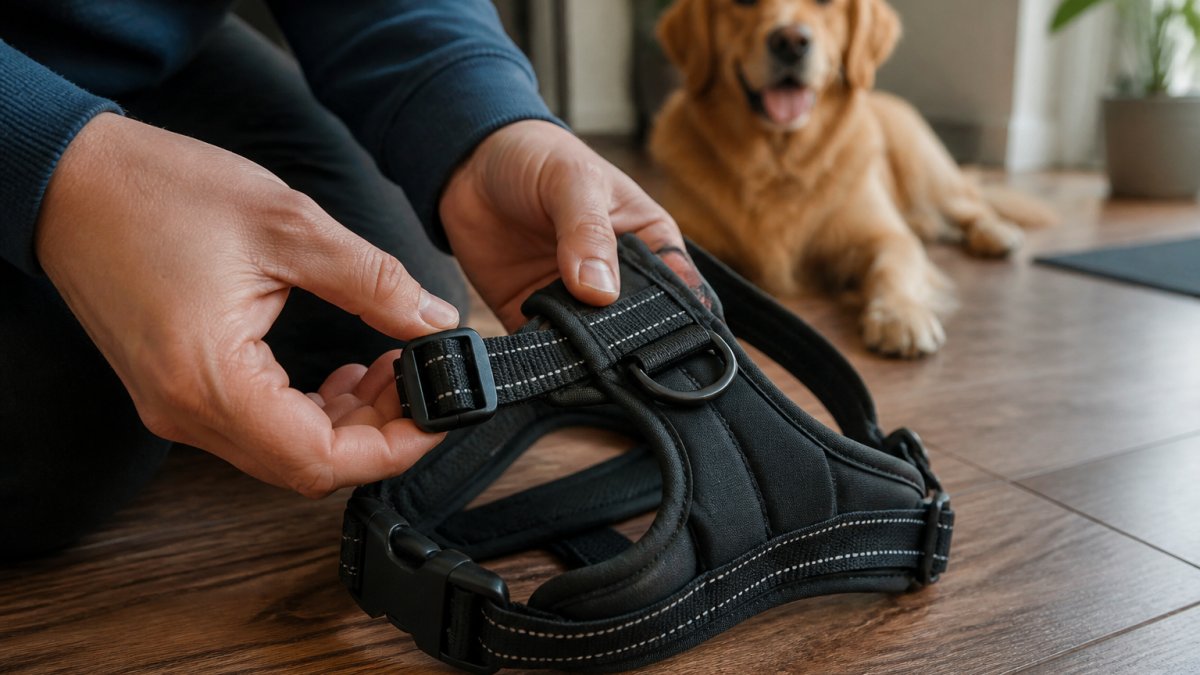
- A no-pull harness for daily walks. Our No-Pull Adventure Harness uses a front-clip design that redirects pulling force onto the chest instead of the neck, with padded lining and reflective stitching for evening walks.
- A supportive bed for sleeping. Our Comfort Den XL uses high-density orthopedic foam and a waterproof, machine-washable cover for dogs up to 80 lbs.
- An elevated bed for hot weather or outdoor use. Our CloudLift Bed keeps pets off hot or damp ground with a breathable, waterproof mesh surface.
Safe to skip or buy cheap:

- Matching outfits and seasonal costumes
- Multiple toy types when your pet has one clear favorite
- Duplicate bowls when one set works fine
What Premium Gear Does Not Fix
Spending more cannot solve a behavior problem. A $160 bed won't stop a dog with separation anxiety from chewing. A premium harness won't fix pulling if you never train loose-leash walking.
Premium gear fixes durability. It does not fix training, anxiety, or health issues. If your dog destroys bedding because of stress, the answer is behavioral work, not a tougher bed. If your cat avoids the carrier because of travel anxiety, a nicer carrier helps only marginally.
Be honest about which problem you're solving. Buy premium for wear and tear. Address behavior with training and, when needed, a veterinarian.
Conclusion: Buy the Middle, Replace Less
The smartest approach sits between the two extremes. Buy mid-to-premium for anything used daily and exposed to stress, and buy cheap for anything temporary, seasonal, or likely to be destroyed. That single rule saves more money than hunting for the lowest price on every item.
At Proudpetshop, we built our catalog around that idea. Every product ships with a 30-day satisfaction guarantee, free shipping on orders over $50, and transparent pricing with no surprises at checkout. Start with the gear your pet uses every day, and replace less often.
Frequently Asked Questions
Are premium pet accessories worth the extra cost?
It depends on the item. Premium pet accessories are worth it when the cheap version fails fast: beds for chewers, harnesses for strong pullers, and carriers used weekly. A $39.99 calming donut bed that survives two years costs less per year than four $15 beds that flatten in six months. Skip the upgrade on items your pet barely touches, like a second leash or a seasonal bandana.
What makes a pet accessory premium?
Price alone does not. Premium usually means specific build choices: reinforced stitching at stress points, metal instead of plastic hardware, removable and machine-washable covers, and materials rated for the job. A waterproof cover on a dog bed or a chew-resistant frame on an elevated cot matters more than a brand name. If a listing cannot tell you what the fabric or frame is made of, treat it as budget gear with a premium label.
Do premium pet accessories last longer?
In the categories where durability is the whole point, yes. Bite-proof and scratch-proof woven fabric on a sofa bed, for example, addresses the failure point that ends most dog furniture: torn fabric. High-density orthopedic foam in a bed like the Comfort Den XL holds its shape instead of compressing into a flat mat within months. On decorative items, the gap is smaller. Match the spend to how much abuse the item takes.
Which pet accessories are worth spending more on?
Prioritize four: beds, harnesses, carriers, and anything your pet uses daily. A front-clip no-pull harness at $37.99 that redirects pulling pressure off the neck is a safety purchase, not a luxury one. An elevated bed with a chew-resistant frame survives outdoor use that destroys fabric mats. For everything else, budget versions work fine. Spend where daily wear, safety, or your pet's joints are involved.
How do you compare premium and budget pet products before buying?
Read the spec list, not the photos. Look for weight limits, exact dimensions, cover materials, and whether the cover comes off for washing. Check the return window and who pays return shipping. Then do the math: divide the price by the months you expect it to last. A $161.99 bite-proof sofa bed that lasts three years beats a $50 bed replaced every four months, and the guarantee limits your risk if it does not hold up.