
Table of Contents
- Why Snuffle Mats Calm Anxious Dogs
- Snuffle Mat for Dog Anxiety: Matching the Mat to the Trigger
- How to Use a Snuffle Mat: A Gradual Plan for Anxious Dogs
- How Often to Use a Snuffle Mat (and How Long Each Session)
- Snuffle Mat vs Lick Mat: Which Calms Your Dog Faster?
- Safety, Supervision, and Food Portions
- How to Tell If the Snuffle Mat Is Actually Helping
- Conclusion
- Frequently Asked Questions
Last Updated: October 10, 2026
Why Snuffle Mats Calm Anxious Dogs
A snuffle mat is a fabric mat with folded layers that hides kibble or treats for your dog to find by scent. For anxious dogs, that act of sniffing and searching gives the brain a job a chew toy cannot.
Sniffing is a natural foraging behavior that lets a dog use its strongest sense in a low-pressure way, with no command to follow and no performance to get right.
The science of sniffing and the calm-down response
Sniffing is one of the few activities that is both active and calming, lowering arousal instead of raising it.
A dog pacing, whining, or watching the door is stuck in a high-alert state, and sniffing gives that energy somewhere to go.
The American Kennel Club's guide to canine enrichment notes that scent work taps into a dog's natural instincts and can help reduce stress.
What snuffle mats can and cannot fix
Snuffle mats help with boredom, nervous energy, and mealtime speed. They give anxious dogs a focus point.
They cannot fix separation anxiety, noise phobias, or fear-based aggression alone; those need a behavior plan and often a vet.
Snuffle Mat for Dog Anxiety: Matching the Mat to the Trigger
The right mat depends on what sets your dog off: a dog that panics at fireworks needs something different from one that chews the couch when left alone.
Here is how we match the tool to the trigger:
| Trigger | Best Enrichment Match | Why It Helps |
|---|---|---|
| Boredom or excess energy | Snuffle mat with adjustable difficulty | Gives a mental workout indoors |
| Fast eating and gulping | Snuffle mat or slow feeder | Slows intake and adds a search task |
| Noise sensitivity | Snuffle mat plus a calming bed | Combines focus with a safe space |
| Alone-time restlessness | Lick mat or treat puzzle | Long-lasting, low-effort engagement |
| Nail trims and bath time | Lick mat with soft food | Redirects attention during handling |
A snuffle mat for dog anxiety works best when the trigger is mental, not environmental.

The ASPCA's guidance on dog behavior and enrichment points out that mental stimulation is a core part of a dog's wellbeing, not an extra.
How to Use a Snuffle Mat: A Gradual Plan for Anxious Dogs
Start slow. An anxious dog must learn the mat is safe before it becomes a challenge. The first week's goal is not a tired dog but one that chooses to put its nose down while you are in the room.
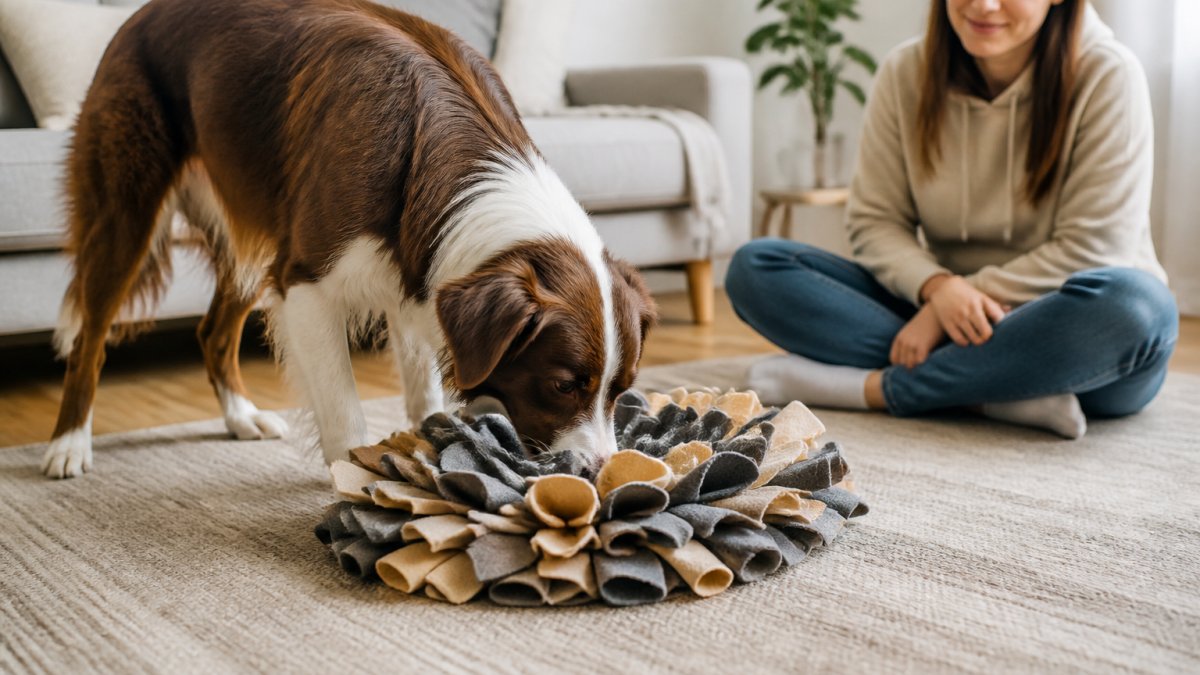
Step-by-step introduction for nervous or noise-sensitive dogs
- Pick a quiet room with no other pets, foot traffic, or background noise.
- Set the mat down and scatter three or four pieces of kibble on top, not inside. The dog should win in under five seconds.
- Sit a few feet away, turned slightly sideways rather than facing the dog; eye contact and leaning forward read as pressure.
- Say nothing. Let the dog investigate, eat, and walk away, ending the session even if it lasted 30 seconds.
- Repeat once a day for three to five days at the same time and spot. Predictability builds the association.
- Once your dog eats off the top without scanning the room, tuck a small handful of kibble under the top layer.
- Add depth one layer at a time, only after two consecutive relaxed sessions. Most anxious dogs need one to two weeks to work up to a fully loaded mat.
Expected result: by week two, your dog settles onto the mat within minutes, keeps its head down, and stops scanning the room between bites.
Reading comfort versus overwhelm
Anxious dogs do not always walk away when stressed, so watch the body, not just the behavior.
Signs your dog is comfortable:
- Soft, relaxed ears and a loosely wagging or neutral tail
- Slow, rhythmic sniffing with the head low
- Licking the mat or the floor between searches
Signs your dog is overwhelmed and the session should stop:
- Freezing, stiffening, or holding the head high and still
- Whale eye (showing the whites of the eyes) or repeated lip licking with no food present
- Sudden frantic digging, biting at the fabric, or trying to flip the mat
If you see two or more overwhelm signs, end the session calmly: pick up the mat, drop a treat on the floor away from it, and retry the next day with less food and depth. A calm ending beats a longer, frustrating session.
Lowering difficulty when the mat is too much
If your dog keeps struggling, you do not need a new mat, just an easier version of the same one.
- Spread the kibble across the whole surface instead of concentrating it in one spot.
- Use only the top layer of fabric and skip the folds entirely.
- Switch to larger, smellier pieces so the dog needs less searching per reward.
Common mistakes that backfire
The biggest mistake is making the first session too hard; a frustrated dog learns the mat is stressful, an association slow to undo.
Other common errors:
- Using high-value treats in a room full of distractions
- Leaving the mat down all day so it loses value
- Correcting your dog for digging or nosing, which punishes the exact behavior you want
How Often to Use a Snuffle Mat (and How Long Each Session)
Most dogs do well with one to two sessions a day of five to fifteen minutes each, enough to tire a busy mind without overdoing it.
Watch your dog, not the clock: one that walks away is done, one that keeps searching is still working.
Proud Pet Shop Sniffing Petal Mat →
For anxious dogs, a pre-bed session helps by becoming part of a bedtime routine that signals the day is winding down.
Snuffle Mat vs Lick Mat: Which Calms Your Dog Faster?
Lick mats calm faster in the moment. Snuffle mats build focus over time.
Sniffing is active and engaging, the better pick for a dog that needs a mental workout to burn off restless energy.
Many owners keep both: the lick mat for short, calming moments and the snuffle mat for longer enrichment sessions.
Our Proudpetshop Sniffing Petal Mat is built for the sniffing side of that pair.

If your dog also needs a quick calm-down tool, the Proud Pet Shop Slow-Feeding System spreads soft food into textured ridges for slow, soothing licking.

Safety, Supervision, and Food Portions
Supervise every session. Felt and fabric can be chewed, and a determined dog can pull pieces loose.
Check the mat after each use. Toss it if you find tears, holes, or loose threads.
Portions matter too. A snuffle mat should replace part of a meal, not add to it. If you use treats, cut back on kibble to keep calories steady.
For dogs with sensitive stomachs, stick to their normal food. A new treat during a stressful week can upset digestion.
How to Tell If the Snuffle Mat Is Actually Helping
Do not judge a snuffle mat by whether your dog looks happy during the session, but by what changes in the hours after. Pick two or three specific behaviors and track them for two weeks; a phone note is enough.
Observable indicators to track
Look for changes in these areas rather than a general sense of "calmer."
- Body language after the session: Does your dog lie down with a soft body, relaxed ears, and a slow tail within 10 to 15 minutes? A dog that stays tense, paces, or keeps checking the door is not decompressing.
- Recovery time after a trigger: If a noise or a visitor sets your dog off, how long until it settles? A drop from 30 minutes to 15 minutes over two weeks is a meaningful signal.
- Engagement with the mat: Does your dog go to the mat on its own, or does it need to be coaxed every time? Voluntary approach is one of the clearest signs the activity is reinforcing rather than stressful.
A simple two-week tracking method
Rate each chosen behavior once a day on a 1 to 5 scale, at the same time each evening so ratings are comparable. After 14 days, look at the trend, not any single day; anxious dogs have good and bad days, and one bad session does not mean the mat is failing.
Signs it is not working
- Your dog ignores the mat even when hungry
- Your dog gets more agitated during or after sessions
- Behavior gets worse, not better, over two weeks of daily, low-pressure sessions
If nothing changes after two weeks of daily, low-pressure sessions, the trigger may need a different plan. A snuffle mat is an enrichment tool, not a treatment for clinical anxiety; separation distress, noise phobias, and generalized anxiety each have their own management approach.
The AVMA's pet owner resources on behavior is a good starting point for finding professional support. A board-certified veterinary behaviorist or a certified applied animal behaviorist can assess whether medication, a structured behavior modification plan, or both are appropriate alongside enrichment.
Conclusion
An anxious dog needs more than a distraction. It needs a routine that lowers stress and builds confidence over time.
At Proudpetshop, we build gear for exactly that. Our Sniffing Petal Mat slows mealtime and adds a mental workout, while our IQ Treat Puzzle and Calming Donut Bed round out a calm-down routine.
Start with one short session today and give your dog a calmer, more focused daily routine.
Frequently Asked Questions
Can a snuffle mat help an anxious dog?
Yes, for many dogs. Snuffle mats work by tapping into your dog's natural foraging instincts, which gives them a job to do and shifts focus away from whatever is stressing them. The repetitive sniffing and food search can lower arousal and help a dog settle. That said, results vary. A snuffle mat is a management tool, not a treatment, and dogs with severe anxiety usually need a vet or behaviorist involved alongside enrichment.
How often should you give your dog a snuffle mat?
Most anxious dogs do well with one or two sessions a day, each lasting 5 to 15 minutes. You can also use it as part of a bedtime routine to help your dog wind down. Watch for signs of frustration, like walking away or pawing aggressively at the mat. If your dog loses interest or gets worked up, shorten the session or make it easier by spreading the food more shallowly.
Is a snuffle mat better than a lick mat for anxiety?
They calm dogs in different ways, so the better choice depends on your dog. Lick mats use repetitive licking, which is soothing and works well during baths, nail trims, or thunderstorms. Snuffle mats use sniffing and foraging, which burns mental energy and occupies a bored dog for longer. Many owners keep both. If your dog needs to burn nervous energy, start with a snuffle mat. If your dog needs to settle fast, try a lick mat.
Are snuffle mats safe for dogs that chew?
Only with supervision. A snuffle mat is not a chew toy, and a determined chewer can rip felt apart and swallow pieces. Put the mat down only during the session, then pick it up and store it out of reach. If your dog starts chewing the mat instead of sniffing, end the session, redirect to a durable chew, and try again later with food spread more thinly so the search takes longer.