
Table of Contents
- The 2026 Dog Training Gear Landscape: Why Methodology Matters
- Quick Comparison: Top Training Gear Picks
- Essential Training Harnesses and How to Choose a Dog Training Harness
- The Best Treat Pouches for Training and High-Value Rewards
- Recall Tools: Long Lines and Smart Tracking Tech
- Mental Stimulation Gear: Puzzles and Snuffle Mats
- Specialized Gear for Reactive Dogs and Puppies
- Conclusion: Building Your 2026 Training Kit
- Frequently Asked Questions
Last Updated: September 6, 2026
The 2026 Dog Training Gear Landscape: Why Methodology Matters
Dog training is rarely a failure of effort; it is often a failure of equipment. The best dog training gear 2026 has to offer actively supports your training protocol, whether that means redirecting pulling force, hiding high-value rewards, or building a reliable recall.
A common mistake is buying gear that fights the dog's natural instincts instead of working with them. For example, a standard collar can cause tracheal strain when a dog pulls, but a harness that redirects pressure to the chest turns that pulling energy into a training opportunity. Below, we cover the seven must-have categories for 2026.
The industry has shifted toward methodology-first design. Rather than simply containing a dog, modern gear is engineered to communicate with the handler. Reflective stitching, breathable mesh, and ergonomic design are now safety standards that support consistent, positive reinforcement.
Quick Comparison: Top Training Gear Picks
| Gear Type | Best For | Key Feature to Look For | Price Range |
|---|---|---|---|
| Front-Clip Harness | Loose-leash walking & pulling | Padded chest panel, reflective stitching | $30-$40 |
| Treat Pouch | High-value rewards on the go | Quick-release buckle, easy access | $15-$25 |
| Long Line | Recall training & safe freedom | Biothane or nylon webbing | $20-$35 |
| GPS/Bluetooth Tracker | Escape-proof peace of mind | Real-time location, waterproof | $30-$40 |
| Puzzle/Snuffle Mat | Mental stimulation & slow feeding | Machine washable, non-slip | $25-$35 |
| Slow Feeder Mat | Anxiety relief & portion control | Food-grade silicone, suction base | $15-$20 |
Essential Training Harnesses and How to Choose a Dog Training Harness
A dog training harness is the cornerstone of any effective kit. When a dog pulls against a flat collar, pressure concentrates on the trachea and cervical vertebrae, causing coughing, gagging, and long-term soft tissue damage. A harness redistributes that force across the sternum and ribcage, but the attachment point determines how it influences movement.
The Proud Pet Shop No-Pull Adventure Harness is our top pick for 2026 because it uses a front-clip configuration that redirects pulling tension away from the neck and onto the chest, turning the dog gently back toward the handler. This eliminates the tug-of-war dynamic common with collar-based restraint, reducing the risk of tracheal compression or neck strain.

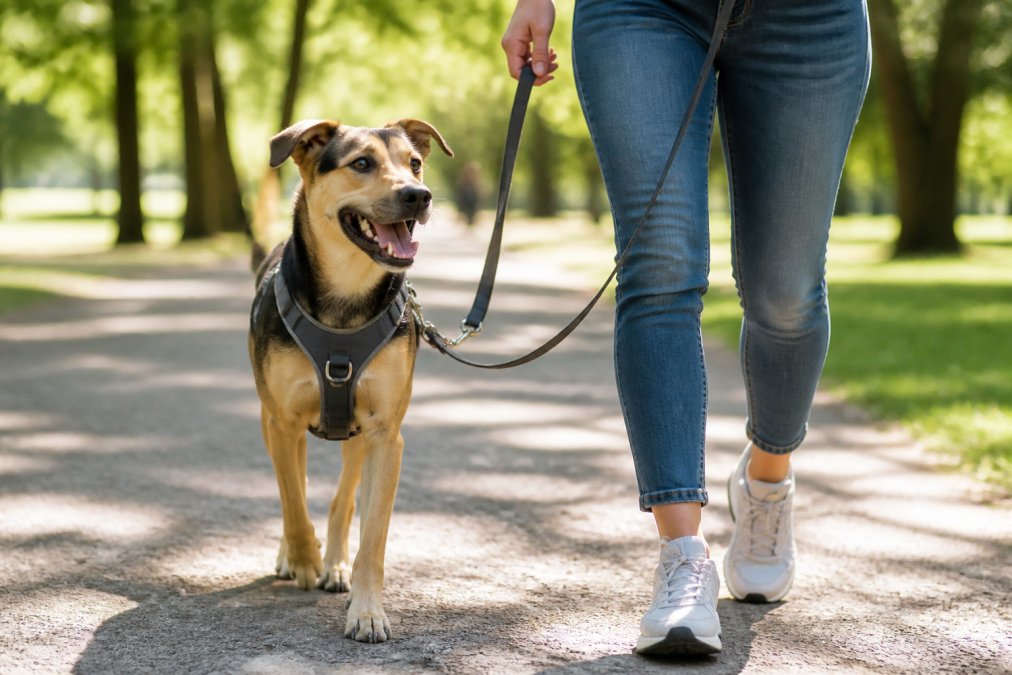
The harness features a breathable, padded lining that prevents hot spots, multiple adjustment points for sizes XS to XL, and integrated reflective stitching for low-light visibility.
Front-Clip vs. Back-Clip vs. Dual-Clip: The Mechanics
Front-clip harnesses are superior for behavior modification because pulling causes the dog's front end to rotate toward the handler, interrupting forward momentum and creating a natural opportunity to reward a loose leash. A back-clip harness attaches over the dog's center of gravity, which actually encourages pulling by applying resistance along the dog's natural line of motion. Back-clip harnesses suit dogs with solid recall who need a comfortable attachment point for casual walks.
Dual-clip harnesses offer both points, but owners often default to the back clip, undermining progress. If you choose a dual-clip model, use the front clip exclusively during training until the behavior is established.
Fit Troubleshooting: Beyond the Two-Finger Rule
The two-finger rule for shoulder blade clearance is a starting point, but it does not address the three most common fit failures:
- Strap migration: If the chest strap slides sideways or rotates around the girth, the harness is either too loose at the sternum or the Y-joint sits too low. The front attachment point should sit directly over the dog's breastbone, not off to one side.
- Chafing behind the elbows: A harness that sits too far back restricts shoulder extension and causes chafing after about 20 minutes of trotting. The back panel should end before the dog's last rib.
- Neck escape: For deep-chested breeds like Greyhounds or Dobermans, a standard harness can slip over the head if the neck opening is too generous. Look for a harness with a secondary girth strap that cinches independently of the neck opening.
Material and Construction Trade-Offs
Harness materials involve real trade-offs. Nylon webbing is strong and affordable but absorbs water and can cause friction burns. Polyester resists water better but has more stretch, reducing steering precision. Biothane is waterproof, easy to clean, and has minimal stretch, but is heavier and less breathable. For hard pullers, look for welded or bartacked stress points at the D-ring rather than box-stitching. Padded chest panels should use closed-cell foam, which resists odor.
For most training scenarios, especially with reactive or strong-pulling dogs, the front-clip design is non-negotiable. The Proud Pet Shop No-Pull Adventure Harness combines this configuration with materials that hold up to daily training.
The Best Treat Pouches for Training and High-Value Rewards
Training currency is the lifeblood of positive reinforcement. While we do not currently manufacture a dedicated pouch, the criteria remain the same: a wide-mouth opening you can reach into without looking, a quick-release buckle, and a secure belt clip. Many trainers prefer multiple compartments to separate high-value rewards from lower-value kibble.
If it takes more than two seconds to retrieve a treat, you have missed the reinforcement window. A quality pouch closes the gap between the correct behavior and the reward.
Recall Tools: Long Lines and Smart Tracking Tech
Recall training requires controlled freedom. A 15- to 30-foot long line made of biothane or durable nylon webbing allows your dog to explore and make mistakes while you maintain a physical connection. Biothane is weather-resistant and easy to wipe down, while nylon is strong but absorbs water and becomes heavy.
Long Line Length by Training Phase
Recall training progresses through distinct phases requiring different line lengths:
- Phase 1 (Foundation, 10-15 feet): In a low-distraction environment, a shorter line keeps the dog within the reinforcement zone. You can reward check-ins within one to two seconds of the behavior occurring. A 15-foot line is manageable for a single handler without tangling.
- Phase 2 (Distraction Building, 20-30 feet): As the dog's recall becomes more reliable, a longer line allows for more exploration while still providing a safety net. The handler must learn to manage the line without creating tension, this is where a line with a lightweight feel becomes important.
- Phase 3 (Off-Leash Transition, 30-50 feet): A longer line simulates off-leash freedom while retaining the ability to intervene. At this length, the line's weight and drag characteristics matter significantly.
Material Mechanics: Biothane vs. Nylon vs. Rope
- Biothane: A polyester core coated with a waterproof polymer. It does not absorb water, does not freeze stiff in winter, and wipes clean with a cloth. It has minimal stretch, which means you feel the dog immediately, but it can be slippery when wet. Weight is moderate, a 30-foot biothane line weighs roughly 12 to 16 ounces depending on width.
- Nylon webbing: Strong and inexpensive, but absorbs water and becomes heavy, a wet 30-foot line can gain 8 to 10 ounces. It also develops a rough texture when wet that can cause friction burns on the handler's hands.
- Polypropylene rope: Floats, which is useful for water work, but it has more stretch than biothane and can develop a fuzzy surface that collects burrs and debris.
For most handlers, biothane is the best all-weather choice.
Smart Tracking Tech: Moving Beyond GPS Alone
The Proud Pet Shop Smart Finder Tag offers a digital safety net. This lightweight device clips onto any standard collar and establishes a secure link to your mobile phone. When your pet wanders out of range, you receive instant alerts, and the waterproof design ensures it operates reliably in rain or damp environments.

Modern smart tags log more than location, they record movement patterns, time at distance, and speed of return. This data creates a measurable training record:
- Distance-at-call metrics: If your dog consistently takes 20 seconds to return from 50 feet but only 5 seconds from 20 feet, you know the reinforcement history at distance needs strengthening.
- Pattern recognition: Many dogs have predictable distraction zones, the corner where they always find a scent, or the spot where they hesitate. A tracking log that shows repeated pauses at the same location identifies where you need to do dedicated training sessions.
- Off-leash readiness scoring: By tracking the percentage of successful recalls at increasing distances over several weeks, you can make data-driven decisions about when to transition to off-leash work rather than guessing.
This integration of physical gear with digital logs is the emerging frontier in dog training equipment. When choosing a smart tag, look for features beyond basic GPS, such as historical location logs and activity pattern recording.
Mental Stimulation Gear: Puzzles and Snuffle Mats
Physical exercise tires a dog's body, but mental stimulation tires the mind, often the missing piece for hyperactive or anxious pets (peer-reviewed research). The Proud Pet Shop IQ Treat Puzzle converts snack time into a problem-solving task with adjustable difficulty and a non-slip base.
The Proud Pet Shop Sniffing Petal Mat hides kibble between folded felt petals, forcing the dog to rely on its sense of smell. This foraging activity slows down fast eaters and provides a calming outlet for natural hunting drives. Both tools are dishwasher-safe or machine washable.

| Gear | Primary Benefit | Best Scenario | Cleaning Method |
|---|---|---|---|
| IQ Treat Puzzle | Problem-solving & slow eating | Indoor play, rainy days | Dishwasher safe |
| Sniffing Petal Mat | Scent work & foraging | Mealtime replacement | Machine washable |
| Slow-Feeding System | Anxiety relief & licking | Bath time, nail trims | Dishwasher safe |
Specialized Gear for Reactive Dogs and Puppies
Reactive or anxious dogs require gear that minimizes pressure points and provides a sense of security. A front-clip harness maintains control without exacerbating fear responses, and pairing it with a bungee leash adds shock absorption to prevent sudden jolts. The goal is a calm, predictable walking experience.
For puppies, start with lightweight, non-restrictive equipment. A well-fitted harness with a quick-release buckle is ideal for early leash manners, while puzzle feeders support cognitive development (mdpi.com). The Proud Pet Shop Slow-Feeding System, made from food-grade silicone, encourages slow licking that soothes anxiety and aids digestion.
Conclusion: Building Your 2026 Training Kit
Building the best dog training gear kit for 2026 means prioritizing methodology over marketing. Start with a quality front-clip harness, add a reliable treat delivery system, and incorporate mental stimulation tools. Every piece of gear should serve a specific purpose in your training protocol.
At Proudpetshop, we design our gear to hold up to real households and real training sessions, backed by a 30-day satisfaction guarantee. From the No-Pull Adventure Harness to the IQ Treat Puzzle, every product supports your dog's growth. Get started with Proudpetshop and build a training kit that actually works.
Frequently Asked Questions
What is the most essential dog training gear for beginners in 2026?
For beginners, start with a well-fitting front-clip harness, a standard 6-foot leash, and a treat pouch stocked with high-value rewards. This combination provides control, prevents neck strain, and sets you up for success with positive reinforcement. The Proud Pet Shop No-Pull Adventure Harness is a great starting point. Add a long line for recall practice and a puzzle toy for mental enrichment as your skills grow.
How do I choose a dog training harness for pulling?
Look for a front-clip harness, as this design redirects your dog's forward momentum back toward you, discouraging pulling without causing neck strain. Ensure it has multiple adjustment points for a snug, escape-proof fit and is made of breathable, durable materials. The Proud Pet Shop No-Pull Adventure Harness fits this criteria, with a padded chest panel and reflective stitching for low-light visibility.
Are treat pouches necessary for effective dog training?
While not strictly necessary, a dedicated treat pouch is highly recommended. It keeps high-value rewards within easy reach, which is critical for timing in positive reinforcement. Fumbling in your pockets slows your reaction time. The best treat pouches for training have a quick-release buckle, are washable, and attach securely to your belt or waist. This keeps your hands free for handling the leash and clicker.
What are the emerging trends for dog training gear in 2026?
The biggest trend is the integration of technology, such as GPS and smart finder tags that enhance recall training and safety. There is also a growing focus on gear for reactive or anxious dogs, with calming aids and specialized harnesses. Sustainability is another key trend, with more owners seeking durable, long-lasting products made from eco-friendly materials that reduce waste.