
Table of Contents
- Why Bed Size Matters More for Large Breeds
- How to Measure a Dog for a Bed
- Dog Bed Size Chart by Breed
- What Makes an Orthopedic Bed Supportive for Large Dogs
- Best Orthopedic Dog Beds for Large Dogs
- Sizing for Puppies, Weight Changes, and Multi-Dog Homes
- Frequently Asked Questions
Last Updated: October 20, 2026
Why Bed Size Matters More for Large Breeds
A large dog sleeping on a bed that's too small gets no real joint support. Their weight lands on compressed foam, and the whole point of an orthopedic bed is lost. At Proudpetshop, we see this mistake constantly: owners buy a supportive orthopedic bed, then pair it with the wrong footprint.
Size and support are linked. A Great Dane or a senior Labrador needs a sleeping surface long enough to stretch out and firm enough to hold their frame. Too small, and pressure builds on hips and elbows. Too soft, and the foam flattens under the weight.
According to the American Kennel Club's breed sizing guidance, body length and weight vary widely even within one breed group. That's why breed alone won't tell you the right bed size.
Below, we'll show you exactly how to measure, read a size chart, and match foam to your dog's body.
How to Measure a Dog for a Bed
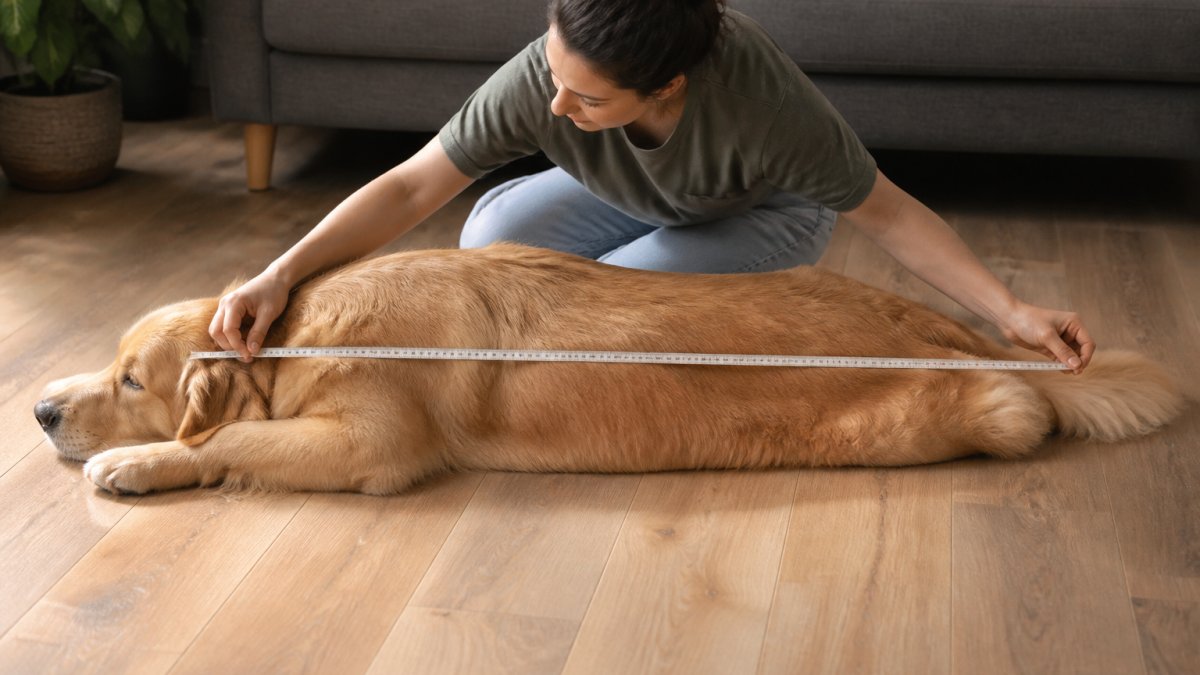
The right bed size starts with three numbers: sleeping length, sleeping width, and standing height at the shoulder. Most owners only take a standing measurement, which is why so many large-breed beds end up too short once the dog stretches out. Measure your dog lying down, in the position it actually sleeps in, on a flat floor with a soft tape.
Step 1: Measure Sleeping Length
Wait until your dog is relaxed and lying in its usual position. Run the tape from the tip of the nose (or the front of the chest, if the head is tucked) to the base of the tail. Do not pull the tape tight, follow the body's natural curve. Write the number down.
Step 2: Measure Sleeping Width
Measure across the widest part of the body while the dog is still lying down. For a sprawler, this is usually across the front elbows; for a curler, it's across the hips. Record it.
Step 3: Add Clearance
Add 4 to 6 inches to the sleeping length and 2 to 4 inches to the sleeping width. That buffer lets a large dog shift position during the night without hanging off the edge. Dogs that stretch out flat need the full 6 inches of length; dogs that curl tightly can take the lower end.
Step 4: Account for Bolsters
Bolsters and raised sides look supportive, but they eat into usable space. If the bed has bolsters on all four sides, subtract 4 to 6 inches per bolstered side from the advertised dimensions to estimate the flat mattress area. A bed listed at 41 x 28 inches with 5-inch bolsters on every side may only give your dog about 31 x 18 inches of flat surface, often too small for a 90-pound dog.
Usable Sleeping Area vs. Advertised Dimensions
Here's what most listings don't tell you: advertised bed dimensions include the bolsters and frame. Always check the usable surface area before buying. If a listing only shows outer dimensions, subtract 4 to 6 inches per bolstered side. That's the real sleeping space your dog gets.
A Repeatable Sizing Formula
Use this sequence every time you shop: (1) sleeping length + 4-6 inches, (2) sleeping width + 2-4 inches, (3) subtract bolster depth per side, (4) compare the result to the bed's usable sleep area, not its outer dimensions. If the usable area is smaller than your dog's sleeping length plus clearance, size up. This method works for any breed and any bed style, and it takes about five minutes.
Dog Bed Size Chart by Breed
Use this chart as a starting point, then confirm with your own measurements. Breed examples are typical adults, not puppies.
| Bed Size | Usable Sleep Area | Typical Weight | Breed Examples |
|---|---|---|---|
| Large | 30 x 20 in | 50-70 lbs | Labrador, Golden Retriever |
| XL | 36 x 24 in | 70-90 lbs | German Shepherd, Rottweiler |
| XXL | 44 x 30 in | 90-120 lbs | Great Dane, Mastiff |
Sizing for Different Sleeping Positions
Sleeping position changes the size you need. A dog that curls up needs less length but more cushioning at the edges. A dog that stretches out flat needs the full body length plus room to spare.
- Curler: a bed with raised sides and a snug center works well
- Stretcher: a flat mattress with extra length is better
- Side sleeper: prioritize width and firm support
- Belly-up sleeper: needs a wide, stable base with no high bolsters
What Makes an Orthopedic Bed Supportive for Large Dogs
Support comes down to foam. A thick mattress with high-density foam holds a heavy frame without bottoming out. Cheap filling compresses fast, and once it flattens, joint support disappears.
Proud Pet Shop Comfort Den XL →
Foam Thickness, Firmness, and Weight Capacity
Look for at least 3 to 4 inches of dense orthopedic foam for a large breed. Firmness matters too: too soft, and a heavy dog sinks through to the floor. Too firm, and pressure relief is lost.
Check the weight capacity against your dog's current weight, then add a buffer. A growing dog or one carrying extra pounds needs headroom.
Best Orthopedic Dog Beds for Large Dogs
The best orthopedic dog beds for large dogs combine a correct footprint, dense foam, and washable covers. Our top pick is the Proud Pet Shop Comfort Den XL. At 41 x 28 x 7 inches, it's built for dogs up to 80 lbs, with high-density orthopedic foam that relieves pressure on sensitive joints.

The raised bolster sides support the head and neck, and the removable cover is waterproof and machine washable. A non-slip base keeps it steady on tile or hardwood. It's $149.99, and it holds its shape over time.
For heavy chewers, the Bite-Proof Sofa Bed ($161.99) uses scratch-proof fabric and a waterproof surface. For warmer months, the CloudLift Bed ($99.00) keeps dogs off hot or damp floors with breathable mesh.
Sizing for Puppies, Weight Changes, and Multi-Dog Homes
A puppy will outgrow a bed fast. Size for the adult weight, not the current one, or plan to size up within a year. For multi-dog homes, buy one bed per dog plus one extra so no one gets crowded off their spot.
Senior dogs need extra thought. A bed that's too tall to step into causes strain, so look for a lower profile or a firm step-up. Proudpetshop backs every bed with a 30-day satisfaction guarantee, so you can check the fit at home.
Frequently Asked Questions
How do I measure my dog for an orthopedic bed?
Have your dog stand on a flat surface and measure from the center of the chest to the base of the tail, then measure the widest point of the body. Add 8 to 12 inches to the length and 4 to 6 inches to the width so your dog can stretch out. For a dog that curls up, you can add slightly less. Write the numbers down and compare them to the bed's usable sleeping surface, not just its outer dimensions, especially if the bed has raised bolsters.
What size orthopedic bed does a Great Dane need?
A Great Dane typically needs a bed with a usable sleeping surface of at least 48 to 54 inches long and 30 to 36 inches wide, depending on whether it stretches out or curls up. Because of their weight and joint strain, look for high-density orthopedic foam that holds its shape under heavy loads. Check the weight rating before buying and confirm the bed's inner dimensions, since bolsters can take several inches off the usable area.
Do large dogs need firm or soft orthopedic beds?
Most large and giant breeds do better on firm, high-density orthopedic foam that supports joints without sinking. A bed that is too soft lets a heavy dog bottom out and press against the floor, which defeats the pressure relief. Firm foam keeps the spine level and cushions pressure points. A softer bolster or top layer can add comfort for the head and neck, but the base should stay supportive, particularly for senior dogs or those with arthritis.
What makes a dog bed orthopedic?
An orthopedic bed uses supportive foam, usually memory foam or high-density foam, to distribute a dog's weight and relieve pressure on joints. The foam needs enough thickness and firmness to keep a heavy dog from sinking through to the floor. Other signs include a removable, washable cover, a non-slip base, and a weight rating that matches your dog. Orthopedic beds are especially useful for senior dogs, large breeds, and dogs with arthritis or mobility issues.
Choosing the right size orthopedic bed for large breeds is really about matching measurements to support. Get the length and width right, confirm the usable surface area, and check the foam and weight rating before you buy.
At Proudpetshop, we make that easier with durable beds, transparent pricing, free shipping on orders over $50, and a 30-day satisfaction guarantee. Find the bed that fits your dog's body and joints, and give them the rest they deserve.