
Table of Contents
- Why Small Dogs Need Different Harness Considerations
- The Real Risks of Heavy-Duty Gear on Small Frames
- Benefits of Front-Clip vs Back-Clip Harnesses
- How to Measure a Dog for a Harness That Fits Right
- Best Harness for Small Dogs That Pull
- Material Breathability and Weight: The Over-Engineering Trap
- Is a Heavy-Duty Harness Worth the Investment?
- Frequently Asked Questions
Last Updated: September 27, 2026
Why Small Dogs Need Different Harness Considerations
Small dogs have different biomechanical needs than larger breeds, and choosing a heavy duty harness small dogs can wear safely requires understanding these distinctions. A heavy-duty harness designed for a 70-pound retriever creates problems on a 10-pound Chihuahua, the weight distribution, hardware density, and strap tension become excessive and potentially harmful for a small frame.
Neck strain and tracheal collapse are serious concerns. Small breeds have naturally narrower, more fragile windpipes, and any harness concentrating pulling pressure on the neck compounds this risk. Even poorly designed harnesses can trigger coughing, wheezing, or airway compression.
The real question is whether durability comes at the cost of your dog's comfort and safety. The best gear for small dogs balances structural integrity with lightweight design, materials and hardware that won't fatigue shoulders or restrict movement.
The Real Risks of Heavy-Duty Gear on Small Frames
Heavy-duty harnesses feature reinforced 1000D nylon, industrial-grade buckles, and thick padding designed for large, powerful dogs. On small breeds, these features create unanticipated problems.
Weight is the first issue. A harness weighing 8-12 ounces represents 0.1% of body weight on a 70-pound dog but 5-7% on a 10-pound dog. Small dogs feel every ounce, and excess weight causes shoulder and neck fatigue over time.
Heavy-duty buckles and D-rings engineered for large dogs create pressure points and chafing on small frames. Hardware that prevents escape on a 60-pound Labrador may dig into a small dog's side during normal movement.
Breathability suffers with heavy-duty construction. Thicker materials trap heat and moisture, reducing airflow. Small dogs, especially brachycephalic breeds like French Bulldogs and Pugs, already struggle with temperature regulation, and a heavy harness compounds this during warm weather.
Benefits of Front-Clip vs Back-Clip Harnesses
The leash attachment point fundamentally changes how a harness functions and affects your dog's body mechanics. Front-clip and back-clip designs serve different purposes.
Front-Clip Harnesses: Pulling Redirection and Neck Protection
Front-clip harnesses attach the leash at the sternum, redirecting pulling force forward and across the chest. When your dog lunges, the attachment point naturally turns the dog toward you, eliminating the tug-of-war dynamic.
Pressure distributes across the padded chest panel instead of concentrating on the throat and trachea. For small breeds prone to tracheal collapse, this design substantially reduces the risk of coughing, wheezing, or airway compression.
Front-clip design has a trade-off: repeated pulling redirection can cause shoulder fatigue over time, especially in chronic pullers wearing the harness for extended periods. Monitor dogs with pre-existing joint sensitivity or those over 8 years old.
Front-clip harnesses require proper leash technique. A front-clip harness works best with a relaxed leash and gentle guidance rather than correction-based training.
Back-Clip Harnesses: Weight Distribution and Natural Movement
Back-clip harnesses attach the leash at the spine, between the shoulder blades. This design is biomechanically neutral and distributes weight evenly along the spine and shoulders, the most natural weight-bearing position for a dog's body.
For small dogs that don't pull, back-clip design offers superior weight distribution for casual walks without turning force or pressure concentration. Back-clip harnesses are lighter and more comfortable for daily wear, ideal for senior dogs or those with shoulder sensitivity.
Back-clip harnesses allow better freedom of movement for dogs navigating obstacles or stairs, with front legs extending fully without restriction.
The trade-off is behavioral: a back-clip harness offers no correction for pulling. For dogs that pull consistently, it can reinforce the behavior because there's no consequence or redirection.
Choosing Between Front-Clip and Back-Clip for Your Small Dog
The decision depends on three factors:
-
Pulling behavior: Does your dog pull during walks? If yes, front-clip is superior for safety and training. If your dog walks calmly on a loose leash, back-clip is more comfortable and allows better natural movement.
-
Age and joint health: Senior small dogs or those with shoulder/joint sensitivity benefit from back-clip's neutral weight distribution. Younger, healthier dogs can tolerate front-clip's redirection without issue.
-
Daily wear duration: If your small dog wears a harness for more than an hour daily, back-clip is gentler for long-term comfort. Front-clip is better for training sessions and walks where pulling is a concern.
Many small-dog owners find a combination approach works best: use a front-clip harness for training walks where pulling is likely, and switch to a back-clip harness for casual walks or daily wear. This balances correction with comfort.
How to Measure a Dog for a Harness That Fits Right
Proper sizing is non-negotiable. Most pet owners guess at sizing or rely on breed weight ranges, which don't account for individual body shape variation. Small breeds vary dramatically, a Chihuahua's chest-to-neck ratio differs completely from a Pug's, yet both may fall into the same weight category.
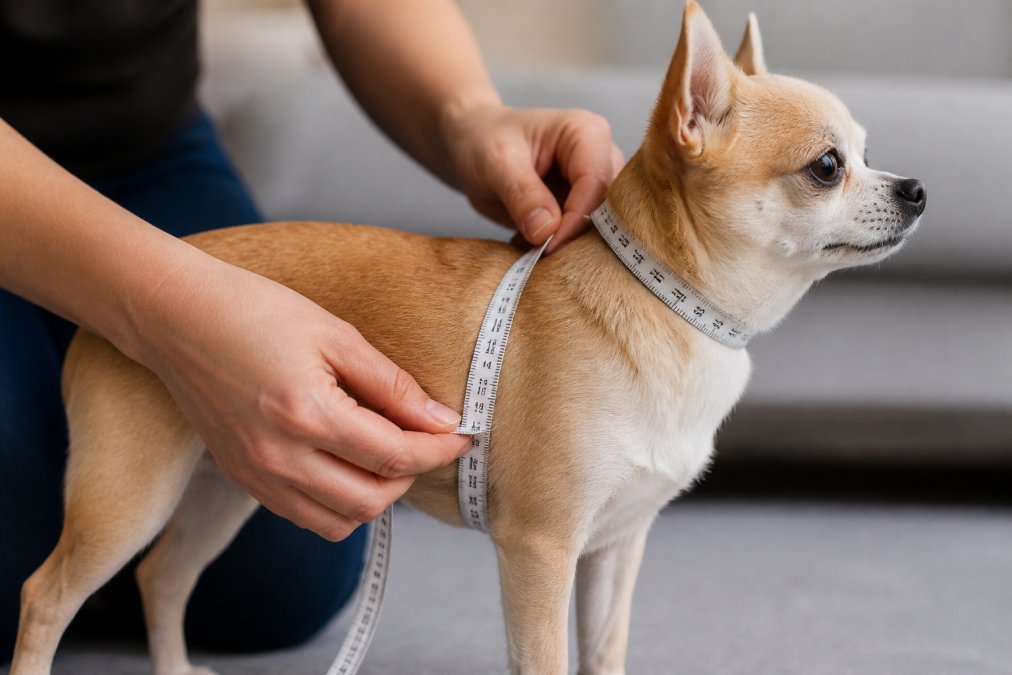
Taking Accurate Measurements
Start with the chest girth measurement. Place a soft measuring tape around the widest part of your dog's ribcage, just behind the front legs. The tape should sit snug but not tight; you should be able to slip one finger underneath comfortably. Write down this measurement in inches. This is your primary sizing reference.
Next, measure neck circumference at the base of the skull with one finger fitting comfortably under the tape. This measurement is critical for preventing the harness from slipping or restricting breathing.
Finally, measure from the base of the neck down the spine to the base of the tail for proper torso coverage. A harness that's too short restricts front-leg movement; one that's too long chafes the armpits and inner thighs.
Cross-reference these three measurements against the manufacturer's sizing chart. Most quality harnesses offer multiple adjustment points to fine-tune fit across the chest, neck, and torso. Adjustable straps are essential for small dogs, whose body proportions vary wildly across breeds and even within litters.
Common Measurement Mistakes and How to Avoid Them
Measuring over a thick coat is a frequent error. For fluffy or double-coated dogs, measure directly against the skin. A harness that fits over the coat will slip during walks.
Another mistake is measuring the neck too loosely. A neck opening more than one finger-width loose allows the harness to shift sideways, concentrating pressure on one side of the neck instead of distributing it evenly.
Failing to account for growth is a trap with puppies. Small-breed puppies grow rapidly in the first 6-8 months. Choose a harness with generous adjustment range rather than one that fits perfectly now but will be too small in two months.
Verifying Fit After Purchase
After fitting a new harness, take your dog on a 10-minute walk and check for specific signs of poor fit:
- Rubbing or red marks on the armpits, inner thighs, or where the neck opening sits. These indicate pressure concentration and will worsen with extended wear.
- Bunching or folding of material, especially at the shoulders or sides. This creates friction and restricts movement.
- Twisting or rotating during normal gait. If the harness shifts to one side, the fit is too loose or the torso length is wrong.
- Restricted front-leg movement or a shortened stride. The dog should move naturally without the harness limiting shoulder extension.
- Panting or reluctance to move after just a few minutes. This may indicate the chest panel is too tight or the harness is trapping heat.
A properly fitted harness should feel invisible to your dog, no pulling, twisting, or visible discomfort during normal activity.
Best Harness for Small Dogs That Pull
The best harness for a small dog that pulls is a heavy duty harness small dogs need, one combining front-clip design with lightweight construction and precise adjustability. It should prioritize pressure distribution over durability theater.
When evaluating any harness for a pulling small dog, ask these questions:
- Does it use a front-clip attachment point?
- Is the overall weight under 6 ounces for sizes XS-S?
- Does it have breathable, padded lining?
- Are there multiple adjustment points for precise fit?
- Is the hardware minimal but secure?
Material Breathability and Weight: The Over-Engineering Trap
This is where the heavy-duty harness myth collapses. Durability is irrelevant if the gear makes your dog uncomfortable or unsafe.
Is a Heavy-Duty Harness Worth the Investment?
For most small dog owners, the answer is no. A heavy-duty harness designed for large breeds creates more problems than it solves on small frames.
Frequently Asked Questions
Are heavy-duty harnesses too bulky for small dog breeds?
Not necessarily. Modern heavy-duty harnesses for small dogs balance durability with lightweight materials like 1000D nylon and minimal hardware. The real issue is weight-to-hardware ratio, a harness should weigh no more than 2-4% of your dog's body weight. A 10-pound Chihuahua, for example, shouldn't wear more than a few ounces of gear. Check the product specs before purchasing to ensure the harness doesn't exceed this threshold.
What's the best harness for small dogs that pull?
Front-clip harnesses redirect pulling force to the chest, turning your dog gently toward you rather than letting them forge ahead. This is especially important for small breeds prone to tracheal collapse from neck strain. The Proud Pet Shop No-Pull Adventure Harness ($37.99) uses a front-clip design with adjustable sizing from XS to XL and breathable padding to prevent chafing during extended wear.
How do I know if a harness will actually last longer than a cheap one?
Quality brands back their products with satisfaction guarantees, Proud Pet Shop offers a 30-day guarantee, so you can test durability risk-free and return if it doesn't perform.
Can a heavy-duty harness help with leash training a small dog?
Yes, front-clip heavy-duty harnesses are excellent training tools because they give you better control without choking your dog. By redirecting pulling behavior to the chest rather than the neck, you eliminate the reward your dog gets from pulling forward. This makes leash training more effective and protects your small breed from the neck strain and tracheal damage that traditional collars cause.