
Table of Contents
- How to Tell If Pet Gear Lasts: The 7-Point Inspection
- Stitching, Seams, and Hardware: The First Failure Points
- How to Choose a Pet Carrier That Survives Daily Use
- Pet Carrier Safety Features That Signal Long-Term Quality
- Pet Carrier Materials: What Holds Up and What Doesn't
- How to Clean a Pet Carrier Without Shortening Its Life
- When to Replace Pet Gear: Warning Signs to Watch
- Conclusion: Test Before You Trust
- Frequently Asked Questions
Last Updated: October 13, 2026
How to Tell If Pet Gear Lasts: The 7-Point Inspection
You can tell if pet gear lasts by checking seven things before and after purchase: stitching, hardware, fabric weight, stress points, material type, cleaning demands, and your pet's chewing style.
Most buyers look at price first. That's the mistake.
This guide covers a 7-point inspection you can run on any pet product, in a store or on your couch, plus a step-by-step look at carriers, where durability matters most.
Why Price Tags Don't Guarantee Durability
Expensive gear fails for the same reasons cheap gear does: weak stitching, thin fabric, and cheap plastic clips. Paying more sometimes buys better materials, sometimes just a nicer logo.
Here's what actually predicts long life:
- Stitch density. More stitches per inch means stronger seams.
- Hardware material. Metal buckles outlast plastic ones under load.
- Fabric weight. Heavier woven fabric resists tearing better than thin knit.
A common mistake is judging gear by feel alone. Soft, plush fabric feels premium but wears through fast; tightly woven, slightly stiff fabric lasts longer.
Stitching, Seams, and Hardware: The First Failure Points
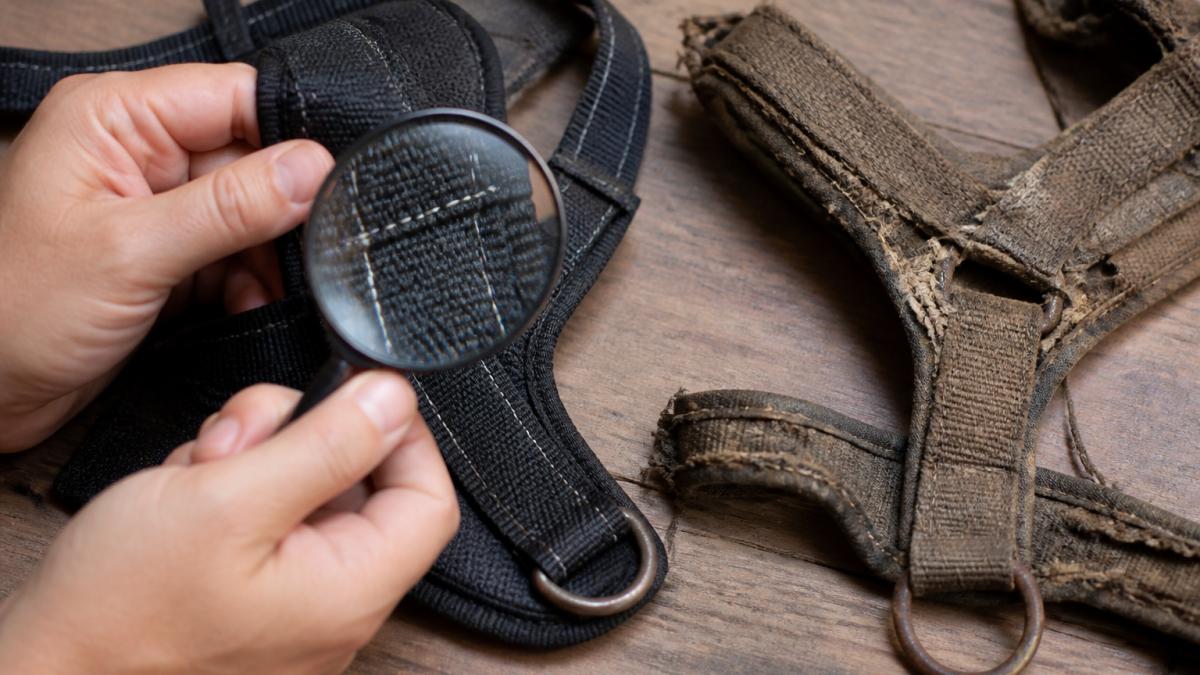
Seams fail before fabric does. Run your thumb along every seam and check three things: even stitching, no loose threads, and doubled stitching at stress points.
The two-minute seam test
You don't need tools to grade a seam:
- Count stitches per inch. Light-duty gear runs 6 to 8; gear built for daily walks and pulling runs 10 to 12. Below 6 is a red flag for anything load-bearing.
- Pull the seam apart gently. Daylight between the fabric edges means the seam allowance is too narrow and will gap under load.
- Run a fingernail along the thread. If it fuzzes or frays immediately, it's low-twist thread that will abrade through at the first stress point.
- Check the thread color. Matching thread hides defects; contrasting thread often signals the maker expects you to inspect the work.
Where seams actually fail
Seams almost never fail mid-run. They fail at four places:
- Where webbing meets fabric, the D-ring anchor on a harness, the handle on a carrier.
- Where the seam turns a corner, inside corners concentrate stress.
- Where two different materials meet, mesh sewn to nylon, because the two stretch at different rates.
That's why bar-tack stitching matters. A bar tack is a short, dense zigzag of 10 to 15 stitches that reinforces an anchor point. Look for it at every D-ring, handle, and strap junction. A load-bearing point with only a plain straight seam is built to a price, not a standard.
Hardware: squeeze, twist, and listen
Hardware fails in predictable ways. Run these checks:
- Squeeze every plastic clip. Side-release buckles should flex and return to shape. Plastic that whitens at the bend is already stressed and will crack.
- Twist every metal D-ring. A welded ring holds; a bent-wire ring opens under load. A visible gap where the wire meets itself means it isn't welded.
- Test the spring in every clip. Open and close it five times. A clip that loses tension by the fifth cycle will pop open on a walk.
The stress-point map
Every piece of pet gear has a few points that take almost all the load. Find them before you buy:
- Harness: D-ring anchor, chest strap junction, and the buckle where the girth strap meets the body.
- Collar: the buckle, the D-ring, and the keeper loop.
- Carrier: the handle-to-body seam, the zipper at the top opening, and the base panel corners.
If any of those points has a single row of stitching, no bar tack, or a plastic component under load, that's where the gear will fail first. Check again after a month of use; wear shows up at stress points first.
How to Choose a Pet Carrier That Survives Daily Use
Choosing a pet carrier that lasts starts with matching it to your pet's weight and travel habits, not the cutest photo online. A carrier rated for 15 pounds won't survive a 25-pound cat who lunges at every squirrel.
Use this decision framework:
| Your Situation | What to Prioritize | What to Avoid |
|---|---|---|
| Daily commutes | Reinforced base, metal zippers | Soft-sided bags with no frame |
| Airline travel | Size-compliant dimensions, locking zippers | Oversized carriers |
| Car rides only | Crash-tested structure, secure straps | Unpadded fabric carriers |
| Occasional vet visits | Easy-clean lining, sturdy handles | Decorative trim, thin mesh |
| Senior or anxious pets | Wide opening, orthopedic base pad | Deep, narrow designs |
One more check: press the floor panel. If it bows under light pressure, it will sag under your pet. A firm, removable base board is a good sign.
Pet Carrier Safety Features That Signal Long-Term Quality
Safety features and durability overlap more than people expect: gear built to protect your pet is usually built to last. Look for:
- Locking zippers that stay closed if your pet paws at them
- Interior safety tethers that clip to a collar or harness
- Reflective strips for visibility on evening walks
The American Veterinary Medical Association's pet travel guidance recommends securing pets in carriers during car travel. A carrier that wobbles or shifts isn't just unsafe. It's also wearing itself out faster with every trip.
Check the tether attachment point specifically. Sewn into a single layer of fabric, it will tear; it should anchor to a reinforced seam or the frame.
Pet Carrier Materials: What Holds Up and What Doesn't
Material choice decides how long a carrier survives. Here's how the common options compare:
- 600D polyester: Tight weave, resists tearing, easy to wipe clean. Best all-round choice.
- Nylon: Strong and light, but thinner versions snag and run.
- Canvas: Very durable, but heavy and slow to dry.
What most guides miss is the mesh. It's where carriers fail first. A pet who scratches at the door will shred thin mesh in weeks. Look for tightly woven mesh with reinforced edges.
For dogs who chew, apply the same logic to beds and mats. Our Proudpetshop Bite-Proof Sofa Bed uses a bite-proof, scratch-proof woven cover with a waterproof surface and a removable, machine-washable cover.

How to Clean a Pet Carrier Without Shortening Its Life
Cleaning a pet carrier the wrong way can cut its life in half. Harsh chemicals break down fabric coatings. Hot water shrinks mesh. A dryer on high heat warps frames and zippers.
Proud Pet Shop Cooling Recovery Mat →
Follow this routine:
- Vacuum loose hair and debris from all surfaces.
- Spot-clean stains with mild soap and cool water.
- Wipe mesh panels gently. Never scrub them.
- Air-dry fully, away from direct sun and radiators.
- Check zippers and clips after every wash.
For machine-washable covers, use cold water and a gentle cycle, then air-dry. Heat is the enemy of every synthetic fabric in pet gear.
When to Replace Pet Gear: Warning Signs to Watch
Replace pet gear the moment you spot structural damage, not when it finally breaks. The ASPCA's pet care and safety resources stress that worn equipment can fail suddenly under load, which is exactly when your pet needs it most.
Retire gear when you see:
- Frayed or broken stitching at any stress point
- Cracks, bends, or rust on hardware
- Stretched or deformed clips that no longer lock
Small damage grows fast. A two-inch tear in mesh becomes a full panel failure within weeks of daily use.
Match the gear to the chewer, not the other way around
Most durability advice assumes a dog who chews politely. If your dog shreds, swallows, or destroys toys within minutes, the question changes. You're not asking "is this worn out?" You're asking "is this safe to leave with my dog for one more session?"
Use this framework to sort your dog into a chewing tier, then match materials accordingly:
| Chewing intensity | Typical behavior | Materials that hold up | Materials to avoid |
|---|---|---|---|
| Light | Nibbles, carries toys, rarely destroys | Plush, fleece, thin rope | Nothing specific, replace when soiled |
| Moderate | Chews edges, removes squeakers, opens seams | Dense rubber, thick woven nylon, tightly braided rope | Thin mesh, single-layer plush, glued seams |
| Heavy | Destroys toys in minutes, tears fabric, works on seams | Reinforced woven covers, thick rubber, ballistic-style fabric | Cardboard, thin plastic, foam fill, gel cores |
| Destructive / ingestive | Swallows pieces, shreds and eats fabric, targets stuffing | Supervised-only items; no loose fabric or foam | Anything the dog can tear into pieces small enough to swallow |
A common pattern is that owners of destructive chewers keep buying the same category of toy in a slightly tougher version, and it keeps failing. The fix isn't a tougher toy in the same category.
The ingestion and obstruction risk most guides skip
Swallowed fabric, foam, cardboard, and plastic fragments are the real danger with destroyed gear, not the destroyed gear itself. A dog who shreds a plush toy and eats the stuffing risks a bowel obstruction; a dog who punctures a gel-filled mat risks ingesting the gel.
Watch for these signs that a dog has swallowed gear material:
- Vomiting, especially repeated vomiting
- Refusing food or eating less than usual
- Straining to defecate or producing small, frequent stools
If you see these signs after your dog has been alone with a destroyed item, contact your veterinarian. Don't wait to see if it passes. Obstructions can become surgical emergencies within a day.
A discard schedule beats a damage inspection
For heavy and destructive chewers, inspecting for damage is too late. The gear is already destroyed. Instead, set a discard schedule based on use:
- Supervised chew sessions: inspect before and after every session. Discard at the first sign of a tear, puncture, or loose piece.
- Daily-use comfort gear (beds, mats): inspect weekly. Discard when the cover has any hole larger than a quarter, when the fill shifts noticeably, or when the cover no longer stays in place.
- Walk gear (harnesses, leashes, collars): inspect monthly. Discard at the first frayed stitch at a stress point, any hardware crack, or any clip that no longer locks.
The one-item rule
If your dog has destroyed two items in the same category within a month, stop buying that category. The problem isn't the specific product.
For heavy chewers, the same rule applies to comfort gear. Our Proud Pet Shop Cooling Recovery Mat pairs a chew-resistant cover with a pressure-activated gel layer that needs no freezer or power.

And for dogs who need a bed that survives both weather and teeth, the Proud Pet Shop CloudLift Bed uses a waterproof breathable mesh sleeping surface on a chew-resistant frame.

Conclusion: Test Before You Trust
Durability isn't a claim you take on faith. It's something you can check in two minutes with your hands and eyes.
At Proudpetshop, we built our catalog around gear that passes that test, from chew-resistant beds to carriers designed for real daily use.
Get started with Proudpetshop and choose gear that holds up to your pet, not just your expectations.
Frequently Asked Questions
How can you tell if pet gear is well made?
Check three things first: stitching density, hardware weight, and material thickness. Well-made pet gear has double-stitched seams with no loose threads, metal buckles instead of thin plastic, and fabric that doesn't stretch or fray when you tug it. Run your fingers along every seam and stress point. If the stitching feels tight and uniform, and the hardware has no flex, the gear is built to handle daily wear. Proud Pet Shop's Bite-Proof Sofa Bed uses bite-proof and scratch-proof woven fabric with a removable, machine-washable cover, which are concrete durability markers you can verify before buying.
What materials make pet gear more durable?
Nylon webbing, reinforced mesh, and tightly woven polyester hold up longest. For carriers, look for materials with a waterproof treatment and structural framing that keeps its shape. Chew-resistant covers matter for beds and mats, especially in households with heavy chewers. Proud Pet Shop's Cooling Recovery Mat includes a chew-resistant cover that shields the internal gel layer, and the CloudLift Bed uses breathable mesh with a waterproof sleeping surface and a chew-resistant frame. These material choices directly extend product life compared to standard fabric alternatives.
How do you care for pet gear so it lasts longer?
Clean gear regularly, dry it fully before storage, and inspect seams and hardware monthly. For pet carriers, spot-clean with mild soap and water, then air-dry away from direct heat. Machine-washable covers, like the one on Proud Pet Shop's Bite-Proof Sofa Bed, make deep cleaning simple without disassembling the frame. Avoid harsh chemicals that break down waterproof coatings. Store gear indoors when not in use, and rotate toys and beds to reduce concentrated wear on any single item. These habits can add months to a product's usable life.
Does a higher price mean pet gear will last longer?
Not automatically. Price reflects brand positioning as much as build quality. A $60 harness with reinforced stitching and metal hardware will outlast a $90 harness with single-stitched seams and plastic buckles. The real indicators are construction details: stitch density, hardware material, fabric weight, and whether stress points have bar-tack reinforcement. Proud Pet Shop's No-Pull Adventure Harness, priced at $37.99, uses a front-clip design with padded lining and reflective stitching. Check the specs, not the price tag, to judge how long pet gear lasts.