
Table of Contents
- Step 1: Assess Your Cat's Temperament and Breed Traits
- Step 2: Choose the Best Cat Harness for Hiking and Daily Walks
- Step 3: How to Leash Train a Cat Indoors First
- Step 4: How Long Does It Take to Train a Cat for Outdoors?
- Step 5: Pick a Cat Backpack for Hiking and Trail Safety
- Step 6: What to Pack: First Aid, ID, and Trail Etiquette
- Step 7: Post-Adventure Recovery and Outdoor Enrichment
- Frequently Asked Questions
Last Updated: September 16, 2026
Step 1: Assess Your Cat's Temperament and Breed Traits
Not every cat will take to a trail. Learning how to train a cat for outdoor adventures starts with an honest read of the animal in front of you.
Watch for these signals before you commit to a harness:
- Approaches novel objects without flattening its ears
- Recovers from a startle within a minute or two
- Accepts being picked up and handled without a flee response
- Shows prey drive through window-watching and stalking
Step 2: Choose the Best Cat Harness for Hiking and Daily Walks
The best cat harness for hiking is an H-style or vest harness that distributes pressure across the chest and shoulders rather than the throat, with at least two adjustment points and a secure buckle closure. Cats have flexible, sloped shoulders that slip out of poorly fitted gear, so escape-proof construction is essential.

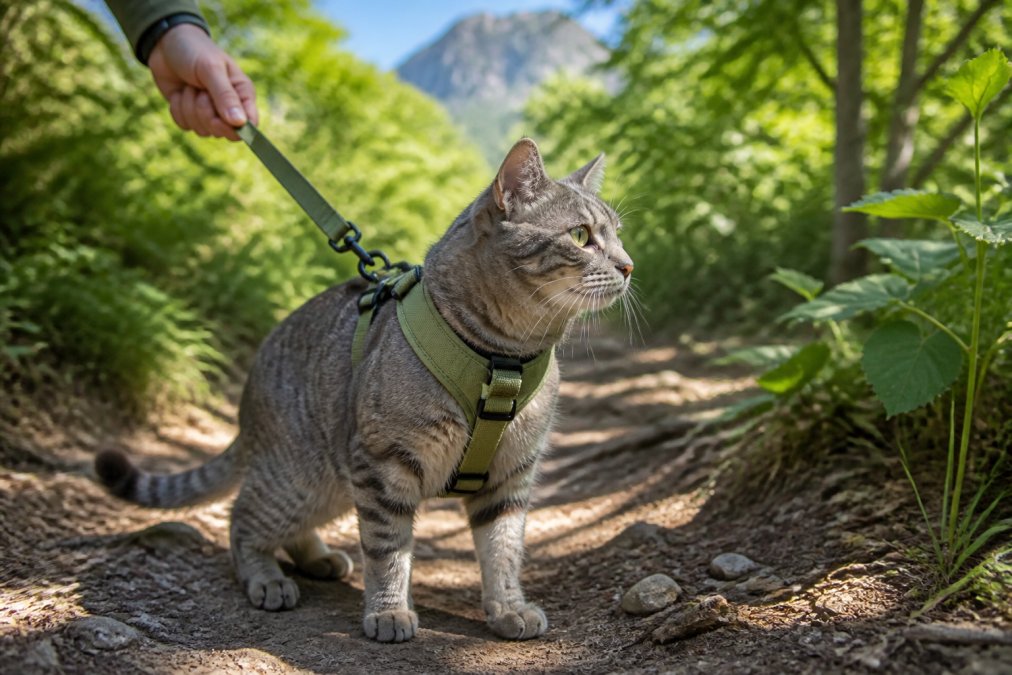
Harness Fit and Escape-Proof Checks
A properly fitted cat harness allows two fingers under each strap, sits snug behind the shoulder blades, and cannot be pulled off when the cat backs up. Test it indoors before clipping on a leash.
Run this check each time:
- Slide two fingers under every strap
- Tug gently upward and backward to confirm no slipping
- Watch for pinched fur or rubbed skin at the armpits
- Confirm the D-ring sits centered on the back
Step 3: How to Leash Train a Cat Indoors First
Learning how to leash train a cat means pairing the harness with treats, short sessions, and zero pressure. Start with the harness on the floor near your cat's food bowl for a few days, then drape it loosely over the back for a few seconds, reward, and remove it.
Positive Reinforcement and Clicker Training Basics
Clicker training is a marker-based method where a distinct click sound is paired with a reward to tell the cat precisely which behavior earned the treat. The sequence is: behavior, click, treat, repeat. Keep sessions to three to five minutes, once or twice a day.
Progress in this order:
- Harness on the floor, treat for sniffing
- Harness draped on the back, treat, remove
- Buckle fastened for a few seconds, treat, remove
- Harness worn for a full minute with treats and play
- Leash clipped on and dragged loosely indoors
- Leash held with slack while your cat walks around the room
Step 4: How Long Does It Take to Train a Cat for Outdoors?
Training a cat for outdoor adventures typically takes four to eight weeks of consistent indoor work before the first outdoor session, plus several more weeks of gradual outdoor exposure. What predicts success is a set of readiness gates your cat either passes or doesn't.
A realistic timeline looks like this:
| Phase | Duration | Focus |
|---|---|---|
| Harness introduction | 1-2 weeks | Sniffing, wearing, treats |
| Leash acceptance | 1-2 weeks | Dragging, holding, indoor walking |
| Indoor exploration | 1-2 weeks | Room-to-room walks, distractions |
| Controlled outdoor exposure | 2-4 weeks | Porch, yard, quiet sidewalk |
| Trail readiness | Ongoing | Distance, terrain, wildlife awareness |
Readiness Gates, Not a Calendar
The biggest mistake is advancing on a schedule instead of on evidence. Before moving to the next phase, your cat should clear a specific behavioral gate. If it doesn't, you stay put.
Use these gates:
- Harness to leash: Cat wears the harness for a full five minutes without crouching, freezing, or trying to bite it off. It should still take treats and move normally.
- Leash to indoor exploration: Cat walks room to room with the leash attached and slack, without the leash going taut or the cat pancaking to the floor.
- Indoor to first outdoor session: Cat explores a new indoor room (a bathroom, a hallway) with curiosity rather than hiding. Novel indoor spaces are a cheap rehearsal for the far more stimulating outdoors.
- First outdoor session to trail: Cat tolerates ten to fifteen minutes on a quiet porch or in a fenced yard with the door closed behind you, without a sustained stress response.
The Stress Signals That Mean Stop, Not Slow Down
Distinguish between a cautious cat and an overwhelmed one. Cautious cats still eat treats, look around, and move. Overwhelmed cats shut down. Watch for:
- Flattened ears held back for more than a few seconds
- A tail tucked tight against the body or lashing hard
- Dilated pupils that stay wide in normal light
- Refusing high-value treats it normally takes instantly
- Freezing in place and refusing to move at all
- Sudden attempts to bolt toward the door or hide
Why Age and History Change the Math
Kittens under about six months have short attention spans and tire quickly, so keep sessions shorter but more frequent. Their growth plates are still developing, so long or rough trail mileage is a poor fit regardless of how bold the kitten seems.
Proud Pet Shop Smart Finder Tag →
Step 5: Pick a Cat Backpack for Hiking and Trail Safety
A cat backpack for hiking lets you carry your cat through terrain it can't safely walk, and doubles as a secure rest spot when the trail gets crowded. Look for breathable mesh panels, an internal safety leash attachment, and a removable washable floor pad.

Step 6: What to Pack: First Aid, ID, and Trail Etiquette
A trail-ready cat kit covers identification, first aid, and sharing space with wildlife and other trail users. Pack light, but never skip ID.
Identification Comes First
A microchip is the permanent backup, and a collar tag with your phone number is the visible one. The Proud Pet Shop Smart Finder Tag clips onto any standard collar and pairs with a companion app to alert you the moment your cat moves out of range. It's weather resistant, with a battery built for continuous use.

Where Cats Are Actually Allowed: The Rules Most Guides Ignore
Pet rules vary dramatically by land manager, and a cat is treated as a pet in nearly every case.
- National Park Service lands: Pets are generally restricted. Where they are allowed, they are almost always required to be on a leash no longer than six feet, and they are typically barred from trails, boardwalks, and backcountry areas. Many parks prohibit pets on trails entirely. Check the specific park's pet page before you go, the rules are set per park, not nationally.
- National forests and Bureau of Land Management lands: Generally more permissive than national parks, but individual districts and wilderness areas can restrict or ban pets. Leash rules still apply in developed recreation areas.
- State parks: Rules vary state by state and park by park. Some allow leashed pets on most trails; others restrict them to paved areas or ban them from swim areas and campgrounds.
- Local and municipal trails: Often the most permissive, but many have seasonal leash requirements, wildlife closures, or bans during nesting season.
- Wildlife refuges and preserves: Frequently prohibit pets outright to protect sensitive habitat and nesting birds.
Minimize Your Ecological Footprint
Cats are predators, and even a leashed cat can stress wildlife. A few habits keep your outing low-impact:
- Keep your cat on a fixed-length leash, not a retractable one, so you can control distance instantly.
- Stay on designated trails. Off-trail wandering disturbs ground-nesting birds, small mammals, and fragile plants.
- Do not let your cat stalk, chase, or corner wildlife. Redirect with a treat and move on.
- Pack out all waste, including used litter or bagged waste. Burying it is not acceptable on most trails.
- Avoid areas with posted wildlife closures, nesting season restrictions, or known predator activity.
- Keep your cat current on flea and tick prevention before any wooded outing, and confirm vaccination status with your vet before the first trip.
Trail Etiquette for a Cat on a Leash
Trail etiquette for cats is simpler than for dogs but still matters. Keep your cat leashed, yield to other hikers, and pack out waste. Because a cat is small and quiet, other trail users often don't see it until they're close, so announce yourself on blind corners and step aside.
- Yield to uphill hikers and to anyone with a dog, horse, or pack animal.
- Give horses a wide berth and keep your cat calm and close; a spooked cat can spook a horse.
- Keep your cat from approaching other dogs. Even a friendly dog can react to a cat on a leash.
- Don't let your cat climb trees or structures where it could get stuck or where it disturbs wildlife.
Cat-Specific First Aid and Emergency Preparedness
Cat-specific first aid differs from dog first aid in ways that matter on a trail. Cats hide pain and overheat faster than most dogs, and their smaller body mass means a minor wound or bee sting can escalate quickly.
Carry a compact kit with these items:
- Gauze pads and self-adhering wrap
- Antiseptic wipes safe for cats
- Tweezers for ticks and thorns
- A small towel for restraint and warmth
- Your vet's number and the nearest emergency clinic address
- A collapsible bowl and water
- A slip lead or spare leash in case the primary one fails
Step 7: Post-Adventure Recovery and Outdoor Enrichment
Recovery after an outing is where most owners stop paying attention, and it's where you protect the training you've built. A tired, overstimulated cat needs a quiet, familiar space to decompress.
Outdoor enrichment pays off indoors too: cats that get supervised outdoor time often show less furniture scratching and fewer stress behaviors. Rotate a few options so the routine doesn't go stale:
- A window hammock for daily bird-watching
- Short harness walks around the yard on non-hike days
- New scent trails using safe herbs or a cardboard box
- Puzzle feeders after a long outing
Frequently Asked Questions
What is the 3-3-3 rule for cats?
The 3-3-3 rule means three days to decompress, three weeks to learn your routine, and three months to feel fully at home. For outdoor training, apply the same patience: give your cat three days to explore the harness indoors, three weeks of short leashed sessions, and three months before expecting full confidence on trails.
What cat breed is best for outdoor adventures?
Breeds like Maine Coon, Bengal, and Abyssinian often adapt well to harness and leash training due to their curious, active temperaments. However, individual personality matters more than breed. Assess your cat's reaction to new environments and stimuli. Even a cautious domestic shorthair can become a confident adventure cat with gradual, positive reinforcement.
How long does it take to train a cat for outdoors?
Most cats need four to eight weeks of consistent indoor training before their first outdoor trip. Start with short harness sessions, then leash walking inside, and finally brief outdoor visits. Some cats progress faster, while others need months. Rushing the process can trigger a flee response and set back your training.
What gear do I need to take my cat hiking?
You need a secure H-style or vest harness, a non-retractable leash, and a cat backpack for hiking that offers ventilation and a safety leash attachment. Bring a first aid kit, your cat's vaccination records, a smart finder tag like the Proud Pet Shop Smart Finder Tag, and a portable water bowl. Also pack a towel for post-adventure recovery.