
Table of Contents
- Why Pet Furniture Belongs in Your Design Plan
- Alternatives to Bulky Plastic Dog Crates for Living Rooms
- How to Style a Dog Bed in a Living Room
- Multi-Functional Pet Furniture That Serves Your Space
- Coordinating Colors, Textures, and Pet Accessories
- Creating Dedicated Pet Zones Without Visual Clutter
- Budget-Conscious and Durable Pet Furniture Solutions
- Frequently Asked Questions
Last Updated: September 25, 2026
Why Pet Furniture Belongs in Your Design Plan
Pet furniture isn't an afterthought anymore. When you're learning how to integrate pet furniture modern decor into your home, you're solving a real design challenge that most pet owners face: keeping your space beautiful while your pets stay comfortable.
Most pet owners struggle with this tension: bulky plastic crates and mismatched beds break the aesthetic flow of a room.
Modern pet furniture is built to blend in, not stand out, it works with your color scheme, materials, and spatial layout.
When you approach pet furniture as part of your interior design, your living room stays cohesive, your pet gets a dedicated space, and you stop choosing between style and function.
Interior design principles from the American Society of Interior Designers emphasize that functional elements should enhance rather than detract from a space. Pet furniture is functional. So it belongs in your design plan from the start, not crammed in last.
Alternatives to Bulky Plastic Dog Crates for Living Rooms
Plastic crates work, they're durable, easy to clean, and portable, but they look industrial in a modern living room.
Your alternatives fall into three categories: enclosed furniture, elevated beds, and stylish dens.
Enclosed furniture gives your dog a den-like space without the plastic look. Wood-frame designs blend into your room like regular furniture. The Proud Pet Shop Cozy Cabin Den ($39.99) has a removable, washable cover and keeps its shape through years of use.

Elevated beds keep your dog off cold floors and create visual lightness. The Proud Pet Shop Waterproof Pet Sofa ($156.99) holds dogs up to 55 lbs, includes a waterproof cover, and matches typical sofa heights.

Stylish dens combine privacy with modern aesthetics. Unlike plastic crates, fabric-covered dens feel soft and intentional. They anchor a corner of your room without dominating it.
Common mistake: Choosing a crate alternative that's too large for your space. Measure first. A dog bed that takes up half your room defeats the purpose.
How to Style a Dog Bed in a Living Room
The secret to styling a dog bed is making it part of your design story.
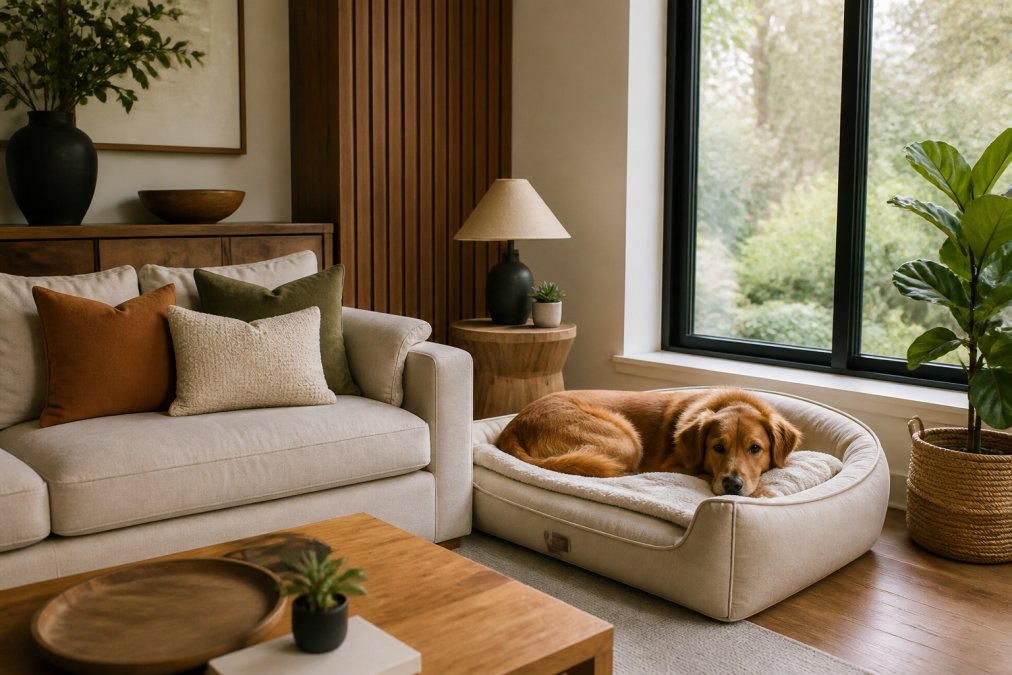
Multi-Functional Pet Furniture That Serves Your Space
Multi-functional pieces give your pet what they need while earning their floor space.
Coordinating Colors, Textures, and Pet Accessories
Mastering pet furniture modern decor comes down to treating pet items like any other design element.
Creating Dedicated Pet Zones Without Visual Clutter
A dedicated pet zone must feel intentional without consuming precious square footage, whether in apartments or open-concept homes.
For apartments and small spaces (under 700 sq ft):
-
Wall-mounted cat shelving creates a complete feline zone without floor footprint. Install floating shelves at 18, 36, and 54 inches high. Bottom shelf holds a litter box enclosure, middle shelves become lounging surfaces, top shelf stores supplies. Total: roughly 8 square feet of wall space.
-
Corner-mounted window perches claim dead corner space. A suction-cup perch plus a wall-mounted shelf below creates a two-level zone in roughly 2 feet by 2 feet.
-
Under-furniture storage beds slide under tables or desks, using allocated but empty space. Your pet sleeps in a defined zone; you gain hidden storage.
-
Feeding station alcoves fit into kitchen corners. A narrow rolling cart (24 inches wide) holds bowls on top and supplies below, tucking away when needed.
For open-concept homes:
-
Area rugs signal a designed zone without closing off space. A 4-by-6-foot rug under a pet bed with color echoing your palette defines the boundary.
-
Furniture arrangement creates implicit zones. Position the pet bed perpendicular to your sofa and add a small side table beside it for water bowls or a lamp.
-
Lighting anchors the zone. A floor lamp or table lamp beside the pet bed signals intention and makes it feel like a designed seating area.
-
Color blocking works in open layouts. Echo your accent colors in the pet bed to create visual continuity.
For homes with dedicated rooms:
-
Pet zones in home offices should sit away from your desk in the opposite corner, keeping your pet visible but separate.
-
Pet zones in bedrooms work best at the foot of the bed or in a corner away from the sleeping area to prevent nighttime disruptions.
-
Pet zones in dens or bonus rooms can be more prominent with matching throw pillows, coordinated colors, and intentional lighting.
The universal principle: Containment and intention.
Regardless of space size, your zone needs two things:
-
Physical containment: A rug, furniture grouping, or wall-mounted structure that defines where the zone is. Without this, pet supplies scatter.
-
Visual intention: Coordinated colors, intentional lighting, or accessory grouping that signals "this is designed, not defaulted." A well-lit bed with matching throw pillows reads as intentional. The same bed in a dark corner reads as storage.
What NOT to do:
- Don't create a zone larger than 5-8% of your room's floor area.
- Don't mix styles within the zone.
- Don't hide the zone completely. Visibility + intentionality = design.
Budget-Conscious and Durable Pet Furniture Solutions
Achieving a high-end look on a modest budget requires three paths: retail ready-made, DIY from scratch, and modified human furniture, the third often delivers the best value-to-aesthetics ratio.
Path 1: Modified Human Furniture (Best Value-to-Aesthetics Ratio)
-
IKEA hacks for pet beds: The IKEA KALLAX shelving unit ($40-$80) becomes a litter box enclosure by removing one shelf, cutting a 6-inch hole, and adding a cushion on top. Cost: roughly $60 total. Matches modern interiors and lasts years.
-
Repurposed side tables as elevated beds: A low wooden side table ($15-$40) becomes a dog bed platform with a cushion on top. Legs create airflow; height matches typical sofas. Cost: $40-$60 total.
-
Wooden crate covers: A shipping crate ($20-$30) becomes a stylish dog den with fabric panels, ties, and a cushion inside. Cost: $40-$50 total.
-
Ottoman conversion: A storage ottoman ($50-$100) works as both seating and a pet bed, the ultimate multi-functional piece.
-
Floating shelf cat perches: Install floating shelves ($15-$30 each) at varying heights with cushions ($10-$20 each). Cost: $50-$100 for a three-shelf setup. Looks like wall décor and lasts indefinitely.
Path 2: DIY from Scratch (Lowest Cost, Highest Customization)
-
Pallet dog beds: Reclaimed pallets (often free) become bed frames. Sand, stain, and add a cushion. Cost: $20-$40. Time: 3-4 hours. Solid wood lasts years; cushions need replacement every 2-3 years.
-
Cardboard box cat caves: Stacked and glued cardboard boxes create a multi-chamber cat hideaway. Cover with fabric or paint. Cost: $5-$15. Time: 2 hours. Aesthetics: modern and sculptural if finished well. Durability: 1-2 years before cardboard softens; replaceable and cheap to rebuild.
-
PVC pipe cat trees: PVC pipes, connectors, and rope create a climbing structure for under $50. Wrap rope around pipes for scratching surfaces. Cost: $40-$60. Time: 4-6 hours. Aesthetics: industrial modern. Durability: PVC lasts indefinitely; rope needs replacement every 1-2 years.
-
Quality markers for durability: Solid wood frames (not particleboard), waterproof or stain-resistant covers, reinforced seams rated for active pets, removable washable covers, and weight capacity that exceeds your pet's weight by at least 20 lbs. These features cost more upfront but reduce replacement frequency.
-
Cost-per-year calculation: A $120 dog bed used daily for 5 years costs $24/year. A $40 bed replaced every 18 months costs $27/year. The expensive option often wins on true cost. Factor in your pet's size and activity level. Large, active dogs destroy cheap beds faster.
-
Warranty and guarantees matter: Proudpetshop's 30-day satisfaction guarantee means you can test pieces in your space before committing. No risk. For budget-conscious shoppers, this eliminates the cost of mistakes. You can try a bed, return it if it doesn't work, and try another without financial loss.
-
Rental-friendly options: Suction-cup window perches and freestanding beds don't require installation. You take them with you when you move. The Proud Pet Shop Sunspot Perch ($24.99) and Waterproof Pet Sofa ($156.99) both move easily. This flexibility saves money if you're renting or expect to relocate.

Proud Pet Shop Sunspot Perch
Budget allocation strategy:
Hybrid approach (Best for most budgets):
Maintenance and cleaning (Often overlooked in budget planning):
- Waterproof covers ($20-$40) protect against accidents and spills. They're worth the cost if your pet is young, old, or prone to accidents.
- Removable covers ($15-$30) let you wash without replacing the entire bed. This extends furniture life significantly.
- Stain-resistant fabrics ($5-$10 more per piece) resist dirt and odors. The upfront cost pays off in reduced cleaning frequency.
Frequently Asked Questions
What are the best alternatives to bulky plastic dog crates for a modern living room?
Furniture-style dog beds, elevated pet sofas, and house-style dens replace plastic crates while enhancing your interior design. The Proud Pet Shop Waterproof Pet Sofa ($156.99) offers a wood-frame bed that fits seamlessly into living spaces. Furniture-style kennels blend function with aesthetics, providing your dog a comfortable retreat without the industrial appearance of traditional crates. These alternatives work especially well in open-concept homes where visual cohesion matters.
How do I choose pet furniture that matches my modern interior design?
Start by identifying your home's color palette and material finishes, wood tones, metal accents, or neutral fabrics. Select pet furniture in complementary colors and textures that echo existing decor elements. Multi-functional pieces like raised beds with storage serve dual purposes. Consider scale: oversized pet furniture overwhelms small spaces, while undersized pieces look lost in larger rooms. Match upholstery durability to your pet's activity level, and prioritize water-resistant fabrics for long-term maintenance.
Can I hide a dog crate or bed in my living room without it looking out of place?
Yes. Use symmetry in furniture placement to make pet zones feel intentional rather than cluttered. Position a stylish dog bed beside a matching side table or under a console. Litter box enclosures and feeding stations can be integrated into existing cabinetry or custom storage solutions. Window perches for cats, like the Proud Pet Shop Sunspot Perch ($24.99), occupy vertical space and become part of the window styling rather than taking up floor space. The key is treating pet furniture as decor, not an afterthought.
What's the difference between cheap pet furniture and durable pieces that actually last?
Durable pet furniture uses reinforced frames, high-quality upholstery, and water-resistant materials that withstand daily wear. Cheap alternatives often have flimsy wood frames that collapse under weight and thin fabric that tears easily. Look for products with weight limits clearly stated, non-slip legs that protect flooring, and removable, washable covers. The Proud Pet Shop Cozy Cabin Den ($39.99) features a removable fleece cover and stable construction designed for repeated use. Quality pieces maintain their shape and appearance for years, while budget options deteriorate quickly.