
Table of Contents
- Why Pet Owners Are Switching from Rubber Dog Toys
- Safe Materials for Dog Toys: What to Look For
- Natural Rubber vs. Synthetic Rubber: What's the Difference?
- Organic Cotton, Hemp, and Wool Toys for Gentle Chewers
- Rope, Wood, and Coffee Wood Chews for Power Chewers
- Dog Enrichment Toys for Chewers: Matching Materials to Chewing Intensity
- DIY Dog Toys: Safe Household Alternatives and Their Limits
- Care, Cleaning, and Replacement Guidance
- Frequently Asked Questions
Last Updated: October 14, 2026
Why Pet Owners Are Switching from Rubber Dog Toys
Many pet owners are surprised to learn that not all rubber dog toys are made the same way.
The shift is practical, not trendy. Synthetic rubber often contains additives and dyes, and a toy that breaks apart can send small pieces into a dog's stomach.
Below, we break down which materials are genuinely safe, how they compare by chewing style, and how to match a toy to your dog's size and bite strength.
Safe Materials for Dog Toys: What to Look For
Safe materials for dog toys are those that are non-toxic, free of harmful dyes, and sturdy enough that a dog cannot swallow them in large pieces. The best choices combine a natural fiber or food-grade material with construction that survives real chewing.
When you pick up a toy, check three things:
- Material source: Look for organic cotton, hemp, wool, or untreated wood rather than vague "rubber" labels.
- Dyes and finishes: Non-toxic dyes matter because dogs mouth toys for hours.
- Construction: Reinforced stitching and tightly braided rope resist unraveling better than loose weaves.
Non-Toxic and Pet-Safe Certifications
There is no single federal certification for pet toys in the same way there is for children's products, so verification falls on the buyer. Reputable makers often test to standards such as those published by ASTM International standards for consumer products or reference guidance from the U.S. Consumer Product Safety Commission on product safety. Ask for material disclosures, and treat any label that lists "rubber" without specifying natural or synthetic as a warning sign.
Material Sourcing and Manufacturing Standards
Where a material comes from affects both durability and safety. Organic cotton is grown without synthetic pesticides, which reduces chemical residue. Hemp canvas is dense and resistant to tearing. Made in the USA manufacturing makes sourcing easier to trace, and many owners now prioritize it for that reason.
Natural Rubber vs. Synthetic Rubber: What's the Difference?
Natural rubber is harvested from the sap (latex) of rubber trees, primarily Hevea brasiliensis, and is biodegradable over time. Synthetic rubber is petroleum-based, common toy formulations include SBR (styrene-butadiene) and EPDM, and is engineered in a lab for consistent hardness and color. Both appear in dog toys, but they behave very differently once a dog starts working on them.
| Feature | Natural Rubber | Synthetic Rubber |
|---|---|---|
| Source | Rubber tree latex | Petroleum-derived polymers |
| Breakdown | Biodegradable over time | Slow to degrade; can persist for decades |
| Texture | Softer, springy, slight latex smell | Varies; often stiffer and more uniform |
| Additives | Fewer by design, but not zero | Plasticizers, dyes, and fillers are common |
| Best for | Moderate chewers and fetch | Varies widely by formula |
| Allergy risk | Latex proteins can trigger reactions in sensitive dogs | Rare, but additive sensitivities occur |
What "Natural Rubber" Does and Does Not Guarantee
A common mistake is assuming "natural" automatically means safe. Three things to know:
- Natural rubber can still be torn apart. A determined power chewer can bite off chunks of even thick natural rubber. Any chunk a dog can swallow is a choking or intestinal-blockage risk regardless of the source material.
- Latex allergy is real. Some dogs develop contact or systemic reactions to the latex proteins in natural rubber. Watch for redness, swelling, or excessive pawing at the mouth after play.
- "Natural" says nothing about additives. Manufacturers still add sulfur for vulcanization, plus pigments and antioxidants. A natural-rubber toy with bright synthetic dye is not the same as an undyed one.
How to Verify Rubber Claims Before You Buy
There is no single federal certification for pet toys the way there is for children's products, so verification falls on the buyer. A few practical checks:
- Ask what "rubber" means. If a label or listing does not specify natural or synthetic, treat it as unknown and move on.
- Look for material disclosures. Reputable makers publish the base polymer, dye type, and country of manufacture. Vague marketing language is a warning sign.
- Check for third-party testing references. Some makers test to standards such as those published by ASTM International standards for consumer products or reference guidance from the U.S. Consumer Product Safety Commission on product safety.
Matching Rubber Type to Your Dog
Rubber is not one product, it is a spectrum of hardness. Use this as a starting point:
- Gentle chewers and puppies: softer natural rubber is fine for fetch and mouthing, but expect it to wear down quickly.
- Moderate chewers: thicker natural rubber with reinforced walls holds up better than thin hollow toys.
- Power chewers: most rubber, natural or synthetic, will not survive. Move to dense rope, coffee wood, or supervised hard chews instead.
The material is a starting point, not a guarantee. Match the hardness to the bite, and inspect the toy after every session for new tears.
Organic Cotton, Hemp, and Wool Toys for Gentle Chewers
For gentle chewers, puppies, and dogs who like to carry and mouth rather than destroy, natural fibers are the sweet spot. They are soft on gums, washable, and biodegradable.
Organic Cotton and Hemp Canvas
Organic cotton is soft and breathable, ideal for plush and stuffed toys. Hemp canvas is the tougher sibling: a dense natural fiber that resists tearing far better than cotton alone. Both are biodegradable and free of synthetic dyes when sourced well. For dogs who shred stuffed toys, hemp canvas holds up longer.
Organic Wool and Natural Fibers
Organic wool is naturally antimicrobial and springy, which makes it good for toys that double as comfort objects. Natural fibers like wool felt are also used in enrichment items. Our Proud Pet Shop Sniffing Petal Mat ($29.99) uses soft felt construction to hide kibble between folded petals, turning mealtime into a scent-based hunt. It is gentle on a dog's nose and mouth while still engaging natural foraging instincts.

Rope, Wood, and Coffee Wood Chews for Power Chewers
Power chewers need density, not softness. Rope, wood, and coffee wood chews are the natural materials that stand up to serious biting.
Proud Pet Shop Sniffing Petal Mat →
- Rope: Tightly braided natural fiber rope resists unraveling and doubles as a flossing tool for teeth.
- Wood: Untreated, kiln-dried wood from safe species gives a firm surface that wears down gradually.
- Coffee wood: A dense, hard material that flakes rather than splinters, making it a popular choice for heavy chewers.
The catch is supervision. Rope can fray into strands a dog might swallow, and any wood can splinter if it is not the right hardness. Match the density to the dog: a small terrier does not need the same chew as a large-breed power chewer.
Dog Enrichment Toys for Chewers: Matching Materials to Chewing Intensity
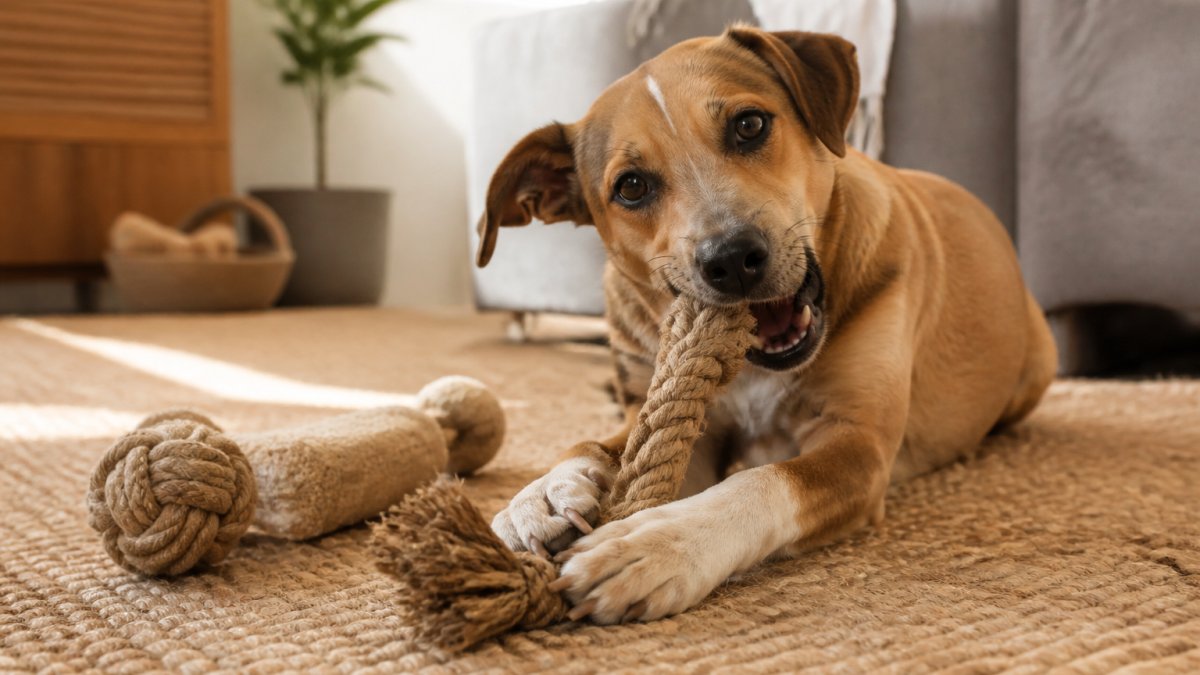
Matching a material to a dog's chewing intensity prevents both destroyed toys and swallowed fragments. Use this as a quick guide:
- Gentle chewers and puppies: organic cotton, wool, and felt enrichment mats.
- Moderate chewers: hemp canvas, natural rubber, and rope.
- Power chewers: dense rope, coffee wood, and hard natural chews.
For dogs who need mental work more than a hard chew, a puzzle feeder does double duty. The Proud Pet Shop IQ Treat Puzzle ($34.99) has adjustable difficulty and a non-slip base, so a dog nudges and paws for treats instead of gnawing furniture.

DIY Dog Toys: Safe Household Alternatives and Their Limits
DIY dog toys can work well when they use safe materials, but they come with real limits. A knotted cotton shirt or a braided fleece tug is fine for gentle play. A homemade toy is not a substitute for a tested chew for a power chewer, and no household item is built to a pet-safety standard.
Safe Starting Points (and Why They Work)
- Old cotton t-shirts cut into strips and braided tightly. Cotton is soft on gums and, when braided densely, resists unraveling better than a loose knot. Wash first to remove detergent residue and any buttons or tags.
- Clean, untreated cotton rope knotted into a ball. Untreated matters, treated rope can carry oils or dyes that leach into a dog's mouth. Boil new rope for a few minutes and air-dry before use.
- A muffin tin with treats hidden under tennis balls. This is a foraging puzzle, not a chew. It redirects mouthing into sniffing and pawing, which is exactly the kind of mental work that tires a dog out.
What to Avoid, and the Mechanism of Harm
This is where most DIY guides stop short. The reason to avoid certain items is not vague caution; it is a specific failure mode:
- Socks with elastic. A dog can swallow the sock whole, and the elastic band can create a linear foreign body that saws against the intestine, one of the most dangerous blockages a veterinarian sees.
- Anything with buttons, zippers, snaps, or plastic eyes. These detach under chewing pressure and become sharp or obstructive once swallowed.
- Plastic bottles. Bottles shatter into sharp shards under a dog's bite, and the caps are a choking hazard. The crinkle sound is appealing, but the failure mode is not worth it.
A Simple DIY Toy Lifespan Rule
Treat every homemade toy as a short-term item, not a durable one. A reasonable pattern most owners settle into:
- Fabric and rope toys: replace every few weeks, or sooner if frayed.
- Cardboard and paper puzzles: single-use, then recycle.
- Food-stuffed items: wash after each use to prevent mold and bacteria growth.
If your dog is a power chewer, skip DIY entirely and choose a purpose-built natural chew. The savings are not worth a veterinary bill for a swallowed sock or a fractured tooth.
Care, Cleaning, and Replacement Guidance
Natural materials need more care than synthetic ones, and replacing them on time is part of keeping a dog safe. Most fabric and rope toys are machine washable on a gentle cycle, while wood chews should be rinsed and dried, then discarded once they develop deep cracks.
| Material | Cleaning | Replace When |
|---|---|---|
| Organic cotton | Machine wash, gentle | Torn or stuffing exposed |
| Hemp canvas | Machine wash, air dry | Seams split |
| Rope | Hand wash, air dry | Strands fray loose |
| Wood / coffee wood | Rinse, air dry | Deep cracks or splinters |
| Felt mats | Machine wash | Flattened or torn |
For washable enrichment, our Proud Pet Shop Slow-Feeding System ($15.99) is a three-piece set made from non-toxic, food-grade silicone with a suction base, and all pieces are dishwasher safe.

Frequently Asked Questions
What are natural alternatives to rubber dog toys?
Natural alternatives include organic cotton, hemp canvas, organic wool, natural rubber (from the Hevea tree), rope, wood, and coffee wood. Each material suits different chewing styles: wool and cotton work well for gentle chewers, while rope and wood handle power chewers. These materials are biodegradable and often free from synthetic chemicals found in some rubber toys.
Are natural dog toys safer than rubber toys?
Natural materials can be safer when they are non-toxic, pet-safe, and free from synthetic dyes or chemicals. However, no material is universally safe. Hard wood can crack teeth, and rope can unravel if swallowed. Always supervise your dog, choose toys sized appropriately, and replace them when they show wear. Natural does not automatically mean indestructible or safe for every dog.
How do I make a DIY toy for my dog?
You can braid old cotton t-shirts into a tug toy, stuff a sock with fabric scraps for a plush, or freeze broth-soaked rope for a teething puppy. Avoid using items with buttons, zippers, or plastic eyes that can detach. DIY toys are not as durable as commercial ones, so inspect them daily and discard them at the first sign of tearing.
What dog enrichment toys for chewers actually last?
Durability depends on your dog's chewing intensity. For power chewers, thick hemp rope, natural rubber, and coffee wood tend to hold up longest. For moderate chewers, organic cotton and wool toys work well. Rotate toys to keep them interesting, and always match the toy's hardness to your dog's size and style. No toy is truly indestructible.
Can dogs chew through rubber?
Yes, dogs can chew through rubber, especially thin or low-quality rubber toys. Natural rubber is more durable than synthetic latex but still not indestructible. Power chewers can destroy even thick rubber in minutes. If your dog consistently destroys rubber toys, try harder materials like coffee wood or thick rope, and always supervise to prevent swallowing chunks.
Choosing natural alternatives to rubber dog toys comes down to matching the material to your dog's bite, not chasing the toughest-sounding label. The wrong pick still ends up shredded, and the right one lasts. At Proudpetshop, we stock durable, thoughtfully designed gear for real households, backed by a 30-day satisfaction guarantee, fast tracked shipping, and free shipping on orders over $50. Browse our enrichment and comfort essentials and give your dog a chew that is built to hold up.