
Table of Contents
- Orthopedic vs Memory Foam: Key Differences
- Benefits of Memory Foam for Dogs
- Best Dog Bed for Arthritis and Joint Support
- Signs Your Senior Dog Needs a New Bed
- How to Choose a Dog Bed for Joint Pain
- Feature Comparison: Orthopedic vs Memory Foam
- Proud Pet Shop Orthopedic Bed Options
- Frequently Asked Questions
Last Updated: September 1, 2026
Orthopedic vs Memory Foam: Key Differences
When your senior dog struggles to rise from their bed or shifts uncomfortably throughout the night, the type of foam beneath them matters. The difference between orthopedic and memory foam dog beds goes beyond marketing language, it's fundamentally about how each foam type supports a dog's skeletal structure and manages pressure on aging joints.
Both serve the same goal: relieving pressure and supporting joint health. But they achieve this through different mechanical properties. Understanding these differences helps you choose the bed that matches your dog's specific needs.
Foam Structure and Support
Orthopedic foam is engineered as a firmer, denser material designed to provide consistent support across the entire sleeping surface. It maintains its shape and doesn't conform deeply to your dog's body, it supports from below rather than cradling.
Memory foam is viscoelastic. It softens in response to body heat and weight, slowly conforming to your dog's contours before gradually returning to its original shape when pressure is removed. For a dog with severe arthritis or hip dysplasia, orthopedic foam's consistent support often prevents the joint misalignment that occurs when a dog sinks unevenly into softer material.
Pressure Relief and Skeletal Alignment
High-density foam reduces pressure on weight-bearing joints by distributing a dog's body weight across a larger surface area rather than concentrating it at pressure points, critical for senior dogs whose joints are already compromised.
Orthopedic foam achieves pressure relief through firmness and density, supporting the dog's natural skeletal alignment by preventing excessive sinking. This keeps the spine, hips, and shoulders in proper position throughout sleep, especially important for dogs with existing joint pain.
Memory foam achieves pressure relief through conforming support, molding to your dog's body and spreading weight evenly. However, if too soft, a heavier dog may sink too deeply, causing the spine to curve unnaturally and increasing stress on joints rather than relieving it.
The key distinction: orthopedic foam maintains alignment through resistance; memory foam maintains alignment through adaptation. Which works better depends on your dog's weight, the severity of their joint issues, and their sleeping position.
Benefits of Memory Foam for Dogs
Memory foam excels at reducing pressure point pain. For dogs with localized pain, a sore shoulder, arthritic knee, or old injury, the conforming nature of memory foam can provide relief that firmer orthopedic foam cannot match.
Many dogs with mild to moderate arthritis sleep better on memory foam because it eliminates concentrated pressure when a dog's weight rests on a single joint. The foam slowly gives way, distributing pressure across a wider area, reducing nighttime restlessness and allowing deeper sleep.
Memory foam also offers thermal regulation benefits. As it warms from your dog's body heat, it becomes more pliable. Some senior dogs with circulation issues find this self-warming property particularly soothing.
The downside: memory foam loses its supportive properties over time. As the material breaks down through repeated compression, it becomes softer and less responsive. Dogs that chew or scratch at their bedding will destroy memory foam quickly, and fragments can be ingested. Memory foam also off-gasses when new, releasing a chemical odor that some dogs find unpleasant, though this typically dissipates within a few days.
Best Dog Bed for Arthritis and Joint Support
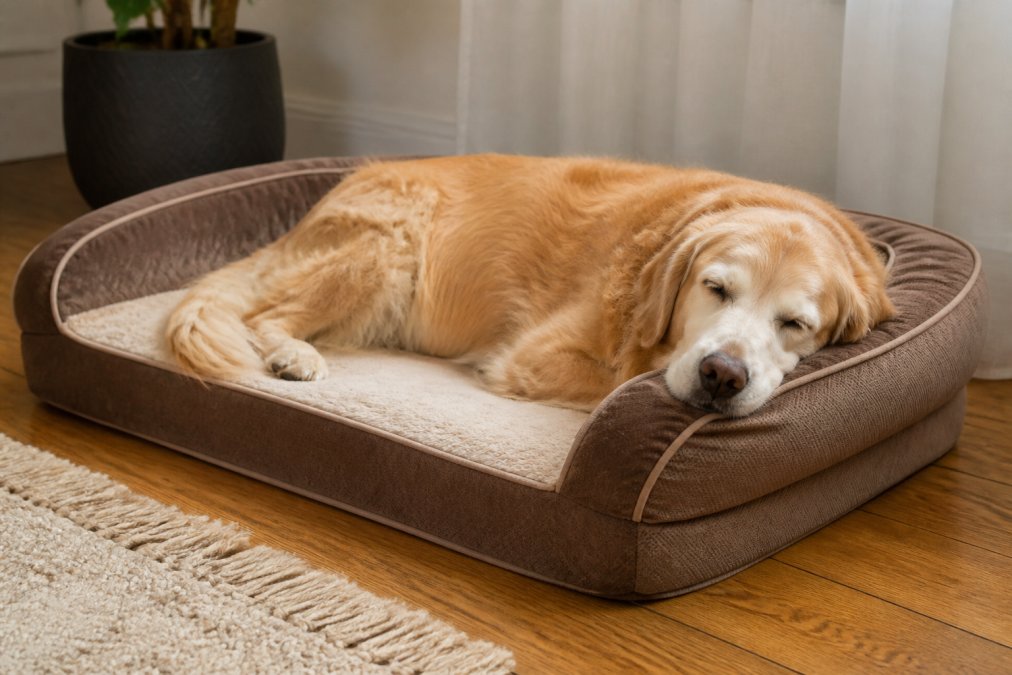
For dogs diagnosed with arthritis, the best bed combines high-density foam with structural features that support proper sleeping position. A bed with raised bolster sides provides neck and head support, reducing strain on the cervical spine and creating a sense of security that anxious senior dogs appreciate. The Proud Pet Shop Comfort Den XL ($149.99) incorporates this design with high-density orthopedic foam and bolster sides engineered for dogs up to 80 pounds.

Elevated beds also deserve consideration for arthritic dogs, especially those with mobility issues. The Proud Pet Shop CloudLift Bed ($99.00) elevates your dog while maintaining a breathable mesh surface that prevents heat buildup, important for dogs that overheat easily.
High-Density Foam and Weight Distribution
High-density foam is measured by pounds per cubic foot (PCF). Orthopedic dog bed foam typically ranges from 1.5 to 2.5 PCF, while memory foam usually sits between 3 and 5 PCF (peer-reviewed research). Higher density means more material per unit of volume, translating to more durability and firmness.
For a 60-pound senior dog, you need foam dense enough that the dog doesn't sink more than 1-2 inches when lying down (aaha.org). Test this by pressing your hand firmly into the bed's surface. If your hand sinks more than 2 inches and doesn't quickly bounce back, the foam density is insufficient for a large senior dog.
Weight distribution matters because uneven sinking creates uneven support. A dog's weight isn't distributed evenly, hips and shoulders are heavier than the spine. A bed that sinks unevenly will allow heavier parts to drop while the spine remains elevated, creating the exact spinal misalignment that orthopedic beds prevent.
Firmness Levels for Different Mobility Issues
Not every senior dog needs the same firmness level. A dog with severe hip dysplasia benefits from firmer orthopedic foam that prevents excessive sinking. A dog with moderate arthritis in one shoulder may sleep better on medium-firmness memory foam that conforms to that specific pain point.
If your dog has difficulty rising from their current bed, they need firmer support. If your dog shifts positions frequently throughout the night, they may benefit from memory foam's pressure-relieving properties. If your dog shows signs of pain in a specific joint, medium-firmness memory foam can target that area while still providing adequate overall support.
Firmness also affects temperature regulation. Firmer orthopedic foam typically sleeps cooler because it doesn't conform as closely to the body, allowing better airflow. Memory foam sleeps warmer because it conforms tightly and retains body heat. For dogs that overheat easily, orthopedic foam is preferable. For dogs sensitive to cold, memory foam's warmth is beneficial.
Signs Your Senior Dog Needs a New Bed

Your dog's current bed may be failing even if it looks fine. The foam breaks down long before the cover wears out.
Watch for these signs: your dog takes noticeably longer to stand up after resting, circles multiple times before lying down, avoids their bed and sleeps on hard floors instead, shows signs of pain when rising (whimpering, limping, stiffness), or shifts positions excessively throughout the night. Check the bed's firmness yourself, if your hand sinks deeply and slowly returns to shape, the foam has broken down and no longer provides adequate support.
Most dog beds last 2-3 years with regular use, though this varies by foam quality and your dog's weight (peer-reviewed research). A 90-pound dog will compress foam faster than a 40-pound dog.
How to Choose a Dog Bed for Joint Pain
Choosing a bed for a dog with joint pain requires matching three factors: foam type, foam density, and bed structure. Getting any one of these wrong undermines the others.
Start by assessing your dog's specific pain pattern. Is the pain localized to one joint or widespread? Localized pain often responds better to memory foam's conforming support. Widespread arthritis typically benefits from orthopedic foam's consistent support.
Next, consider your dog's weight and sleeping position. A heavy dog that sleeps stretched out needs firmer support than a small dog that curls up. Finally, evaluate the bed's structural features beyond foam: bolster sides for neck support, elevation, and cover washability.
Matching Foam Density to Your Dog's Weight
Use this weight-to-density framework as a starting point:
| Dog Weight | Recommended Foam Type | Recommended Density | Best For |
|---|---|---|---|
| Under 30 lbs | Memory foam or orthopedic | 1.5-2.0 PCF | Comfort, pressure relief |
| 30-60 lbs | Orthopedic foam | 2.0-2.5 PCF | Joint support, alignment |
| 60-90 lbs | High-density orthopedic | 2.5+ PCF | Firm support, durability |
| Over 90 lbs | Extra-firm orthopedic | 3.0+ PCF | Maximum support, minimal sinking |
This is a guide, not a rule. The goal is to find the minimum density that prevents more than 1-2 inches of sinking. Test before committing, let your dog rest on the bed for a few hours before purchasing and watch how deeply they sink.
Durability, Cover Materials, and Long-Term Care
Foam quality matters, but cover quality determines how long the bed remains usable. Look for removable and machine-washable fabric, waterproof or water-resistant lining to protect the foam, non-slip base to prevent sliding, and durable stitching.
The Proud Pet Shop Bite-Proof Sofa Bed ($161.99) addresses durability with bite-resistant and scratch-resistant fabric, critical for dogs prone to destructive behavior. Its removable cover can be machine-washed without disassembling the entire frame.

Maintenance extends a bed's life significantly. Vacuum weekly, wash the cover monthly, and air the bed in sunlight occasionally. Inspect the foam annually, if you notice permanent indentations, sagging, or musty smell, the foam has broken down and needs replacement.
Feature Comparison: Orthopedic vs Memory Foam
| Feature | Orthopedic Foam | Memory Foam | Winner for Joint Pain |
|---|---|---|---|
| Spinal Alignment Support | Firm, consistent | Adaptive, conforming | Orthopedic (prevents sinking) |
| Pressure Point Relief | Moderate | Excellent | Memory foam (localizes relief) |
| Durability | 3-5 years | 2-3 years | Orthopedic (longer lifespan) |
| Firmness Level | Stays consistent | Softens over time | Orthopedic (maintains support) |
| Best for Severe Arthritis | Excellent | Good | Orthopedic |
| Best for Mild Arthritis | Good | Excellent | Memory foam |
| Temperature Regulation | Cooler (airflow) | Warmer (conforms) | Orthopedic (for heat-sensitive dogs) |
| Chew Resistance | Moderate | Poor (tears easily) | Orthopedic |
For most senior dogs with moderate to severe arthritis, orthopedic foam provides the support structure they need. For dogs with localized pain or mild arthritis, memory foam often delivers better comfort. Many owners find that a combination approach works best: an orthopedic base with a memory foam topper provides both support and pressure relief.
Proud Pet Shop Orthopedic Bed Options
Proudpetshop offers several orthopedic and supportive bed options designed specifically for senior dogs and dogs with joint concerns.
The Proud Pet Shop Comfort Den XL ($149.99) is purpose-built for large senior dogs. At 41 x 28 x 7 inches, it accommodates dogs up to 80 pounds with high-density orthopedic foam and raised bolster sides. The waterproof cover protects the foam from accidents, and the non-slip base prevents sliding.
The Proud Pet Shop CloudLift Bed ($99.00) keeps your dog off cold, damp floors year-round. The breathable mesh surface allows airflow while the elevated structure improves circulation, particularly beneficial for senior dogs with stiffness.
The Proud Pet Shop Waterproof Pet Sofa ($156.99) combines elevated sleeping with furniture-style design. With a solid wood frame and foam-reinforced cushion rated for pets up to 55 pounds, it provides both support and a designated rest space that fits into living areas.
The Proud Pet Shop Bite-Proof Sofa Bed ($161.99) uses specialized bite-resistant and scratch-proof fabric that withstands daily wear. Its removable, machine-washable cover and waterproof protection make it ideal for active dogs or those with incontinence issues.

The Proud Pet Shop Calming Donut Bed ($39.99) is designed for anxious dogs. The raised rim provides head and neck cushioning, and the plush filling retains warmth. While not a primary orthopedic solution, it can complement orthopedic support for dogs whose anxiety exacerbates pain-related behavior.
All Proudpetshop beds include a 30-day satisfaction guarantee, allowing you to assess whether a particular bed actually improves your dog's comfort and mobility before committing long-term.
Choosing between orthopedic and memory foam for your senior dog isn't about picking the "better" option, it's about matching the right support system to your dog's specific joints, weight, and pain pattern. Orthopedic foam provides the consistent support that prevents misalignment in dogs with severe arthritis. Memory foam delivers the pressure relief that helps dogs with localized pain sleep through the night. The best bed combines both: high-density orthopedic foam as the foundation with structural features like bolster sides and waterproof covers that extend its usable life.
Start with Proudpetshop's orthopedic bed options, which offer the joint support senior dogs need with practical features like removable covers and non-slip bases. Test your choice over 30 days, Proudpetshop's satisfaction guarantee means you can return it if your dog doesn't show improved comfort or mobility. Your senior dog's quality of life depends on getting this decision right.
Frequently Asked Questions
Is orthopedic foam or memory foam better for senior dogs with arthritis?
Both support joint health, but orthopedic foam typically offers firmer, more consistent support across the bed, while memory foam conforms to your dog's body shape for targeted pressure relief. Orthopedic beds work best for dogs needing spinal alignment and mobility support, while memory foam excels at reducing pressure sores and stiffness. The choice depends on your dog's specific condition, consult your veterinarian if your dog has diagnosed arthritis or hip dysplasia.
What signs indicate my senior dog needs a new bed?
Watch for limping after rest, difficulty standing or climbing stairs, reluctance to jump on furniture, visible sagging in the current bed, or excessive panting during sleep. Aging joints become sensitive to pressure, and worn bedding loses its cushioning properties. If your dog is over 7 years old or shows these mobility issues, upgrading to an orthopedic or memory foam bed can significantly improve comfort and joint support.
How do I choose the right foam density for my dog's weight?
Higher-density foam (typically 3.0-4.0 lbs per cubic foot) provides better support for larger dogs and those with significant joint issues, while medium-density foam (2.0-3.0 lbs per cubic foot) suits average-weight dogs. Heavier dogs compress softer foam too much, losing support, while lightweight dogs may find high-density foam uncomfortable. Match the foam density to your dog's weight and activity level, and prioritize beds with removable, washable covers for long-term durability.
Do memory foam dog beds help with arthritis and hip dysplasia?
Yes, memory foam reduces pressure on painful joints by distributing weight evenly and conforming to your dog's body, which alleviates stress on arthritic hips and knees. However, memory foam alone doesn't provide the firm spinal support some senior dogs need. Many veterinarians recommend combination beds that pair memory foam with a high-density orthopedic base for maximum therapeutic benefit in dogs with diagnosed arthritis or hip dysplasia.
This article was written using GrandRanker