
Table of Contents
- Quick Comparison: Premium Pet Essentials at a Glance
- Durable Materials for Dog Collars: What Actually Holds Up
- Benefits of a Lifetime Warranty on Pet Gear
- How to Choose the Right Size Dog Collar
- Hassle-Free Returns: What to Check Before You Buy
- Cost-Per-Wear: Why Cheap Collars Cost More Over Time
- Premium Pet Essentials That Pair With Durable Collars
- Frequently Asked Questions
Last Updated: September 14, 2026
Quick Comparison: Premium Pet Essentials at a Glance
Premium pet essentials are built from higher-grade materials and backed by stronger post-purchase protections than standard gear. At Proudpetshop, buyers can find durable pet collars and carriers, with value showing up in the return and satisfaction guarantee terms, not just the stitching.
Most shopping guides stop at materials and never explain what happens when something fails. This comparison covers both: what makes gear last, and what makes a return painless. We break down materials, sizing, and cost-per-wear so you can judge long-term value instead of sticker price.
| Factor | Premium Gear | Budget Gear |
|---|---|---|
| Material | Vegetable-tanned leather, reinforced nylon webbing | Thin synthetic fibers, glued seams |
| Hardware | Solid metal D-ring, secure buckle | Stamped alloy, plastic clips |
| Warranty | Lifetime guarantee common | Rarely offered |
| Return window | 30 days or longer | Often 14 days or none |
| Cost-per-wear | Lower over 3+ years | Higher after replacements |
Durable Materials for Dog Collars: What Actually Holds Up
What holds up is a collar where the material, stitching, and hardware all fail at roughly the same point. Weak links break first, so a strong strap with a cheap buckle is still a broken collar waiting to happen. Judge durability by understanding which component fails first under load, and how each material behaves after a year of real use.
Leather vs. Nylon Webbing: Material Trade-Offs
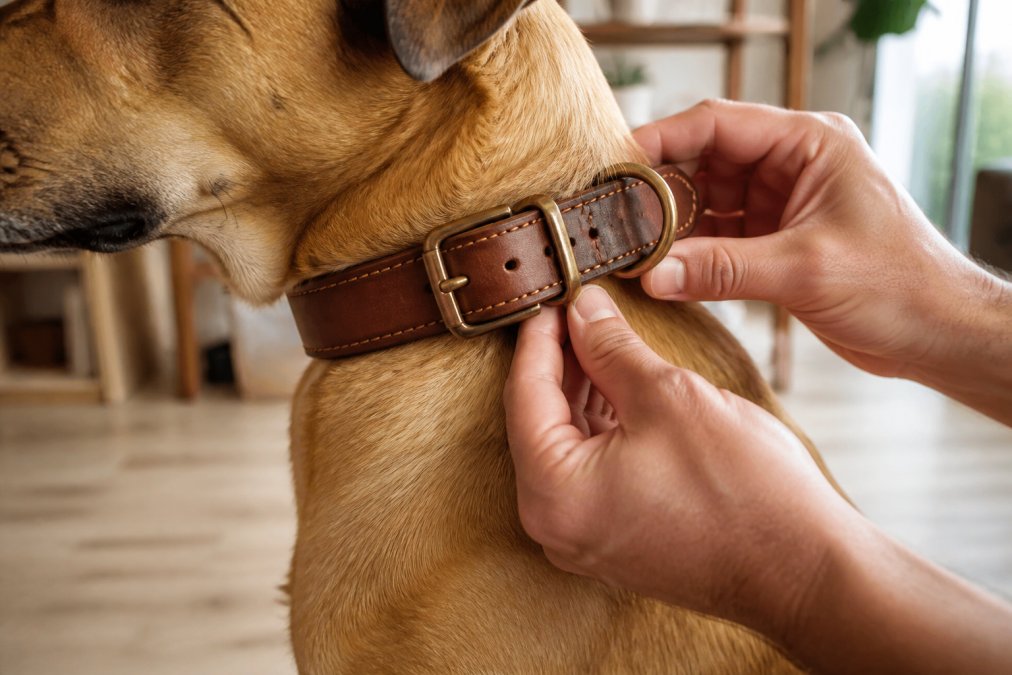
Leather wins on longevity and comfort; nylon wins on price and easy cleaning. Vegetable-tanned leather softens with wear and develops a patina, but it needs occasional conditioning and dislikes prolonged soaking. Nylon webbing resists water and mud, yet cheaper grades fray at the edges and lose tensile strength after repeated washing. For a dog that swims daily, nylon is a practical pick. For a dog that wears one collar for years, leather can be a durable option.
Leather stretches slowly under constant tension and molds to the neck, so a well-fitted leather collar can become more comfortable over time, but that stretch means rechecking the fit every few months, especially in humid climates. Nylon is dimensionally stable, but UV exposure can degrade the weave, and a collar worn outdoors year-round may fade and weaken. Budget nylon collars commonly fail at the buckle end of the strap, where the webbing folds back and the stitching abrades against the buckle frame.
Hardware Integrity and Reinforced Stitching
Hardware integrity is where most collars quietly fail. A D-ring that bends under load, or a buckle that releases on a hard pull, defeats every other quality feature. Look for box-stitched or bar-tacked seams at stress points, and check that the D-ring is welded, not just bent wire. The leash attachment point takes the load, so inspecting that first can be helpful.
Three hardware details separate premium from budget gear:
- D-ring construction. A welded D-ring is a closed loop of solid metal; a bent-wire D-ring is an open loop that can pull apart under a hard lunge. Run a fingernail along the seam, if you can feel a gap, it may not be welded.
- Buckle type. A metal side-release buckle or a traditional metal roller buckle can handle more load than a plastic side-release. Plastic buckles are fine for small, calm dogs but may be the first component to crack on a strong puller.
- Stitching pattern. Box-stitching (a rectangle with an X through it) or bar-tacking (dense zigzag reinforcement) distributes load across multiple stitch lines. Single-line stitching concentrates stress on one row of thread, which is why it is the most common failure point on cheap collars.
A practical testing methodology you can run at home: clip the leash to the D-ring, hold the collar in both hands, and pull firmly in opposite directions. Listen for creaking from the buckle and watch for any gap opening at the D-ring seam. This is not a load test, but it surfaces the obvious weak points before your dog does it for you on a walk. For a more rigorous view of what failure looks like in the field, the Consumer Product Safety Commission guide to pet product safety is worth reading.
Benefits of a Lifetime Warranty on Pet Gear
A strong guarantee can shift the risk of failure from you to the maker, which is why the guarantee matters.
Warranty Coverage for Damaged Gear vs. Return Windows
Satisfaction guarantees and return windows solve different problems, and confusing them can cause disputes. A return window handles "this isn't right for us" within a set period; a satisfaction guarantee addresses concerns after purchase. Check three things before buying: what the guarantee covers, whether normal wear and tear counts as damage, and who pays shipping on a claim. Many policies exclude chewing damage, which is fair, but one that excludes everything short of a manufacturing defect may be less helpful.
How to Choose the Right Size Dog Collar
Measure the neck, then add two fingers of slack. A collar should sit snug enough that it cannot slip over the head, but loose enough to slide two fingers underneath comfortably (avma.org).
- Measure the widest part of the neck, at the base, not up near the ears
- Add roughly two finger-widths of room for an adjustable fit
- For growing puppies, size up only if the collar still fits snugly today
- Weigh the dog's pull strength: strong pullers need wider collars to spread load
- Recheck fit monthly, since coat thickness changes with season
A collar that is too loose can be dangerous as it may catch on fencing or furniture and slip off during a startle response.
Hassle-Free Returns: What to Check Before You Buy
Hassle-free returns come down to three details buried in the fine print: the return portal, the exchange process, and who pays shipping. Read those before you add anything to a cart. A return window and a satisfaction guarantee are two different promises, and the brands worth buying from make both easy to use, vetting that combination before purchase can be helpful for long-term value.
Return Portal, Exchange Process, and Who Pays Shipping
A return portal is the self-service page where you start a return and print a label; if a store makes you email support and wait, expect friction. Ask whether exchanges ship the replacement immediately or wait until the original arrives. On shipping, the usual split is: the store covers defective items, you cover change-of-mind returns. Proudpetshop keeps this simple with a 30-day satisfaction guarantee and free shipping on orders over $50. Before buying anywhere, confirm the portal exists, check exchange timing, and note who pays postage each way.
The Warranty-and-Return Audit: A Pre-Purchase Checklist
Most shoppers evaluate durability and return policy separately. The real question is whether the two promises reinforce each other or leave a gap in the middle. A collar built to last five years but carrying only a 14-day return window and no guarantee is a less secure bet than a slightly pricier collar with a 30-day return window and a strong satisfaction guarantee.
Run this audit before you buy:
- Find the warranty page, not the marketing line. "Lifetime guarantee" in a hero banner means nothing until you read the exclusions. Look for the words "manufacturing defects" and "normal wear and tear" and see how each is defined.
- Check whether the return window overlaps the warranty. A 30-day return window plus a lifetime warranty covers both the "I do not like it" phase and the "it broke in year three" phase. A 30-day return window with no warranty leaves you exposed the moment the window closes.
- Confirm who pays shipping on a warranty claim. A warranty that requires you to ship the item back at your own cost is a warranty with a hidden deductible.
- Test the return portal before you need it. Open the return page in a separate tab. If you cannot find it in under a minute, you will not want to find it under stress.
- Read the exchange timing. Immediate-ship exchanges mean you are not without gear while the original is in transit. Wait-until-received exchanges mean a gap of a week or more.
Brands that get this right offer a return window generous enough to cover a full trial, a satisfaction guarantee covering defects, and one portal for both. Brands that get it wrong have a short return window, a guarantee excluding everything short of a manufacturing defect, and a support email instead of a self-service portal.
Sustainability of Return Logistics
There is a quieter cost to easy returns: the shipping. Every returned collar travels back, gets inspected, and often gets resold or discarded. The most sustainable return is the one you never have to make, which is why durable gear and a clear return policy work together. A collar that lasts five years generates one shipment; a budget collar replaced annually generates five, plus returns for the ones that fail early. Choosing durable gear with a strong satisfaction guarantee can reduce the number of packages moving through the system. When you do return something, consolidating into a single shipment and using the store's prepaid label keeps the footprint lower.
Cost-Per-Wear: Why Cheap Collars Cost More Over Time
Cost-per-wear is the purchase price divided by the number of days the item stays in service, a useful number in this comparison.
A budget collar that costs a few dollars and lasts eight months may cost more per day than a durable collar that lasts five years. Add the replacement shipping, the time spent reordering, and the risk of a collar failing mid-walk, and the cheaper option may be less cost-effective. This is the gap most reviews miss: they compare price tags, not service life. A Consumer Product Safety Commission guide to pet product safety is worth a read if you want to understand what failure actually looks like in the field.
Premium Pet Essentials That Pair With Durable Collars
The right collar is the anchor, but the gear around it determines how well a walk, drive, or vet visit goes. These are the pieces we recommend most often to pair with a durable collar.
- Proud Pet Shop Smart Finder Tag ($34.99): A waterproof clip-on tracker that attaches to any standard collar and sends an alert to your phone the moment your pet moves out of range. It pairs naturally with a leather or nylon collar because it clips on without replacing existing gear.
- Proud Pet Shop TrailFold Carrier ($34.99): A front-or-back carrier for small dogs and cats, with breathable mesh panels, an interior safety leash, and a removable washable floor pad. Available in three sizes.
- Proud Pet Shop Sidekick Sling ($28.99): A crossbody sling for pets up to 15 lbs, built for vet visits and quick errands where you want both hands free.
- Proud Pet Shop RoadTrip Ride Guard ($34.99): A non-slip car seat cover with built-in storage pockets and a machine-washable surface, sized for small and medium dogs.
Each item carries the same 30-day satisfaction guarantee, so you can test fit and comfort at home rather than guessing from a product photo.

Buying premium gear and buying with easy returns should not be a trade-off. Proudpetshop builds durable gear for real households, backs it with a 30-day satisfaction guarantee, and keeps shipping free on orders over $50 so trying something new carries no real risk. If a collar, carrier, or car cover does not fit your pet's life, the return portal handles it without a phone call. Get started with Proudpetshop and gear that holds up past the first muddy season.
Frequently Asked Questions
What makes a pet collar truly durable for active dogs?
Durability comes down to three things: material composition, hardware integrity, and workmanship. Vegetable-tanned leather and thick nylon webbing resist wear and tear better than thin synthetic fibers. Look for reinforced stitching at stress points and a solid metal D-ring that won't bend under pulling. Buckle security matters too. A collar that passes product testing for tensile strength will outlast one that only looks sturdy. For dogs that swim or hike in wet conditions, weather resistance and rust-proof hardware are essential additions.
Why is a hassle-free return policy important for premium pet gear?
Premium gear costs more upfront, so the return policy is your safety net. A 30-day satisfaction guarantee means you can test fit, comfort, and durability without risk. Check whether the brand covers return shipping and how the exchange process works. Some brands offer a return portal that generates a prepaid label in minutes. If a product arrives damaged or doesn't match its description, a clear replacement policy protects your investment. Hassle-free returns signal that the brand stands behind its quality assurance claims.
Are premium pet essentials worth the higher price point?
It depends on cost-per-wear. A $12 collar replaced three times a year costs $36 annually. A $35 collar with a lifetime guarantee that lasts five years costs $7 per year. Premium essentials use better materials, which means fewer replacements and less waste. The math favors premium when you factor in longevity, customer satisfaction, and the time saved not re-ordering. For multi-pet households, the savings compound quickly. The key is choosing brands that back durability claims with real warranty coverage.
How do I know if a pet collar is built to last?
Start by examining the material composition. Vegetable-tanned leather develops a patina and softens with age rather than cracking. Nylon webbing should feel dense, not flimsy. Check the stitching: reinforced stitching at the D-ring and buckle points prevents premature failure. Hardware integrity matters too. A rust-resistant D-ring and a buckle that snaps firmly without wobbling are good signs. Finally, look for brands that publish product testing details or offer a warranty. If the brand won't stand behind it, the collar probably won't either.
What should I look for in a pet brand's warranty policy?
Read the fine print on what's covered. A lifetime guarantee on workmanship and materials is stronger than one that only covers manufacturing defects for 90 days. Check whether the warranty covers damage from normal wear and tear or only defects. Also look at the claims process: does the brand require original packaging, receipts, or photos? A straightforward replacement policy with no hidden fees builds trust. Pair the warranty with the return window. Together, they tell you how confident the brand is in its own gear.