
Table of Contents
- Safe Travel Gear for Cats: What You Actually Need
- Quick Comparison: Top Cat Travel Gear Picks
- Carrier Standards: Choosing a Cat Travel Carrier That Meets Safety Standards
- 1. TrailFold Carrier: The Versatile Front or Back Pack
- 2. Sidekick Sling: Hands-Free Carrying for Short Trips
- 3. No-Pull Adventure Harness: Secure Outdoor Stops
- 4. Smart Finder Tag: Real-Time Location for Wandering Cats
- How to Acclimate a Cat to a Travel Backpack Before the Trip
- Frequently Asked Questions
Last Updated: September 5, 2026
Traveling with a cat is rarely as simple as grabbing a carrier and heading out the door. Safe travel gear addresses ventilation, security, and your ability to respond if your cat escapes or gets anxious. At Proudpetshop, we offer carriers, harnesses, and tracking devices designed for real journeys.
The five picks below cover the full range of travel scenarios, from short vet visits to longer road trips. Each product solves a specific problem: secure containment, hands-free carrying, controlled outdoor stops, or real-time location tracking. No single item covers every situation, so build a small kit around your most common travel pattern.
TL;DR:
- The TrailFold Carrier is the most versatile option, working as both a front pack and a backpack
- The Sidekick Sling is ideal for quick errands with cats under 15 lbs
- The No-Pull Adventure Harness is essential for pit stops where your cat needs to stretch safely
- The Smart Finder Tag provides peace of mind if your cat slips out of a carrier or harness
- Acclimating your cat to any carrier before the trip is the single biggest predictor of a stress-free journey
Safe Travel Gear for Cats: What You Actually Need
Safe travel gear prevents escape, maintains proper airflow, and minimizes anxiety during transport. A carrier with poor ventilation or a flimsy latch fails the most basic safety test. The gear must match your travel context: a crossbody sling works for a quick trip to the groomer, but a structured backpack with a safety leash attachment is better for longer excursions.

Most cat owners buy a single carrier and expect it to work for every scenario. A hard-sided carrier suits airline travel but is heavy for walking several blocks. A soft-sided backpack is lighter but may not meet airline requirements. Understanding these trade-offs saves money and prevents last-minute scrambling.
Quick Comparison: Top Cat Travel Gear Picks
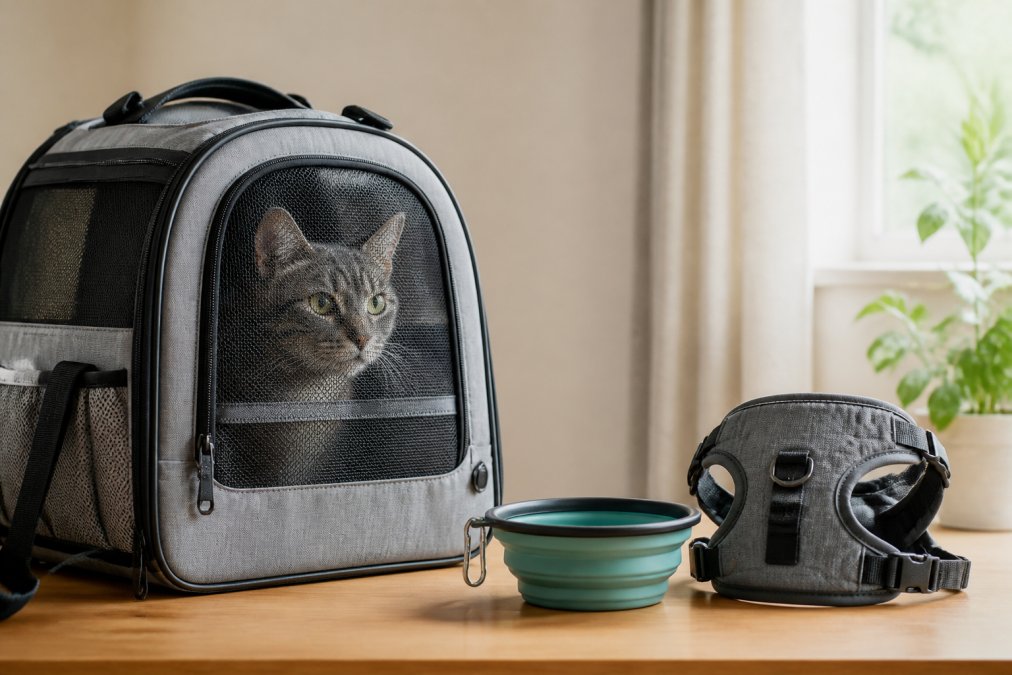
| Product | Price | Best For | Key Safety Feature |
|---|---|---|---|
| TrailFold Carrier | $34.99 | Multi-mode travel (front or back carry) | Interior safety leash attachment |
| Sidekick Sling | $28.99 | Short trips, cats under 15 lbs | Buckle-close enclosure |
| No-Pull Adventure Harness | $37.99 | Outdoor stops and walks | Front-clip redirects pulling force |
| Smart Finder Tag | $34.99 | Escape prevention and recovery | Real-time location alerts |
Each product addresses a distinct gap in the travel safety chain: the TrailFold Carrier and Sidekick Sling handle containment, the No-Pull Adventure Harness manages controlled outdoor time, and the Smart Finder Tag covers the worst-case scenario of a lost cat. Most owners benefit from owning at least one carrier and one tracking solution.

Carrier Standards: Choosing a Cat Travel Carrier That Meets Safety Standards
A safe cat travel carrier must prevent escape, maintain thermal regulation, and protect your cat during sudden stops or impacts. The market divides into two categories, hard-sided and soft-sided, each with distinct safety profiles.
Hard-Sided Carriers: Maximum Protection, Specific Requirements
Hard-sided carriers are typically made from impact-resistant plastic or fiberglass. They are the only type accepted by most airlines for in-cabin travel because they provide a rigid shell that protects the cat from being crushed by shifting cargo or being compressed against the seat in front of you. The American Veterinary Medical Association travel guidelines recommend hard-sided carriers for air travel specifically because they maintain their structural integrity under pressure changes and are easier to sanitize.
However, hard-sided carriers are heavier, more awkward to carry, and often have ventilation only on the door and small side windows. In a parked car, temperatures inside can rise dangerously fast. If you choose one, look for ventilation on at least three sides and a removable top or front door.
Soft-Sided Carriers: Versatility with Trade-Offs
Soft-sided carriers are lighter, more comfortable to carry, and often collapse flat for storage. The primary safety concern is structural integrity: a flimsy frame can collapse onto your cat during a sudden stop. Look for a reinforced internal frame or a rigid bottom panel that cannot flex under weight.
Ventilation is the most critical safety feature. Mesh panels on at least two, ideally three, sides allow continuous airflow for temperature regulation. A single mesh window on the front, common in budget carriers, is insufficient for longer trips; your cat's body heat will quickly raise the internal temperature, leading to panting, drooling, and heat stress.
The Zipper Test and Escape Prevention
Interior Safety Leash Attachment
A non-negotiable safety feature is an interior tether or leash attachment point. This small loop or clip attaches to your cat's collar or harness, preventing bolting if a zipper fails or a door opens accidentally. The tether should be short enough to prevent reaching the opening but long enough to allow standing and turning around.
Size and Fit Standards
The carrier must be large enough for your cat to stand, turn around, and lie down comfortably. Measure your cat's length from nose to base of tail and height from floor to top of head while standing, then add two to three inches to each dimension for the minimum interior size. For airline travel, check the specific under-seat dimensions required by your carrier.
Material and Cleanability
A carrier with a removable, washable floor pad or waterproof interior lining is essential for hygiene. A soiled carrier creates a negative association with travel. Look for interiors that can be wiped down or floor liners that can be machine-washed, and avoid absorbent, non-removable padding that retains odors.
Crash Testing and Real-World Performance
While the Center for Pet Safety has conducted crash tests on pet carriers, there is no federal safety standard for pet travel products in the United States. This means 'crash-tested' claims should be scrutinized. A carrier that is certified by the Center for Pet Safety has undergone independent testing for crashworthiness, but these are typically more expensive and harder to find. For most road trips, the practical safety priorities are escape prevention, ventilation, and structural integrity under normal driving conditions, not high-speed collision protection. If you are concerned about crash safety, look for carriers that have been tested by the Center for Pet Safety or that use rigid, impact-resistant materials similar to those used in child car seats.
1. TrailFold Carrier: The Versatile Front or Back Pack
The TrailFold Carrier functions as both a front-facing pack and a traditional backpack. Wearing your cat on your chest allows you to monitor their breathing and body language, which is useful for anxious cats. Switching to back mode distributes weight evenly across your shoulders, making it better for longer walks or hikes.
Safety features include an interior leash attachment point that prevents sudden escapes when you open the zipper, extensive mesh panels for continuous airflow, and a removable floor pad for easy cleanup. External pockets keep treats, waste bags, and a collapsible water bowl within reach.
The carrier is available in S, M, and L sizes, so measure your cat's length and height before ordering to ensure they have room to stand and turn. A carrier that is too small will cause your cat to associate travel with discomfort, making future trips harder.
2. Sidekick Sling: Hands-Free Carrying for Short Trips
The Sidekick Sling is designed for short-duration travel where a full backpack is overkill. It accommodates cats up to 15 lbs and positions them securely against your body, which many cats find calming. The buckle-close design prevents accidental openings, and the breathable side panel keeps the interior from heating up.
This sling excels at vet visits, neighborhood walks, and errands where you need both hands free. The adjustable strap fits most body sizes, and the compact profile folds into a larger bag when not in use. For cats that panic in enclosed spaces, the open-top design of some slings provides more visual access, reducing anxiety.
3. No-Pull Adventure Harness: Secure Outdoor Stops
The No-Pull Adventure Harness is essential for trips involving rest stops or parks. The front-clip configuration redirects pulling tension toward the chest rather than the neck, preventing tracheal compression and making it easier to guide your cat. Pressure distributes evenly across the padded chest panel, and the breathable lining reduces heat retention.
Size availability ranges from XS to XL, and the reflective stitching makes your cat visible during evening outings. A cat that is not harness-trained will need practice at home before an outdoor stop; skipping this step often results in a cat that freezes, flops, or tries to back out.
4. Smart Finder Tag: Real-Time Location for Wandering Cats
The Smart Finder Tag addresses the most frightening travel scenario: your cat escaping into unfamiliar territory. This lightweight device clips onto any standard cat collar and connects to your mobile phone, monitoring location in real time. When your cat wanders out of range, you receive an instant alert, enabling a rapid response.

The tag is waterproof and designed for long battery life. It is not a replacement for a properly secured carrier or harness, but it functions as a critical backup layer. If a zipper fails or a harness slips, the tag gives you a fighting chance to locate your cat quickly.
How to Acclimate a Cat to a Travel Backpack Before the Trip
Most travel anxiety stems from sudden, involuntary confinement in an unfamiliar moving box. The most effective prevention is a structured desensitization protocol beginning two to three weeks before departure. This isn't just 'leaving the carrier out', it's a deliberate, staged process that builds a positive association with the carrier and movement.
Week One: Scent and Positive Association
Place the carrier in a high-traffic, low-stress room with the door removed or propped open. Put a worn t-shirt of yours inside with a high-value treat or catnip so it becomes a 'safe den' that smells like you. Do not force your cat inside; toss treats near and then inside the opening, rewarding voluntary approaches. Most cats begin napping inside within a few days.
Week Two: Meals and Short Enclosures
Once your cat is voluntarily spending time inside, feed all meals in the carrier with the door open. After three to four days, close the door for the meal duration, then open it immediately, gradually extending the time. Never open the door while your cat is crying or scratching, wait for a moment of quiet. This teaches that calm behavior, not panic, leads to release.
Week Three: Simulated Motion
Begin wearing the carrier around the house for five-minute sessions while your cat is inside. Walk slowly, talk in a soothing tone, and offer a treat through the mesh at the end. Next, place the carrier on the floor of your car while it's parked and stationary. Start the engine for two minutes, then turn it off. The next day, drive around the block. Each session should end with a high-value reward and a return to the safety of home. The ASPCA cat travel recommendations emphasize that the first few real trips must be short and end positively, so a practice drive to a quiet parking lot where you offer treats is more valuable than a first trip straight to the vet.
Troubleshooting Specific Behaviors
- Refusal to Enter: Use a high-value, irresistible treat like a lickable puree or a small piece of cooked chicken. Never use physical force to push a cat inside. If necessary, gently guide them in rear-first while supporting their chest.
- Crying or Yowling: This is a distress signal, not a tantrum. If it happens during a practice session, stop the session and return to a less challenging step. If it happens during a real trip, do not open the carrier, this rewards the behavior. Instead, speak calmly and drive to a safe spot to assess the situation.
- Excessive Drooling or Panting: These are signs of severe motion sickness or stress. Consult your veterinarian about anti-nausea medication options before your trip. A cat that is nauseous will never learn to enjoy travel.
- Attempting to Escape: If your cat frantically claws at the zipper or mesh, it is overwhelmed. Stop the session immediately and shorten the duration of your next attempt. This behavior also highlights why a carrier with an interior safety leash attachment is non-negotiable, it prevents a full escape if a zipper fails.
Carrier training is not just about comfort; it's a safety measure. A cat that willingly enters its carrier is significantly easier to manage at security checkpoints, veterinary offices, and hotels. It also reduces the likelihood of a panicked escape when you open the carrier door at your destination. For air travel, check the specific requirements of your airline, as regulations vary regarding carrier dimensions and whether your cat can remain inside during the flight. The USDA pet travel regulations provide official guidance on documentation and health certificates required for interstate and international travel, but no regulation can replace the behavioral preparation that makes the journey tolerable for your cat.
Frequently Asked Questions
What is the safest type of carrier for cat travel?
The safest carrier is one that has secure zippers or locks, sturdy construction, and ample ventilation. A hard-sided carrier offers protection in a car, but a well-made soft-sided option with a reinforced frame and an internal safety leash attachment, like the TrailFold Carrier, is a secure choice for most trips. Always secure the carrier with a seatbelt.
How do I keep my cat calm during travel?
Start by acclimating your cat to the carrier at home, leaving it open with familiar bedding inside. On travel day, use a calming spray on the carrier's interior and keep your voice low. Covering the carrier with a light blanket can reduce visual stress. For longer trips, take breaks to offer water, but never open the carrier outside a secure space like a bathroom.
Are soft-sided or hard-sided carriers safer for my cat?
Hard-sided carriers provide superior crash protection and are often required for airline cabin travel. Soft-sided carriers are lighter, easier to store, and more comfortable for your cat to rest in during car rides. For car travel, a soft-sided carrier that has good ventilation and fits securely with a seatbelt is a practical choice for most cats.
What are the essential items for a safe cat road trip?
Beyond a secure carrier, pack a well-fitted harness and leash for secure breaks, a portable litter box, collapsible food and water bowls, and a spill-proof water bottle. Include a copy of your cat's health certificate and microchip information in case of an emergency. A familiar toy or blanket helps reduce anxiety during the journey.
This article was written using GrandRanker