
Table of Contents
- Best Cooling Gear for Dogs in Hot Weather: Quick Comparison
- The Best Cooling Vest for Dogs: What Actually Works
- Dog Cooling Mat: Resting Relief at Home and on the Go
- Signs of Overheating in Dogs and When to Stop
- Cooling Performance by Climate and Humidity
- Fit, Sizing, and Building a Complete Cooling Kit
- Conclusion: Matching Cooling Gear to Your Dog's Day
- Frequently Asked Questions
Last Updated: October 9, 2026
Best Cooling Gear for Dogs in Hot Weather: Quick Comparison
Finding the best cooling gear for dogs in hot weather means matching the product to your dog's day: a vest for hikes, a mat for recovery, an elevated bed for naps.
Dogs do not sweat through their skin the way people do. The American Veterinary Medical Association's guidance on heat and pets notes that dogs are especially vulnerable to heat because their cooling system is far less efficient than ours.

Below, we break down the three product types that matter most, how to use each, and how to spot when cooling stops being enough.
How We Evaluated These Cooling Products
We judged every product on four criteria: how it cools (evaporative, gel, or airflow), durability against chewing and daily wear, ease of activation, and fit across sizes. Price mattered only after performance.
| Product | Type | How It Cools | Best For | Price |
|---|---|---|---|---|
| Proud Pet Shop Cooling Recovery Mat | Gel mat | Water-activated pressure gel | Resting and post-walk recovery | $28.99 |
| Proud Pet Shop CloudLift Bed | Elevated bed | Breathable mesh airflow | Outdoor naps and hot patios | $99.00 |
| Proud Pet Shop Waterproof Pet Sofa | Raised sofa | Elevation off warm floors | Indoor naps for small dogs and cats | $156.99 |
The Best Cooling Vest for Dogs: What Actually Works
A cooling vest helps a dog stay cool during activity by holding water against the coat, where evaporation pulls heat away from the body.
Construction separates a good vest from a disappointing one. Look for a three-layer build: an outer shell that holds water, a middle layer that slows evaporation, and a breathable mesh lining that keeps air moving against the skin.
The Fit Check That Decides Whether a Vest Cools
Fit is not a comfort detail on a cooling vest. It is the mechanism. A vest that shifts or bunches will rub, and a loose one loses contact with the body, killing the cooling effect. Run this check before you commit to a size:
- Chest girth: measure the widest part of the ribcage, just behind the front legs. This is the number that decides the size, not weight or breed.
- Back length: measure from the base of the neck to the base of the tail. A vest that is too long will bunch at the hips when your dog sits.
- Two-finger rule: with the vest fastened, you should be able to slide two fingers flat under the girth strap. One finger means it is too tight; three or more means it will slide.
If your dog wears a harness, choose a vest with a harness pass-through or a cut that leaves the D-ring exposed; layering a standard vest under a standard harness usually ends with the vest bunched at the shoulders within ten minutes.
How to Use a Dog Cooling Vest on Walks and Hikes
Soak the vest in cool water, wring it out until damp rather than dripping, and fasten it snug against your dog's chest and back.
A common mistake is assuming the work is done once the vest is wet. Evaporative cooling only works while the fabric stays damp, so a vest that dries out becomes a warm layer that traps heat.
When to Stop the Walk, Vest or Not
Gear does not prevent heat illness. Set a stop rule before you leave and follow it:
- Panting that does not slow down during a rest break means the dog is not recovering. End the outing.
- Thick, ropey drool, bright red gums, or glazed eyes are escalation signs. Move to shade or air conditioning and start active cooling.
- Wobbling, stumbling, or refusing to keep moving is a veterinary emergency. Cool the dog with cool (not ice-cold) water on the chest, belly, and paws while you call ahead to the vet.
A useful rule of thumb: if you would not walk in the same conditions in a long-sleeve shirt, your dog should not be out there either. Gear buys time, not a different day.
Dog Cooling Mat: Resting Relief at Home and on the Go
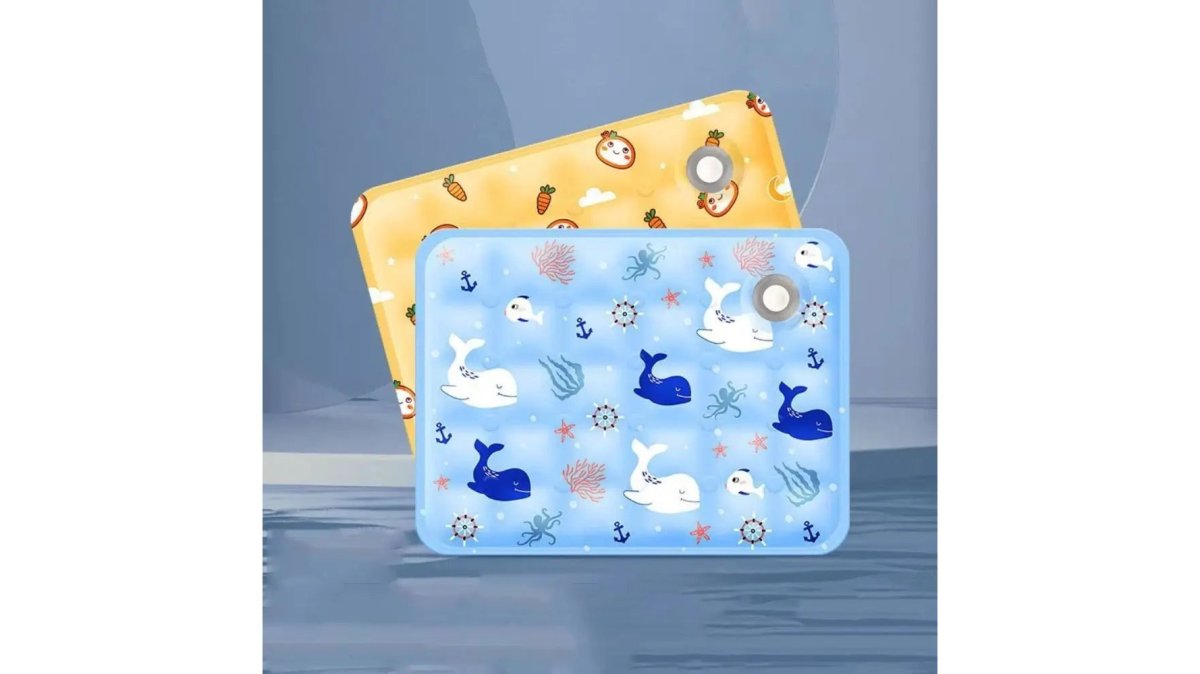
A dog cooling mat gives a dog a cool surface to lie on, which is exactly what a hot dog wants after activity. The Proud Pet Shop Cooling Recovery Mat activates when you add water, using a pressure-sensitive gel layer that cools where your dog's body weight presses down.

The chew-resistant cover matters most for real households: standard gel pads split open under a determined chewer, and once the gel leaks, the mat is finished. A reinforced cover keeps the cooling layer intact.
Cooling mats are not a substitute for a vest on a walk. They are recovery and rest gear: use one after a hike, in the car between stops, or where your dog naps during the hottest part of the day.
Signs of Overheating in Dogs and When to Stop
Recognizing overheating early is the most important cooling skill an owner can have, because gear cannot fix a dog already in trouble. Heavy, nonstop panting is the first sign, followed by thick drooling, bright red gums, glazed eyes, wobbling, and refusing to keep moving.
If you see those signs, stop the activity, move to shade or air conditioning, offer cool water, and wet your dog's chest, belly, and paws with cool (not ice-cold) water. The CDC's heat safety information explains that rapid cooling and getting out of the heat are the priorities in any heat-related emergency.
Cooling Performance by Climate and Humidity
Cooling gear performs differently depending on where you live, and this is the part most buying guides skip. Evaporative cooling depends on how much water the air can still absorb: when the air is dry, water leaves the fabric quickly and carries heat with it; when the air is near saturation, the water has nowhere to go, and a soaked vest can sit damp against your dog without dropping its temperature much at all.
Proud Pet Shop Cooling Recovery Mat →
That fact should change what you buy, not just how often you rewet. Here is how the main cooling mechanisms stack up:
| Mechanism | Dry heat (low humidity) | Humid heat (high humidity) | Notes |
|---|---|---|---|
| Evaporative (bandana, wet towel) | Strong, this is where it shines | Weak, evaporation stalls | Needs re-wetting every 20-30 min in dry heat; more often in humid heat with little payoff |
| Ice-pack or gel (freezer-chilled inserts, chilled mats) | Moderate, cold surface, but warms through | Moderate to strong, does not depend on evaporation | Limited duration; refreeze time is the bottleneck |
| Pressure-activated gel (water-activated mats) | Moderate | Moderate | Cools where body weight presses; best for rest, not activity |
| Airflow (elevated mesh beds, raised cots) | Moderate | Strong, works when evaporation fails | No activation, no re-wetting, no power; the most reliable humid-climate option |
How to Read Your Own Conditions
You do not need a weather station to make this call. The heat index your local forecast reports already combines temperature and humidity into a single number, and that is the number that matters for your dog, not temperature alone. A dry 95-degree afternoon and a humid 85-degree afternoon can feel similar to a dog, and the humid one is often more dangerous because the dog's panting is less effective.
A practical way to think about it:
- If sweat evaporates off your skin quickly, or your lips and hands feel dry, you are in evaporative-friendly conditions. Soaked gear will do real work. Rewet on schedule and keep moving.
- If you feel sticky, the air feels heavy, or sweat does not seem to dry, evaporation is compromised. Shift the plan toward shade, airflow products, chilled mats, and shorter outings. A wet vest is still worth wearing, but treat it as one tool, not the tool.
- If the forecast heat index is in the range where local authorities issue heat advisories, the right answer is usually to change the plan, not the gear. Move the walk to early morning or after sunset, shorten it, and pick a shaded route.
What This Means for Building a Kit
Elevated beds work in both climates because they rely on airflow rather than evaporation. The Proud Pet Shop CloudLift Bed uses a breathable mesh surface that lets air move under your dog, which helps in humid conditions where wet gear struggles. That is why we treat airflow products as the base layer of a cooling setup.

A climate-matched kit usually looks like this:
- Dry-heat climate: a water-soaked vest for activity, a cooling mat for recovery, and a collapsible bowl for re-wetting on the go. Evaporative gear carries most of the load.
- Humid-heat climate: an elevated mesh bed as the foundation, a pressure-activated or chilled mat for rest, and a vest used with realistic expectations and frequent breaks. Airflow and chilled surfaces carry more of the load than evaporation.
- Mixed or variable climate: own one of each and rotate by the day's heat index rather than by the calendar. The same dog may need a vest in June and an elevated bed in August.
How to Test Whether Gear Is Actually Working
Most product descriptions tell you what a mat is supposed to do, but few tell you whether it works for your dog. A simple home check closes that gap:
- Pick a consistent spot and time. Same location, same time of day, similar conditions, so you are comparing the gear and not the weather.
- Note your dog's resting pant rate before the gear goes on. Count chest movements for 15 seconds and multiply by four.
- Apply the gear and re-check the pant rate at 10, 20, and 30 minutes. A working cooling product should bring the rate down or keep it from climbing during light activity.
- Feel the fabric or surface at each check. If a soaked vest is dry to the touch, it has stopped cooling. If a mat is warm where your dog is lying, it has given up its chill.
- Log drying time. How long the gear stays effective tells you your re-wetting or re-chilling interval better than any general recommendation.
Run that check once per product in the conditions you actually live in, and you will know more about your dog's cooling setup than any roundup can. The goal is not the best spec sheet, but gear that measurably helps your dog on the days that matter.
Fit, Sizing, and Building a Complete Cooling Kit
The right cooling kit depends on your dog's day, not on buying everything at once.
- Active dogs on daily walks and hikes: a cooling vest plus a collapsible bowl and water bottle.
- Dogs that overheat at home: a cooling mat in their favorite nap spot.
- Dogs that nap outdoors or on hot patios: an elevated bed with breathable mesh.
Sizing is where most returns happen. Measure chest girth, back length, and weight before you buy, and check the size chart rather than guessing from breed.
Durability and care round out the picture. Rinse cooling gear after use, let it dry fully before storing, and check seams and covers for wear.
Conclusion: Matching Cooling Gear to Your Dog's Day
The best cooling gear for dogs in hot weather is the piece that fits your dog's routine and gets used correctly. A mat for recovery, and an elevated bed for the nap cover the moments when heat hits hardest.
If you want gear that holds up to daily use, Proudpetshop offers the Cooling Recovery Mat, the CloudLift Bed, and the Waterproof Pet Sofa, all backed by a 30-day satisfaction guarantee and free shipping on orders over $50.
Frequently Asked Questions
Do cooling vests really work for dogs?
Evaporative cooling can help dogs stay comfortable during outdoor activity, but it is not a substitute for shade, water, and rest breaks. In humid conditions, evaporation slows, so pair evaporative methods with a cooling mat and frequent stops.
Are cooling mats safe for dogs?
Cooling mats are safe for most dogs when used as directed. The Proud Pet Shop Cooling Recovery Mat activates with water and uses a pressure-sensitive gel layer, so there is no electricity or freezer needed. Choose a mat with a chew-resistant cover, place it on a flat surface, and supervise dogs that tend to chew. If your dog ingests gel or fabric, contact your veterinarian.
How long can a dog wear a cooling vest?
Most dogs can use cooling gear for the length of a typical walk or hike, usually 30 to 60 minutes, as long as the gear stays effective and your dog is not showing signs of overheating. Re-wet or re-chill gear when it starts to lose its cooling effect. For longer outings, bring water to rewet gear and take shade breaks. Remove cooling gear once your dog is resting in a cool space.
How do you keep a dog cool on a hot walk?
Walk during early morning or evening when temperatures are lower, choose shaded routes, and bring water for both drinking and re-wetting gear. A water-soaked bandana plus a portable cooling mat for rest stops helps regulate body temperature. Watch for signs of overheating in dogs, such as heavy panting, drooling, and slowing down, and end the walk if they appear.
What should I look for in dog cooling gear?
Look for breathable mesh and materials that hold water without getting heavy. For mats, choose a chew-resistant cover and a size that matches your dog's resting space. Check sizing charts before buying. Durable construction and easy cleaning matter for daily summer use.