
Table of Contents
- Why Teething Puppies Need Indestructible Chew Toys
- Puppy Teething Timeline: What to Expect Month by Month
- Safe Materials for Puppy Chew Toys
- Top Indestructible Chew Toys for Aggressive Chewers
- How to Stop Puppy from Chewing Furniture
- Breed-Specific Chewing Profiles: Match the Toy to the Jaw
- Signs of Toy Wear and When to Replace Them
- Conclusion
- Frequently Asked Questions
Last Updated: September 28, 2026
Why Teething Puppies Need Indestructible Chew Toys
Puppies chew because their mouths hurt. Between roughly three and seven months, baby teeth loosen and adult teeth push through, and chewing applies counter-pressure that eases the discomfort. This guide from Proudpetshop explains how to pick indestructible chew toys that survive that pressure while protecting your puppy's mouth.
Puppy Teething Timeline: What to Expect Month by Month
Puppies get baby teeth at three to four weeks and begin losing them near the three-month mark. Adult teeth finish coming in by six to seven months, though some large breeds run longer.
Here's what that looks like in practice:
| Age | Dental Stage | Chewing Intensity | What Helps |
|---|---|---|---|
| 3-8 weeks | Baby teeth emerge | Low | Soft fabric, gentle mouthing |
| 8-12 weeks | Full baby teeth | Rising | Soft rubber, frozen washcloth |
| 3-4 months | Baby teeth loosen | High | Natural rubber, edible chews |
| 4-6 months | Adult teeth push through | Peak | Durable rubber, reinforced nylon |
| 6-7 months | Adult teeth settle | Declining | Dental chews, harder rubber |
Safe Materials for Puppy Chew Toys
The safest puppy chew toys are made from non-toxic natural rubber or food-grade reinforced nylon, materials that flex under pressure instead of shattering. Avoid anything that splinters, peels into strips, or breaks off in swallowable chunks.
A few material rules worth memorizing:
- Natural rubber flexes and bounces back, surviving repeated pressure without cracking. Its elasticity spreads the force instead of concentrating it at one fracture point.
- Reinforced nylon resists even power chewers thanks to densely packed polymer chains, but that density makes it hard enough to chip a tooth under obsessive chewing.
- Avoid cheap plastic, which cracks along stress lines, and soft vinyl, which tears into swallowable strips.
- Check for non-toxic materials and look for toys made without phthalates or BPA. Children's products carry strict phthalate limits under Consumer Product Safety Commission rules, but pet toys aren't held to the same standard, so "non-toxic" on a pet toy label is largely a manufacturer claim.
Why "Indestructible" Is a Marketing Word, Not a Standard
No federal agency certifies a chew toy as indestructible. The term is marketing, and the closest thing to a durability benchmark is the manufacturer's own testing plus third-party reviews. Your best defense is reading the material and construction, not the label: thin-walled plastic will fail faster than a plain rubber toy with thick walls.
Natural Rubber vs. Nylon: Which Holds Up Better?
Natural rubber wins for most teething puppies: softer on sore gums, it flexes instead of splintering and holds up to moderate chew intensity. Nylon is tougher, making it the better pick for a confirmed power chewer.
Sizing: The Rule Most Owners Get Wrong
A toy should be large enough that your puppy can't fit the whole thing in its mouth and swallow it, but small enough to chew comfortably. Size up, not down: slightly too big is safe, slightly too small is a choking hazard. For a puppy expected to reach 50 pounds or more, buying adult-large toys early avoids the mid-teething replacement cycle.
Edible vs. Non-Edible Teething Aids
Edible aids like bully sticks, collagen chews, and dental chews give short-term relief and keep a puppy busy, but they disappear fast and a puppy can swallow a soft end. Always supervise, and remove any edible chew once it's short enough to fit entirely behind the puppy's front teeth.
Top Indestructible Chew Toys for Aggressive Chewers
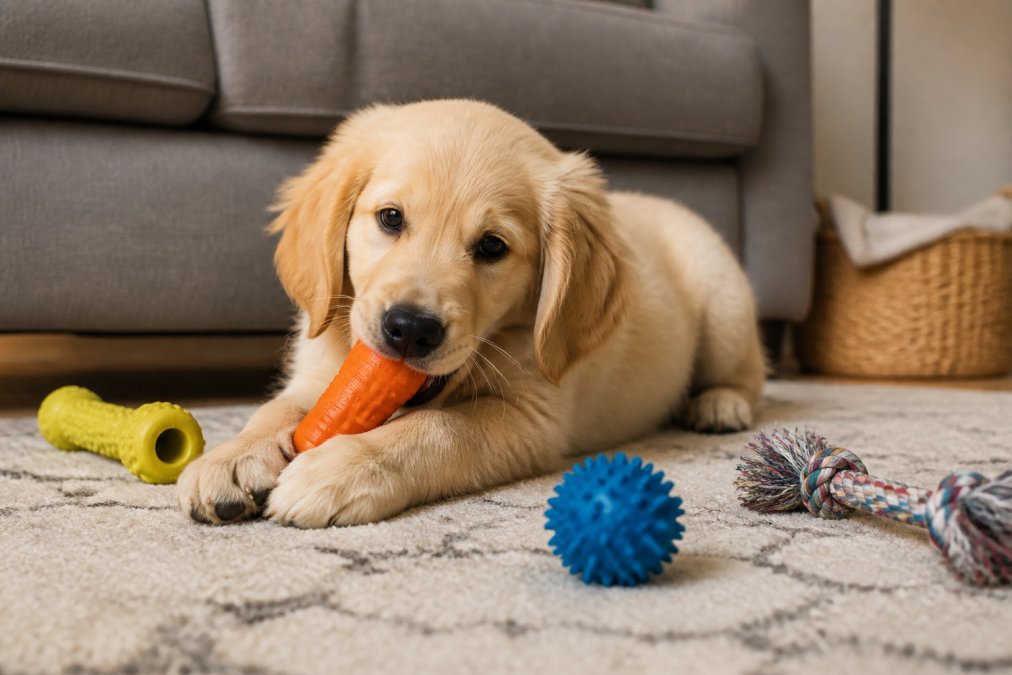
For an aggressive chewer, the best indestructible chew toys combine thick natural rubber or reinforced nylon with a shape too big to swallow and too solid to shred. Match toughness to chew intensity, not just size.
Comparison Table: Toughness, Material, and Best For
| Toy Type | Toughness | Material | Best For |
|---|---|---|---|
| Classic rubber chew | High | Natural rubber | Teething puppies, moderate chewers |
| Reinforced nylon bone | Very high | Nylon | Power chewers, strong jaws |
| Rubber treat-stuffer | High | Natural rubber | Boredom, interactive play |
| Dental rubber ring | Medium-high | Rubber with texture | Gum massage, dental health |
| Rope tug toy | Medium | Cotton fiber | Interactive play, supervised only |
At Proudpetshop, the durable gear we carry is built for exactly this problem: pets that cause serious wear and tear. Our catalog focuses on long-lasting essentials, backed by a 30-day satisfaction guarantee, so you can test a toy against your puppy's jaw without risk.
How to Stop Puppy from Chewing Furniture
You stop furniture chewing by redirecting the behavior, not punishing it. Every time your puppy mouths a table leg, swap in an appropriate chew toy and praise the swap. Puppies repeat what gets attention, so make the toy the rewarding choice.
A simple redirect routine:
- Keep a durable chew toy within arm's reach in every room.
- The moment your puppy targets furniture, say "no" calmly and offer the toy.
- Praise immediately when your puppy takes the toy.
- Repeat every single time. Consistency is what trains the behavior.
DIY Frozen Teething Hacks That Actually Work
Frozen chews numb sore gums, which is why they work so well during the worst teething weeks. The simplest version: soak a washcloth in water or low-sodium broth, twist, freeze, and hand it over under supervision.
Other options that hold up:
- Freeze a rubber treat-stuffer packed with plain yogurt or mashed banana.
- Freeze carrot sticks for a crunchy, edible chew.
- Freeze apple slices for a cooling, low-calorie treat.
Breed-Specific Chewing Profiles: Match the Toy to the Jaw
Chewing intensity tracks breed as much as age. A Labrador retriever or German shepherd chews harder and longer than a toy breed, so the same toy can be perfect for one puppy and shredded by another.
Rough guide:
- Power chewers (Labradors, shepherds, pit bulls): reinforced nylon and thick natural rubber.
- Moderate chewers (retrievers, spaniels): classic rubber chews and treat-stuffers.
- Light chewers (toy breeds, seniors): softer rubber and dental rings.
Signs of Toy Wear and When to Replace Them
Replace a chew toy the moment it shows deep cracks, missing chunks, or pieces that pull off. Wear and tear is normal, but structural failure is a safety signal, a worn toy can shed fragments a puppy swallows.
Check toys weekly for:
- Cracks or splits in the rubber or nylon
- Missing pieces or chewed-off edges
- Loose or exposed squeakers
- Softening that lets you compress the toy easily
- A change in texture, such as a glossy surface turning dull or tacky
The Nail Test and the Twist Test
Two quick checks catch most failures. The nail test: press a fingernail into the toy, a permanent dent or crumbling surface means the material has degraded. The twist test: grip both ends and twist gently; if it flexes at a crack line or a hard edge forms, retire it. Both take seconds and beat eyeballing.
Replacement Cadence by Chew Intensity
There's no universal schedule, but a common pattern is:
- Light chewers (toy breeds, seniors): a durable rubber toy can last six months or more with weekly checks.
- Moderate chewers: expect to replace a favorite rubber chew every two to four months.
- Power chewers: a reinforced nylon toy may need replacing every few weeks, and rubber toys can fail in days.
Buying durable construction up front costs less than replacing cheap toys constantly: a $15 rubber chew that lasts three months beats a $6 toy that dies in a week, in cost per month and in reduced fragment risk.
When to Retire a Toy Immediately
Retire any toy that fails the checks above, and pull it the same day you notice the failure, not at the next cleaning. For a power chewer, keep a spare on hand so you're not tempted to leave a compromised toy in the rotation. If you ever see your puppy gag, paw at its mouth, or swallow without chewing, take the toy away and watch for signs of obstruction, which the ASPCA's pet safety guidance lists among common household hazards.
Conclusion
The hardest part of teething isn't finding a toy; it's finding one that survives a determined puppy without becoming a hazard. Match the material to your puppy's chew intensity, rotate toys to spread wear, and replace anything that cracks or sheds.
Frequently Asked Questions
What is the best thing for a teething puppy to chew on?
The best options are durable rubber toys with some give, like natural rubber chews, or edible aids such as bully sticks and collagen chews. These let your puppy soothe their gums without cracking teeth. Avoid hard nylon or antlers during the intense teething phase. Always supervise play and rotate toys to keep things interesting.
Are nylon chew toys safe for teething puppies?
Nylon chew toys can be safe if they are specifically designed for teething puppies and rated for moderate chewers. Look for reinforced nylon with rounded edges and no sharp fragments. However, aggressive chewers can break off pieces, which poses a choking hazard. Always check for wear and tear and replace the toy when it becomes rough or small.
How can I tell if a chew toy is safe for my puppy?
Check for non-toxic materials, a size appropriate for your puppy's mouth (not small enough to swallow), and no loose parts. The toy should have some flexibility so it doesn't damage teeth. Supervised play is key: if the toy shows deep cracks, missing chunks, or becomes sharp, throw it away immediately.
At what age do puppies stop the intense teething phase?
Puppies typically start teething around 3 to 4 months and the most intense phase lasts until about 6 months, when all adult teeth have come in. By 7 to 8 months, most puppies have a full set of adult teeth and the urge to chew decreases. However, some dogs continue to enjoy chewing for life, especially power chewer breeds.