
Table of Contents
- What Counts as a Puzzle Toy for Aggressive Chewers
- Quick Comparison: Top Picks for Heavy Chewers
- Safe Materials for Heavy Duty Dog Toys
- How to Keep Aggressive Chewers Entertained
- Age-Specific Durability: Puppies, Adults, and Seniors
- Repair, Recycling, and Noise Considerations
- Common Mistakes When Buying Puzzle Toys for Aggressive Chewers
- Frequently Asked Questions
Last Updated: September 24, 2026
What Counts as a Puzzle Toy for Aggressive Chewers
A puzzle toy for aggressive chewers is a durable, food-dispensing device built to survive powerful jaws while forcing a dog to work for its kibble or treats. The best puzzle toys for aggressive chewers combine heavy-duty rubber or reinforced plastic with a solving mechanism that rewards nose work, pawing, and problem-solving instead of raw biting power.
Quick Comparison: Top Picks for Heavy Chewers
The best all-around pick for most strong chewers is the Proud Pet Shop IQ Treat Puzzle, priced at $34.99. It pairs an adjustable difficulty setting with a non-slip base and a dishwasher-safe body, which covers the three things heavy chewers need most: resistance, stability, and easy cleanup.

| Pick | Best For | Key Features | Price |
|---|---|---|---|
| Proud Pet Shop IQ Treat Puzzle | Most aggressive chewers | Adjustable difficulty, non-slip base, dishwasher-safe | $34.99 |
| Slow feeder bowl | Fast eaters with strong bite force | Slows eating, holds kibble, sturdy base | Varies |
| Heavy-duty rubber treat toy | Solo play | Chew resistance, treat-dispensing | Varies |
Proud Pet Shop IQ Treat Puzzle
Our top pick is the Proud Pet Shop IQ Treat Puzzle because it targets the root problem: a bored, powerful chewer needs a job, not just a tougher surface. The adjustable difficulty lets you raise the challenge as your dog solves it, so the toy stays interesting instead of becoming another chew victim.
Best Slow Feeder Bowl for Dogs With Strong Bite Force
A slow feeder bowl is the practical answer for dogs that inhale meals and then redirect that energy into furniture. The best slow feeder bowl for dogs with a strong bite force uses a heavy, wide base that resists tipping and a maze pattern that forces the dog to work around obstacles.
Safe Materials for Heavy Duty Dog Toys
Safe materials for heavy duty dog toys come down to two things: chew resistance and non-toxic construction. But "non-toxic" is a claim, not a guarantee, so it helps to know what backs it up.
What the labels actually mean
- Natural rubber: Tapped from rubber trees, it flexes under bite force instead of shattering. It tends to have a slight rubber smell and a matte finish.
- Heavy-duty rubber compounds: Thicker walls and higher tear resistance than standard rubber. These are the materials used in most long-lasting treat-dispensing toys.
- BPA-free plastics: Safe only if the dog does not break the surface. Once a hard plastic cracks, the exposed interior can splinter into sharp fragments.
- Thermoplastic rubber (TPR): A rubber-plastic hybrid that sits between the two. It is softer than hard plastic but less springy than natural rubber, so it can gouge under sustained chewing.
Non-toxic standards to look for
There is no single federal toy-safety law that covers pet toys the way the Consumer Product Safety Commission covers children's products. That means the burden falls on you to read the label. A few signals are worth trusting:
- "BPA-free" and "phthalate-free" on the packaging, with a stated material (not just "safe plastic").
- Food-grade silicone for toys that hold kibble or treats, since the dog will be eating directly off the surface.
- Made in the USA labeling, which at least tells you the toy was produced under domestic manufacturing rules rather than an unverified overseas supply chain.
- A stated durometer or hardness rating. Some premium brands publish this; most do not. If a brand publishes it, that is a sign it has actually tested the material.
Durability testing you can do at home
You do not need a lab to screen a new toy. A few simple checks catch most failures before they happen:
- The thumbnail test. Press your thumbnail into the material. If it leaves a permanent dent, the toy is too soft for a determined chewer. If it feels like a rock, it is too hard for teeth.
- The twist test. Grip the toy with both hands and twist. A toy that flexes and returns is safer than one that creaks or shows stress marks.
- The seam check. Run a finger along every seam and molded edge. Raised seams are the first place a chewer will start a tear.
- The first-session watch. Give the toy for a supervised five-minute session and inspect it immediately after. Look for puncture marks, gouges, or small pieces missing.
Signs a toy is no longer safe
Retire a toy the moment you see any of these:
- A crack, split, or deep gouge that reaches the interior
- A piece missing, no matter how small
- A loose squeaker or treat-dispensing mechanism that can be pulled out
- A surface that has gone tacky or sticky, which usually means the material is breaking down
How to Keep Aggressive Chewers Entertained
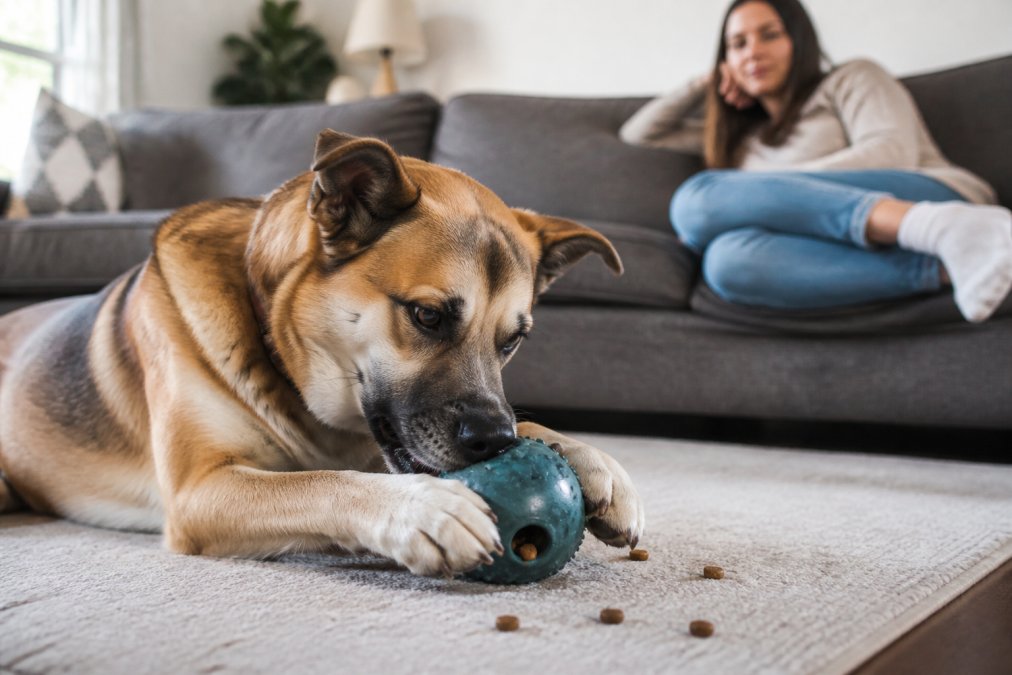
Keeping aggressive chewers entertained means replacing destruction with problem-solving. A dog that shreds cushions is usually under-stimulated, not badly behaved. Mental enrichment tires a dog faster than a walk because it works the brain alongside the body.
Age-Specific Durability: Puppies, Adults, and Seniors
Age changes what a puzzle toy needs to deliver. Puppies need softer materials for teething relief and simpler mechanisms they can solve without frustration. Adults with full bite force need the toughest construction and adjustable difficulty. Seniors need low-resistance puzzles that accommodate weaker jaws and stiffer joints.
- Puppies: soft rubber, easy reward release, teething relief
- Adults: heavy-duty rubber, adjustable difficulty, high chew resistance
- Seniors: gentle resistance, shallow puzzles, easy-to-reach treats
Repair, Recycling, and Noise Considerations
Most buying guides stop at the checkout page. But what happens after a toy starts to fail, and how loud it is while it is still in one piece, matters just as much for households living with a determined chewer.
When a toy can be repaired, and when it cannot
A small surface nick is not a death sentence. A deep structural failure is. The line between the two is whether the damage reaches the interior of the toy.
Repairable (with supervision):
- Shallow surface scratches that do not reach past the outer layer
- A slightly chewed edge that can be smoothed with fine-grit sandpaper (150-220 grit) to remove sharp burrs
- A treat-dispensing opening that has stretched but still holds kibble
Not repairable, retire immediately:
- Any crack, split, or puncture that exposes the hollow interior
- Missing pieces, even small ones
- A separated seam or a squeaker that has come loose
- A toy that has gone tacky or gummy, which means the rubber is breaking down
Recycling pathways for damaged rubber toys
Recycling a dog toy is harder than recycling a milk jug, because most curbside programs do not accept mixed rubber or TPR. A few realistic options exist:
- Manufacturer take-back programs. A small number of premium rubber toy brands run take-back or trade-in programs. Check the brand's website before you throw anything away.
- Specialty rubber recyclers. Some regional recycling centers accept natural rubber, but you usually have to call ahead and confirm.
- Repurpose before you recycle. A retired rubber toy with no missing pieces can become a garden hose bumper, a doorstop, or a fillable base for a planter. It is not a dog toy anymore, but it is not landfill yet.
- Last resort: municipal waste. Mixed-material toys with plastic squeakers, fabric covers, or electronic components generally cannot be recycled and should go in the trash once they are unsafe.
Noise: the overlooked apartment-dweller problem
A puzzle toy that clatters across hardwood at 6 a.m. is a real problem for anyone living above a neighbor. Noise depends on three things: material, base design, and floor surface.
- Hard plastic puzzles are the loudest. They slide, clatter, and amplify on hardwood, tile, and laminate.
- Rubber puzzles with weighted bases stay planted and absorb impact, making them the quietest option for hard floors.
- Fabric or plush puzzle toys are quiet but rarely survive an aggressive chewer.
- A simple rug or yoga mat under the toy cuts noise dramatically without changing the toy itself.
Common Mistakes When Buying Puzzle Toys for Aggressive Chewers
The biggest mistake is choosing a toy by size alone. A large dog with a moderate bite force needs a different puzzle than a medium dog with a powerful, determined jaw. Bite force, not body weight, decides whether a toy survives.
- Picking by size instead of bite force
- Ignoring age and life stage
- Buying one toy instead of a rotating set
- Skipping material and safety checks
- Leaving a new toy unsupervised on day one
Frequently Asked Questions
What are the best puzzle toys for dogs with aggressive chewing?
Look for puzzle toys made from heavy-duty natural rubber or reinforced nylon with no small detachable parts. The Proud Pet Shop IQ Treat Puzzle ($34.99) uses adjustable difficulty and a non-slip base, so it holds up during solo play while dispensing kibble. Avoid thin plastic puzzles, which crack under strong bite force. Check that the toy is labeled dishwasher safe and BPA-free before buying.
Are puzzle toys safe for dogs that chew through everything?
They can be, if you supervise play and pick chew-resistant materials. Natural rubber and thick food-grade plastic handle more wear than thin ABS shells. Inspect the toy after each session for cracks, missing pieces, or sharp edges. Swap it out the moment damage appears. Puzzle toys for aggressive chewers work best when you rotate them and pair them with size-appropriate options, not as unsupervised all-day chews.
What materials are safest for aggressive chewer puzzle toys?
Natural rubber, heavy-duty nylon, and BPA-free food-grade plastic are the safest choices. These materials flex under bite force instead of shattering. Avoid toys with glued-on parts or small treat doors that pop off. The Proud Pet Shop IQ Treat Puzzle is dishwasher safe and built with a non-slip base, which keeps it stable during heavy pawing. Always match material thickness to your dog's size and chew style.
How do I keep aggressive chewers entertained without a walk?
Rotate puzzle feeders, slow feeder bowls, and treat-dispensing toys through the week so novelty stays high. The Proud Pet Shop IQ Treat Puzzle converts snack time into problem-solving, which tires a dog mentally in 15 to 20 minutes. Add a slow feeder bowl for meals to stretch eating time. Short, supervised sessions beat one long session, and reward-based play keeps the dog focused on the toy instead of furniture.
Heavy chewers are hard on gear, and finding toys that survive the week can feel impossible. Proudpetshop stocks durable, thoughtfully designed pet essentials, including the Proud Pet Shop IQ Treat Puzzle, backed by a 30-day satisfaction guarantee, fast tracked shipping, and free shipping on orders over $50. Every product is selected for real households with real wear and tear, not showroom conditions. Get started with Proudpetshop and give your dog enrichment that actually lasts.