
Table of Contents
- Why the Best Slow Feeder Bowl for Dogs Matters for Fast Eaters
- Benefits of Slow Feeder Dog Bowls: Bloat Prevention and Better Digestion
- How to Stop a Dog From Eating Too Fast: Transitioning to a Slow Feeder
- Slow Feeder Bowl vs Puzzle Feeder: Which One Does Your Dog Need?
- Top Slow Feeder Bowls for Dogs: Materials, Safety, and Picks
- Cleaning and Maintenance: Keeping Complex Maze Designs Hygienic
- Conclusion: Matching the Right Slow Feeder to Your Dog
- Frequently Asked Questions
Last Updated: September 29, 2026
Why the Best Slow Feeder Bowl for Dogs Matters for Fast Eaters
A dog that inhales dinner in under a minute isn't just messy. That speed can pull air into the stomach, trigger regurgitation, and put real strain on the digestive tract. Finding the best slow feeder bowl for dogs is one of the simplest fixes available, and it costs less than most people expect.
Benefits of Slow Feeder Dog Bowls: Bloat Prevention and Better Digestion
The main benefit of slow feeder dog bowls is straightforward: they stretch a 30-second meal into five to ten minutes. That extra time lets food reach the stomach in smaller amounts, which supports steadier digestion.
Other gains show up in daily life:
- Less gulping and swallowed air
- Fewer episodes of regurgitation right after meals
- Better portion control for weight management
- Real mental enrichment, since the dog has to work for food
How to Stop a Dog From Eating Too Fast: Transitioning to a Slow Feeder
To stop a dog from eating too fast, start with a shallow design and increase the difficulty over about two weeks. Most dogs adjust faster than owners expect, but a few need a gentler ramp.
Here's a transition plan that works:
- Days 1-3: Offer a small portion in the new bowl alongside the old one. Let the dog succeed without frustration.
- Days 4-7: Move the full meal into the slow feeder. If your dog gives up, scatter a few pieces on top to restart interest.
- Week 2: Add difficulty by choosing a deeper maze or a fabric foraging mat.
- Ongoing: Rotate two or three designs so the challenge stays fresh.
Slow Feeder Bowl vs Puzzle Feeder: Which One Does Your Dog Need?
The difference between a slow feeder bowl and a puzzle feeder comes down to purpose. A slow feeder bowl controls the speed of a normal meal. A puzzle feeder turns eating into a problem-solving task, often with treats instead of a full portion.
| Feature | Slow Feeder Bowl | Puzzle Feeder |
|---|---|---|
| Primary goal | Pace a full meal | Mental stimulation |
| Best for | Gulpers, bloat-prone dogs | Bored or high-energy dogs |
| Food type | Kibble, wet food, raw | Treats, small kibble |
| Difficulty | Fixed by design | Often adjustable |
| Typical session | 5-10 minutes | 10-20 minutes |
Top Slow Feeder Bowls for Dogs: Materials, Safety, and Picks
The best slow feeder bowl for dogs is one that matches your dog's eating style, muzzle shape, capacity needs, and cleaning routine. Material matters as much as maze depth, and so does size.
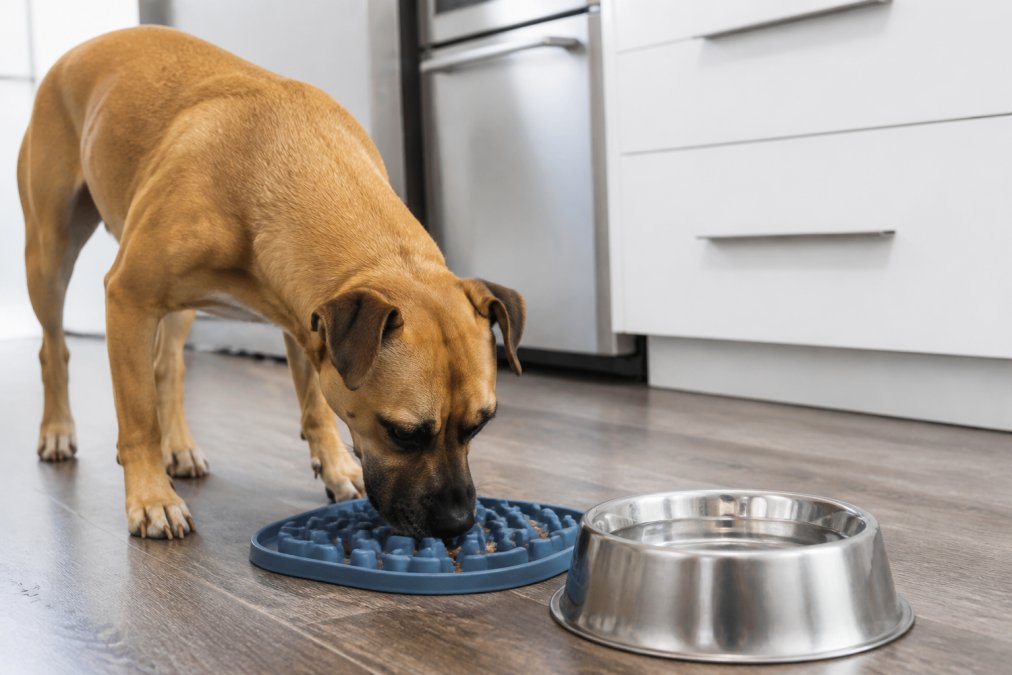
Material comparison
Plastic mazes are the cheapest and most widely available option. They come in the deepest, most complex ridge patterns, which makes them effective for hardcore gulpers. The trade-off is durability: plastic scratches, and those scratches hold onto oils and bacteria over time. Look for food-grade, BPA-free plastic, and plan to replace the bowl once the surface feels rough or chalky.
Capacity and size guide
Match the bowl's capacity to your dog's meal size, not to the dog's body weight alone. A bowl that is too small forces you to split meals, and a bowl that is too large lets kibble pile up in the center, which defeats the purpose.
- Toy and small breeds (under 20 lb): 1 to 2 cups capacity
- Medium breeds (20 to 50 lb): 2 to 4 cups capacity
- Large breeds (50 to 90 lb): 4 to 6 cups capacity
- Giant breeds (over 90 lb): 6 cups and up, or a wide-diameter bowl
Durability and chew resistance
If your dog chews bowls, skip plastic and silicone entirely. Stainless steel is the only material that reliably survives a determined chewer. For silicone mats, check the edges and seams monthly; a dog that likes to chew fabric can shred a mat quickly, and torn pieces are a choking risk. Suction bases help with sliding but are not a chew-proofing feature, and some dogs will work at the suction cup until it pops off.
Elevated vs. floor-level feeders
Elevated feeders raise the bowl off the floor, which can be easier on the neck and joints of older dogs and large breeds. The trade-off is that some veterinary guidance suggests elevated feeding may not be ideal for dogs at risk of bloat, so if your dog is a deep-chested breed or has a history of digestive issues, talk to your vet before switching to an elevated setup.
Proud Pet Shop Slow-Feeding System →
Our picks from the Proudpetshop catalog
- Proud Pet Shop Slow-Feeding System (3-Piece Set) ($15.99), food-grade, BPA-free silicone with a heavy-duty suction base and dishwasher-safe pieces. Best for most fast eaters and brachycephalic dogs. See it here
- Proud Pet Shop Sniffing Petal Mat ($29.99), soft felt layers that hide kibble for scent-based foraging. Best for mental enrichment and portion control. See it here
- Proud Pet Shop IQ Treat Puzzle ($34.99), adjustable difficulty, non-slip base, dishwasher safe. Best for dogs that need a real challenge. See it here
A note on flat-faced breeds
For flat-faced (brachycephalic) breeds like pugs and French bulldogs, deep plastic mazes are often a poor fit. A flat silicone lick mat with shallow ridges lets them reach food without pressing their whole face into a wall of plastic. This is one of the most common mismatches we see, and it is worth measuring your dog's muzzle length before buying a deep maze bowl.


Cleaning and Maintenance: Keeping Complex Maze Designs Hygienic
Complex maze designs collect food in corners that a quick rinse won't reach. That residue is exactly where bacteria and mold grow, so cleaning needs to be deliberate. This is the part most buying guides skip: they say "dishwasher safe" and move on, but a dishwasher does not always reach the bottom of a deep, narrow groove, especially if dried kibble has hardened in place.
Why deep mazes are harder to clean than they look
The tighter the maze, the better it slows a fast eater, and the harder it is to clean. Narrow channels trap kibble dust, saliva, and oils. Over time, that film becomes a biofilm that a normal rinse will not remove. If your bowl has a smell even after washing, or if you can see a dark film in the corners, the bowl needs a deeper clean or replacement.
Material-by-material cleaning routine
Plastic mazes: These need the most attention. Fill a sink with warm soapy water and submerge the bowl for five minutes before scrubbing. The soak loosens dried kibble from tight corners, so you don't have to fight it with a brush. Use a soft bottle brush or a dedicated crevice brush to reach the bottom of each channel. Avoid abrasive scrubbers, which create the scratches that trap bacteria.
A weekly deep-clean checklist
- After every meal: rinse and shake dry
- Daily: wash with warm water and pet-safe soap
- Weekly: run dishwasher-safe bowls through a full cycle, or hand-scrub every groove with a crevice brush
- Weekly: inspect the suction base, rubber ring, and any seams for trapped food
- Monthly: inspect for cracks, deep scratches, or worn suction bases, and replace if found
- Monthly: check fabric mats for tears and loose stitching
When to replace instead of clean
Some bowls reach a point where cleaning is no longer enough. Replace a plastic maze if you see deep scratches, a chalky surface, or a persistent smell after washing. Replace any bowl with cracks, chips, or a loose suction base, since those can trap food or come apart in your dog's mouth. Stainless steel and silicone generally last longer than plastic, but even those should be inspected monthly for wear.
Conclusion: Matching the Right Slow Feeder to Your Dog
Picking a slow feeder comes down to three questions: how fast does your dog eat, how flat is their face, and how much cleaning can you realistically do? Answer those and the choice narrows quickly.
Frequently Asked Questions
Do vets recommend slow feeder bowls?
Many veterinarians suggest slow feeder bowls for dogs that gulp their food. Fast eating can lead to swallowing air, which increases the risk of bloat and gastric dilatation-volvulus (GDV), a life-threatening condition. A slow feeder bowl forces a dog to eat around obstacles, extending mealtime and reducing air intake. If your dog has a history of digestive issues, regurgitation, or bloat, ask your vet whether a slow feeder or puzzle feeder fits your dog's specific needs.
What material is best for a slow feeder dog bowl?
Food-grade silicone and stainless steel are the most hygienic options. Silicone is flexible, BPA-free, and dishwasher safe, making it easy to clean complex maze designs. Stainless steel resists scratches and bacteria buildup but may be noisier. Plastic bowls are lightweight and affordable but can develop scratches that harbor bacteria over time. Look for a non-slip base and food-contact-safe materials regardless of which type you choose.
Are slow feeder bowls better for dogs?
For fast eaters, yes. Slow feeder bowls can reduce gulping, which helps with portion control and digestive health. They also provide mental enrichment by turning mealtime into a problem-solving task. However, they are not necessary for every dog. If your dog eats at a normal pace and has no digestive issues, a standard bowl works fine. Slow feeders are most beneficial for dogs that inhale food, gulp, or show signs of regurgitation after meals.
What are the downsides of slow feeder bowls for dogs?
Some dogs get frustrated with deep maze designs and may paw or flip the bowl. Flat-faced (brachycephalic) breeds like pugs and bulldogs may struggle to reach food in deep grooves. Cleaning can be tedious if the design has narrow crevices, so dishwasher-safe options are worth prioritizing. Also, a slow feeder bowl does not address the root cause of fast eating if it is driven by competition from other pets. In multi-pet households, feeding dogs separately may be necessary.
How do I choose the right size slow feeder for my dog?
Match the bowl size to your dog's muzzle length and breed. Flat-faced breeds need shallow, wide designs with gentle ridges. Long-nosed breeds can handle deeper maze patterns. The bowl should be wide enough that your dog's snout fits comfortably without scraping. For capacity, choose a bowl that holds your dog's full meal without overflow. A 3-piece set or adjustable puzzle feeder lets you modify difficulty as your dog gets faster at solving the challenge.