
Table of Contents
- Why Compact Cat Carriers Matter in Small Spaces
- Key Features of the Best Collapsible Cat Carrier Designs
- Soft-Sided vs. Hard-Shell: Which Works Better for Apartments
- How to Store Cat Carriers in Small Living Areas
- Airline-Approved Standards and Portability
- Top Compact Cat Carrier Options for Apartment Dwellers
- Reducing Noise and Anxiety During Transport
- Conclusion
Last Updated: August 24, 2026
Why Compact Cat Carriers Matter in Small Spaces
Living with a cat in a small apartment creates a storage problem: traditional carriers take up closet space you don't have. A compact cat carrier solves this by collapsing to a fraction of its original size while maintaining structural integrity for safe transport. At Proudpetshop, we understand that apartment dwellers need carriers that disappear when not in use but perform flawlessly during vet visits, travel, and emergencies.
Standard hard-shell carriers measure roughly 24 by 17 by 16 inches. A collapsible soft-sided alternative compresses to 8 inches thick or less, fitting easily under a bed or on a closet shelf. Beyond storage, compact carriers reduce physical strain during transport and fit more easily into car trunks and smaller vehicles.
Key Features of the Best Collapsible Cat Carrier Designs
Not all collapsible carriers perform equally. The difference lies in three core design elements: how the frame collapses, how ventilation is managed, and how durable the materials are under repeated use.
Breathable Mesh and Ventilation
A cat confined to a carrier for even 20 minutes can become anxious if air circulation is poor (peer-reviewed research). Breathable mesh panels allow your cat to see out, reducing stress, and provide consistent airflow that keeps your pet calm during transport.
Quality matters. Cheap mesh tears easily when a stressed cat paws at it. The best compact carriers use reinforced mesh bonded securely to the frame. Multi-panel ventilation, side panels plus a top panel, distributes airflow evenly rather than concentrating it in one spot.
Temperature control matters too. In warm weather, mesh ventilation prevents the carrier from becoming an oven. In cold weather, the same ventilation can be a drawback when moving between heated and unheated spaces.
Weight Capacity and Durability Standards
A carrier's weight capacity indicates structural support. Most compact carriers for cats max out at 15 to 20 pounds, which covers virtually all domestic cats (vet.cornell.edu). The real question is whether the frame will hold that weight repeatedly over years of use.
Durable frames use reinforced aluminum or sturdy plastic tubing that resists bending. Check zipper quality too, reinforced zippers with metal teeth outperform plastic zippers significantly. A broken zipper makes a carrier unusable.
The base padding also affects durability. A quality pad uses multiple layers of foam that maintain their shape and provide comfort during longer trips.
Secure Zippers and Escape-Proof Design
An escape-proof carrier is essential. The best compact carriers use double-zipper systems where two separate zippers run along the same seam. If one fails, the other keeps your cat secure.
Seam quality matters as much as zipper quality. Carriers with reinforced seams resist tearing far better than single-stitched seams. Some carriers add a secondary safety feature: a small loop or carabiner attachment point where you can clip a leash to your cat's harness.
Soft-Sided vs. Hard-Shell: Which Works Better for Apartments
The choice between soft-sided and hard-shell carriers fundamentally shapes how a carrier fits into apartment living.
Soft-sided carriers collapse and fold, making them ideal for space-constrained apartments. They're lighter and easier to maneuver in tight stairwells. The downside is structural: soft-sided carriers flex more during transport, which some cats find unsettling.
Hard-shell carriers provide rock-solid structure and don't flex at all. Many cats find this less stressful, and hard shells provide better protection if dropped. The critical drawback for apartments is size, a hard-shell carrier measures roughly 24 by 17 by 16 inches regardless of use. You can't compress it or make it smaller.
A middle ground exists: hybrid carriers that use a soft-sided frame with reinforced plastic corners. These collapse partially but not fully, providing more stability than fully soft-sided designs while taking up less space than hard shells.
Consider your cat's temperament too. Anxious cats often prefer hard shells because solid walls create security. Confident cats adapt well to soft-sided carriers. For most apartment dwellers, soft-sided compact carriers offer the best balance.
How to Store Cat Carriers in Small Living Areas
Storage strategy determines whether a carrier becomes a permanent eyesore or genuinely disappears when not needed.
Vertical Storage and Under-Bed Solutions
Vertical storage uses wall space instead of floor space. Install a shelf in an upper closet corner, and you've created dedicated carrier storage without sacrificing usable closet space.
Under-bed storage works if your bed frame has adequate clearance, typically 10 to 12 inches. A compressed carrier easily slides under a bed in a flat storage container, keeping it dust-free and completely hidden.
Closet organization systems designed for hanging storage can accommodate collapsed carriers. Some carriers include carrying handles or attachment loops that let you hang them on a closet rod or hooks.
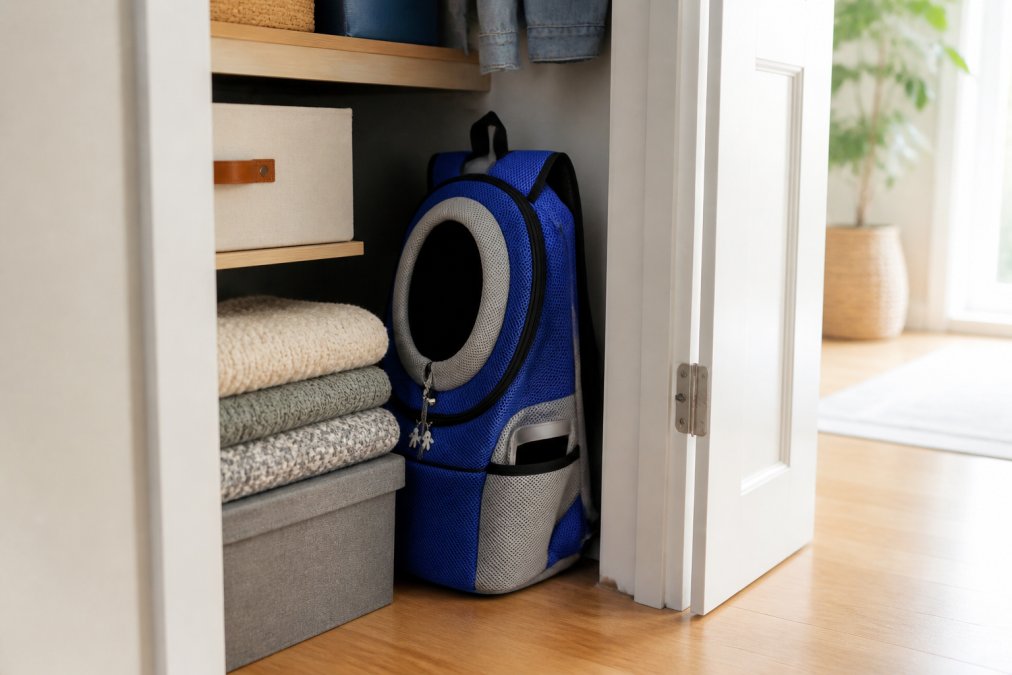
Avoid storing carriers in high-traffic areas where they'll be bumped or crushed. Choose storage locations with minimal daily contact and avoid damp basements or attics where temperature fluctuations might weaken adhesives.
Multi-Functional Carrier Furniture Options
Some apartment dwellers have discovered that carriers can serve double duty as functional furniture. A sturdy soft-sided carrier can become a pet bed when placed in a living room corner, eliminating the storage problem entirely.
Storage ottomans designed to hold carriers provide another solution. These pieces have a flat top surface for sitting while the interior holds a collapsed carrier. The ottoman becomes a functional furniture piece that solves storage invisibly.
Some carriers come with removable pads that can be used as standalone cat beds. You store the carrier frame collapsed, and the pad serves as regular bedding. During transport, you reassemble the carrier around the pad your cat already sleeps on, reducing stress through familiar scent.
Airline-Approved Standards and Portability
If you travel with your cat or anticipate needing to fly, airline-approved carriers become essential. Most major airlines accept carriers that meet specific dimensional requirements: typically 17 by 12 by 8 inches or smaller for in-cabin transport (faa.gov).
Airline approval indicates structural quality. Carriers meeting airline standards undergo testing for durability and safety. An airline-approved carrier is almost always better-made than one without this certification.
Check your specific airline's requirements before purchasing, as dimensions vary. The safest approach is choosing a carrier comfortably under the maximum dimensions.
Portability means more than just size. A carrier with a comfortable handle and shoulder strap options makes transport significantly easier. Handles should be padded to reduce hand fatigue. Weight matters too, the best compact carriers for apartments weigh under 3 pounds when empty, making them genuinely portable even when carrying a 10-pound cat.
Top Compact Cat Carrier Options for Apartment Dwellers
When evaluating carriers for apartment living, the best options combine genuine portability with structural reliability.
Proud Pet Shop TrailFold Carrier: Front-Carry Versatility
The Proud Pet Shop TrailFold Carrier offers front-carry or back-carry options at $34.99. The carrier features breathable mesh panels on multiple sides, keeping your cat calm while providing excellent visibility.
The TrailFold design uses adjustable shoulder straps that distribute weight evenly, reducing physical strain compared to handheld carriers. Front-carry positioning lets you bond with your cat during shorter trips while keeping your hands relatively free. For longer distances, you can shift to back-carry mode.
Durability is solid. The carrier uses reinforced mesh bonded securely to the frame, and zippers are metal-toothed with double-zipper redundancy. The removable, washable pad provides comfort. A safety leash attachment loop adds extra security.
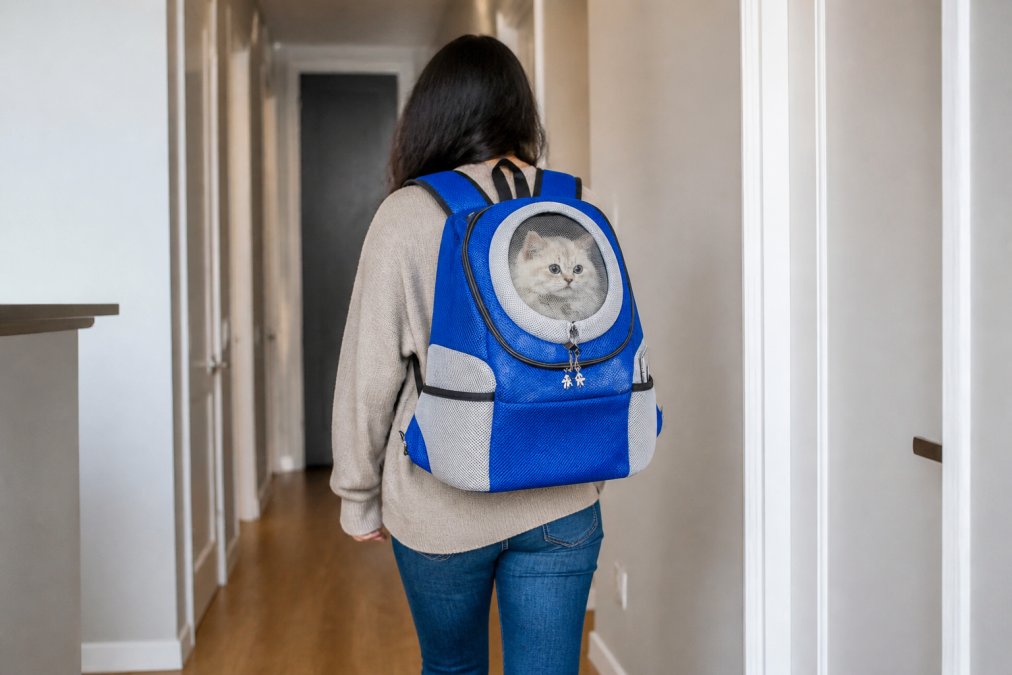
The TrailFold compresses to approximately 8 inches thick and weighs 2.8 pounds empty. It fits easily under a bed or on a closet shelf. For apartment dwellers needing to carry their cat while keeping hands free for keys and doors, this carrier solves that problem.
Proud Pet Shop Sidekick Sling: Hands-Free Comfort
The Proud Pet Shop Sidekick Sling at $28.99 offers a different approach. Rather than a backpack-style carrier, the Sidekick positions your cat against your body in a crossbody sling configuration, ideal for frequent short trips.
The sling accommodates cats up to 15 pounds comfortably. The breathable panel keeps your cat calm while allowing airflow. The adjustable strap fits most body types and distributes weight across your shoulder and torso.
This carrier excels at reducing anxiety. Because your cat is held against your body, they can feel your heartbeat and sense your calm demeanor. Many anxious cats settle quickly in a sling carrier.
Storage is minimal. The Sidekick Sling folds to roughly 10 inches by 8 inches and weighs just 1.2 pounds. Some apartment dwellers keep their sling in a kitchen drawer permanently, ready for spontaneous trips.
The trade-off is capacity. A sling works beautifully for cats under 12 pounds but becomes uncomfortable for heavier cats or longer trips.
Reducing Noise and Anxiety During Transport
A stressed cat creates noise, affecting neighbors. Several strategies reduce transport anxiety.
The carrier itself influences anxiety levels. Carriers that provide visibility reduce stress, your cat can see you and their surroundings, providing reassurance. Soft-sided carriers with mesh panels often perform better than solid hard shells for anxious cats.
Familiarization reduces anxiety significantly. Leave the carrier out in your apartment for several days before a trip. Let your cat explore it and become comfortable with it as a normal part of the environment.
Temperature control matters too. A warm carrier feels safer than a cold one. In winter, warm the carrier briefly before transport. In summer, ensure adequate ventilation.
During transport, keep your voice calm and movements smooth. Avoid sudden acceleration, hard braking, and jerky movements. Some apartment dwellers use calming supplements or pheromone sprays designed for cats. For chronic anxiety, discuss anti-anxiety medication with your veterinarian.
Choosing a compact cat carrier for apartment living means prioritizing storage efficiency without sacrificing safety or comfort. The Proud Pet Shop TrailFold Carrier and Sidekick Sling represent strong options because they compress genuinely, perform reliably during transport, and integrate into apartment living without becoming permanent fixtures.

Proudpetshop offers both carriers with a 30-day satisfaction guarantee, which means you can test whether a particular style works for your cat and your lifestyle. Free shipping on orders over $50 removes the cost barrier to trying multiple options. For apartment dwellers managing space constraints, that flexibility matters, you're not locked into a carrier that doesn't fit your actual needs.
Frequently Asked Questions
What makes a compact cat carrier suitable for small apartments?
A compact cat carrier for small apartments combines a small storage footprint, collapsible or foldable design, and lightweight construction. Look for carriers with breathable mesh panels for ventilation, secure zippers, and dimensions that fit under beds, in closets, or on shelves when not in use. The best options weigh under 3 lbs and collapse to roughly 12x8x6 inches, allowing you to store them without consuming valuable living space.
Are collapsible cat carriers safe for travel and vet visits?
Yes, collapsible cat carriers are safe when they meet airline-approved standards and feature escape-proof zippers, reinforced stitching, and padded bases. Many soft-sided collapsible designs are IATA-compliant for air travel. The key is choosing carriers with durable polyester construction, secure buckles, and interior space that allows your cat to turn around comfortably. Always inspect zippers and seams before each trip.
How do I know if a carrier will actually fit my storage space?
Measure your intended storage location (closet shelf, under-bed clearance, or closet floor space) in inches. Compare those dimensions to the carrier's collapsed size, which manufacturers list on product pages. Collapsible carriers typically compress to 12-14 inches long, 8-10 inches wide, and 6-8 inches tall. Account for an extra inch on each side for easy insertion and removal. Soft-sided carriers generally compress more than hard-shell options.
What's the weight-to-sturdiness ratio I should look for?
Aim for carriers under 3 lbs that still support your cat's full weight plus 20% extra capacity. A quality compact carrier should have a weight capacity of 15-20 lbs while remaining portable. Check customer reviews for durability feedback, especially regarding zipper longevity and base reinforcement. Carriers with padded, reinforced bases and heavy-duty zippers maintain sturdiness despite lighter overall weight, making them ideal for apartment living.
This article was written using GrandRanker