
Table of Contents
- Dog Backpack Carrier vs Sling Bag: The Core Differences
- How Each Carrier Distributes Your Dog's Weight
- Best Hiking Carriers for Dogs: Backpack or Sling on the Trail?
- Safe Pet Carrier Weight Limits: What Each Style Can Hold
- How to Measure Your Dog for a Carrier (Fitment Guide)
- Durability, Ventilation, and Storage: What Actually Lasts
- Breed Size, Climate, and Training: What Most Guides Skip
- Frequently Asked Questions
Last Updated: September 16, 2026
Dog Backpack Carrier vs Sling Bag: The Core Differences
Choosing between a durable dog backpack carrier and a sling bag comes down to one question: how much of your dog's weight are you willing to carry on one shoulder? A dog backpack carrier is a two-shoulder, structured pack that distributes weight across your torso, while a sling bag is a single-strap carrier that keeps small pets against your hip or chest.
The practical split: backpacks handle longer treks and heavier pets; slings win for quick errands and pets under roughly 15 pounds.
How Each Carrier Distributes Your Dog's Weight
Weight distribution is the biggest functional difference between these styles.
A sling bag routes the entire load through one shoulder and diagonally across your torso, fine for a vet visit, but the asymmetric load pulls on your neck and opposite hip over time. A backpack carrier splits the weight between both shoulders, and models with a hip belt transfer much of the load to your pelvis.
Best Hiking Carriers for Dogs: Backpack or Sling on the Trail?
For hiking, a backpack carrier is the better choice in almost every case. Trails mean uneven ground and hours of walking; a two-shoulder pack with padded straps and a hip belt keeps your hands free and your center of gravity stable.
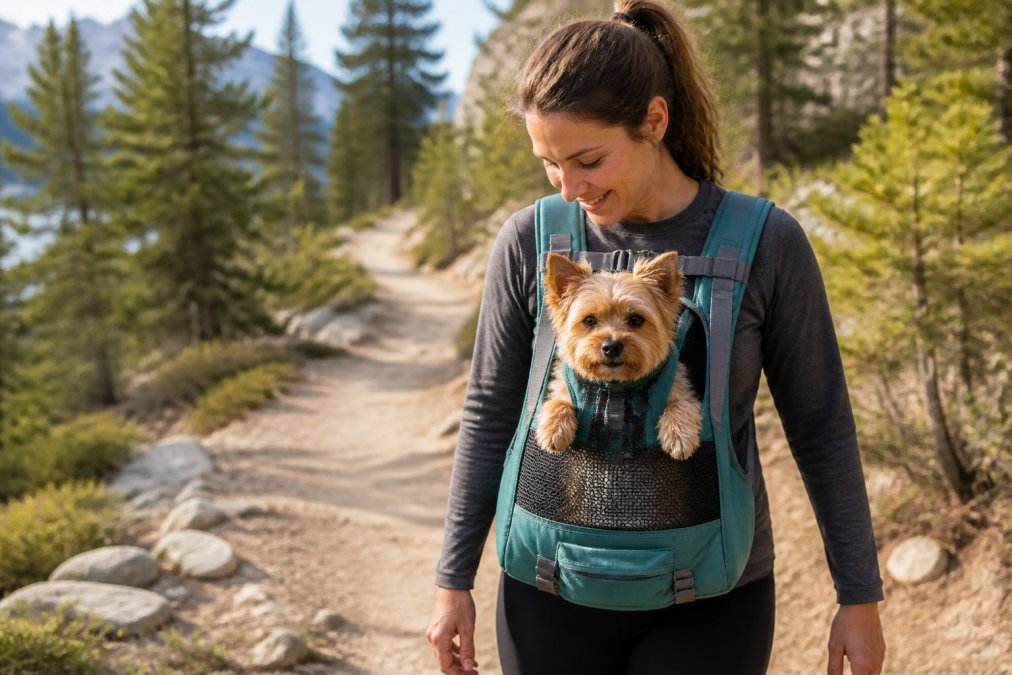
Slings still earn a place on the trail, but for a narrower job: short, flat walks and quick breaks.
Safe Pet Carrier Weight Limits: What Each Style Can Hold
Weight capacity separates the two styles cleanly. Slings are built for small pets, and the Proud Pet Shop Sidekick Sling is rated for pets up to 15 lbs.
| Carrier Style | Typical Weight Range | Best For | Load Path |
|---|---|---|---|
| Sling bag | Up to 15 lbs | Errands, vet visits, short walks | One shoulder, crossbody |
| Backpack carrier | Small to medium pets | Hiking, long treks, heavier pets | Both shoulders, hip belt |
How to Measure Your Dog for a Carrier (Fitment Guide)
Measuring your dog takes about five minutes and prevents the two most common fit problems: a carrier too tight for your pet to stand and turn, and one so loose your dog shifts around and throws off your balance.
- Body length: from the base of the neck to the base of the tail, along the spine.
- Chest girth: around the widest part of the ribcage, just behind the front legs.
- Standing height: from the floor to the top of the shoulders, so your dog can stand inside without crouching.
Durability, Ventilation, and Storage: What Actually Lasts
Durability in a pet carrier comes down to four things: fabric and stitching, hardware, ventilation design, and storage layout. A carrier that traps heat, fails at a buckle, or forces you to juggle a separate bag is one your dog learns to dread.
Fabric, Stitching, and Hardware: Where Carriers Fail
The failure points on any carrier are predictable, and almost never the main body panel: the stress seams where straps meet the bag, the zipper that takes the dog's weight, and the buckles and D-rings that carry the load.
- Fabric: Look for a tightly woven, high-denier synthetic (often coated polyester or nylon) rather than a thin, loose weave. A coated or water-resistant face fabric sheds trail dust and light rain; an uncoated one wicks mud into the weave and stains permanently.
- Stitching: Bar-tacked or box-X stitching at strap anchors spreads load across more fabric than a single straight seam. A single row of stitching at the shoulder-strap junction is the first thing to pull.
- Hardware: Metal D-rings and load-bearing buckles outlast molded plastic. On a sling, the single shoulder strap and its attachment point take 100% of the load, so that junction matters more than any other seam.
- Zippers: A zipper that runs the full length of the opening and locks at both ends resists a dog pushing outward better than a short zipper with a single pull.
Breathable Mesh, Safety Tethers, and Secure Closures
Ventilation and security separate a carrier your dog tolerates from one they fight. Breathable mesh panels keep air moving in warm weather, and a safety tether adds a second line of defense beyond the zipper or buckle.
Proud Pet Shop TrailFold Carrier →
Climate-Specific Ventilation: Why Humidity Changes the Answer
Most guides treat ventilation as a single checkbox. It is not, heat dissipation behaves differently in dry heat than in humid heat.
Storage Layout: Backpack vs Sling
Storage is the quiet differentiator. Backpack carriers typically include multiple pockets for treats, waste bags, and keys, so you are not juggling a separate bag. Slings carry less, fine for a quick trip, limiting on a full-day hike.
Breed Size, Climate, and Training: What Most Guides Skip
Three factors decide whether a carrier works long-term, and most buying guides skip all three: breed-specific ergonomics, climate, and training. Weight alone tells you almost nothing about fit.
Breed-Specific Ergonomics: Spine Length and Chest Width
Two dogs of the same weight can need completely different carriers. What matters is body proportions, spine length and chest depth, because those determine whether a dog can stand, sit, and turn inside a compartment sized only by pounds.
- Long-backed, short-legged breeds (Dachshunds, Corgis, Basset Hounds): a long spine needs a longer, flatter floor so the dog is not forced into a curve. A deep, bucket-style compartment will make a long-backed dog arch unnaturally.
- Deep-chested, narrow breeds (Greyhounds, Whippets, Boxers): chest girth runs large relative to weight, so a carrier sized by pounds alone will be too tight across the ribcage. Measure chest girth first and treat it as the binding constraint.
- Compact, broad-chested breeds (French Bulldogs, Pugs, Boston Terriers): front-heavy and often with restricted airways, these dogs need a wider, shallower compartment that lets them sit upright rather than lie flat, plus generous front ventilation.
- Small terriers and toy breeds (Jack Russells, Chihuahuas): light and compact, these are the dogs slings are built for, but a terrier that wants to sit up needs a sling with a structured, reinforced base rather than a soft hammock that collapses.
Long-Term Orthopedic Considerations
A carrier is not neutral for a dog's body. How a dog is supported over repeated carries affects the spine and hips.
Transition Training: A Step-by-Step Desensitization Plan
A dog that has never been inside a carrier will resist the first attempt, no matter how well it fits. Skipping training is the most common reason owners give up on a perfectly good carrier. Here is a sequence that works for most dogs:
- Leave it open on the floor for a few days. Let your dog sniff and investigate on their own terms. No forcing, no lifting.
- Reward voluntary entry. Toss a treat inside and let the dog step in to get it. Repeat until entering is easy and relaxed.
- Close it briefly, then open. With the dog inside and calm, close the closure for a few seconds, reward, and open. Build duration gradually.
- Lift and hold, stationary. Pick the carrier up with the dog inside and stand still for a few seconds. Reward calm behavior; put it down if the dog panics.
- Short practice carries at home. Walk a few steps, then a few laps of a room, rewarding a settled dog.
- First real trip, kept short. A 10-minute errand beats a two-hour hike for a first outing.
Frequently Asked Questions
Is a sling bag better than a backpack for small dogs?
It depends on duration and weight. A sling bag like the Proud Pet Shop Sidekick Sling ($28.99) holds pets up to 15 lbs and works well for quick errands, vet visits, and short walks where you want hands-free carrying. A backpack carrier distributes weight across both shoulders, which matters more as your dog gets heavier or the outing gets longer. For a 10 lb dog on a 20-minute errand, a sling is fine. For a 15 lb dog on a two-hour hike, a backpack wins.
Are sling bags safe for long-term dog transport?
Sling bags are designed for short-duration transport, not extended wear. One-sided carrying puts uneven load on your shoulder and back over time, and your dog sits in a single position without the structural support a backpack frame provides. The Sidekick Sling's soft buckle closure and breathable panel keep a small pet secure and cool during errands, but for anything past an hour or two, switch to a backpack carrier with padded shoulder straps and a hip belt.
How do I measure my dog for a carrier?
Measure three things: body length from base of neck to tail base, chest girth around the widest part of the ribcage, and standing height from floor to top of the head. Compare those numbers against the carrier's size chart. Your dog needs room to stand, sit, and turn around inside. The TrailFold Carrier comes in S, M, and L, and matching your dog's measurements to the right size prevents both cramped confinement and dangerous looseness. When between sizes, size up.
What features make a dog backpack carrier truly durable?
Look for reinforced stitching at strap attachment points, water-resistant fabric that holds up to mud and rain, quick-release buckles that do not crack under load, and a removable washable floor pad. The TrailFold Carrier ($34.99) includes breathable mesh panels, a safety leash attachment inside the main compartment, and multiple external pockets for treats and bags. Durability shows up in the details: hardware quality, seam construction, and how the carrier handles repeated loading and unloading.