
Table of Contents
- The Verdict: When a Dog Backpack Carrier Earns Its Place on the Trail
- Dog Backpack Carrier Weight Limits: Matching Your Dog to the Right Gear
- How to Train a Dog to Use a Backpack Carrier
- Dog Hiking Safety Tips for Carrier Users
- Weight Distribution for the Human: Protecting Your Own Back
- What to Carry: Emergency Prep and Weather-Specific Gear
- Frequently Asked Questions
Last Updated: September 12, 2026
The Verdict: When a Dog Backpack Carrier Earns Its Place on the Trail
A dog backpack carrier is a wearable pack that holds your dog securely against your body, letting you carry them hands-free over terrain they cannot handle. At Proudpetshop, we hear this question most from owners of small breeds, senior dogs, and pups recovering from injury. The honest answer: it is worth it when your dog's legs give out before your ambition does.
A ten-pound dog cannot cover six miles of rocky switchbacks. A carrier turns a three-mile walk into a real hike, keeps a senior dog on the trail after arthritis sets in, and lets a puppy come along before their joints are ready for distance.
But a carrier is not a magic solution. If your dog is 45 pounds, you are now carrying 45 pounds plus water plus gear. Below, we break down weight limits, fit, training, and the human-side load math.
Research from the American Kennel Club on canine exercise needs shows that exercise requirements vary enormously by breed and age, which is exactly why one carrier does not suit every dog.
Dog Backpack Carrier Weight Limits: Matching Your Dog to the Right Gear
Most soft-sided dog backpack carriers are built for dogs between roughly 8 and 25 pounds, with the ceiling set by the pack's structure and your own back (akc.org). The Proud Pet Shop TrailFold Carrier comes in S, M, and L, so you match measurements against a size rather than guessing from breed.

Exceeding the stated limit is the most common mistake: seams stress, straps dig in, and your dog sits lower in the pack, reducing airflow on hot days.
How to Measure Your Dog for a Carrier
Measure three things with a soft tape: back length from the base of the neck to the tail, chest girth at the widest point behind the front legs, and standing height at the shoulder. Compare against the size chart rather than ordering by weight alone, because a long-backed dog and a stocky dog of the same weight need different fits.
A carrier that is too small compresses the chest; one that is too large lets your dog shift on descents, throwing off your balance on loose rock.
Ventilation, Fit, and Posture: What to Check Before You Buy
Ventilation mesh on the sides and front is not a luxury feature, it is the difference between a comfortable dog and an overheated one. The TrailFold Carrier uses mesh panels on the sides and front, plus a removable, washable floor pad for mud and moisture.
Check for a safety leash attachment point inside the main compartment; without one, a sudden lunge can put your dog on the ground. Quick-release buckles and padded shoulder straps matter for you, not just your dog.
| Feature to Check | Why It Matters | What to Look For |
|---|---|---|
| Ventilation mesh | Prevents overheating | Panels on sides and front |
| Internal safety leash | Stops escape on sudden movement | Clip point inside main compartment |
| Adjustable straps | Distributes load off your neck | Padded shoulder straps, sternum strap, waist belt |
| Removable pad | Hygiene and comfort | Washable floor pad |
| Size range | Correct fit, not guesswork | S, M, L matched to measurements |
How to Train a Dog to Use a Backpack Carrier
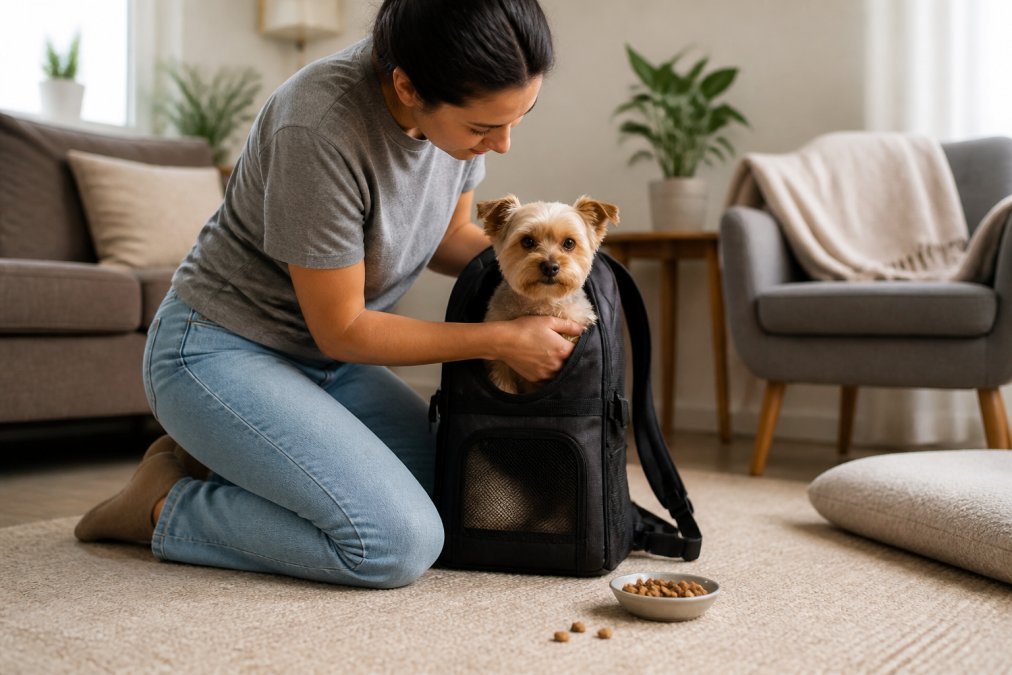
Training a dog to accept a backpack carrier takes one to two weeks of short, positive sessions, starting with the carrier on the floor and ending with short carries around the block. Rushing this step is why some dogs panic on the trail. The goal is a positive association, so the carrier predicts treats, praise, and forward motion.
A Session-by-Session Progression
Most trainers use a five-stage progression. Repeat each stage until your dog shows relaxed body language, soft eyes, loose tail, willing to take treats. If your dog stiffens, freezes, or tries to back out, you moved too fast; drop back one stage.
Stage 1, Carrier as furniture (days 1-3). Leave the carrier open on the floor with the top unzipped. Toss high-value treats inside and let your dog walk in and out freely, five to ten repetitions per day. The carrier should become a place where food appears, not where confinement happens.
Stage 2, Brief closure (days 3-5). With your dog standing inside, close the zipper for three to five seconds, feed a treat through the mesh, then open and release. Build to thirty seconds, then one minute. When your dog stops eating, open the pack, a dog taking treats inside the closed carrier is not panicking.
Stage 3, Movement on the ground (days 5-7). Lift the closed carrier a few inches off the floor and set it down. Then carry it across the room, then step outside for thirty seconds. The carrier moves, but your dog is not yet on your back.
Stage 4, Wearing it at home (days 7-10). Put the carrier on with your dog inside and stand still for two minutes, then walk the living room, then to the mailbox. Keep sessions under five minutes and end on a success.
Stage 5, Real walks (days 10-14). Start with a five-minute loop on familiar pavement, extending to fifteen minutes, then thirty. Introduce trail terrain only after your dog is calm on neighborhood walks.
Troubleshooting the Three Common Failure Modes
- Pawing at the mesh or trying to climb out. Usually a fit problem, not a training problem. Re-measure your dog and check the carrier is not compressing the chest or leaving room to shift.
- Stiffening or refusing to move once loaded. Often a balance issue. Try front-carry first, most dogs accept a front-facing position faster because they can see you. Switch to back-carry only once the dog is relaxed in front.
- Vocalizing or trembling. Stop the session immediately. Go back to Stage 1 for several days and rebuild the positive association; one bad carrier experience may need a full week of counter-conditioning before progressing again.
When to Transition from Carrier to Walking
A carrier is not a permanent solution for a healthy dog. The transition point depends on terrain and distance, not a fixed age. A common pattern: carry your dog on the climb and let them walk the descent, or carry on rocky sections and let them walk smooth dirt. When your dog asks to get out, pawing at the top, standing up, whining, honor that signal.
Dog Hiking Safety Tips for Carrier Users
Trail safety with a carrier comes down to three habits: keep the internal safety leash clipped at all times, check straps before every descent, and take your dog out every 45 to 60 minutes for bathroom breaks and leg stretches.
Watch for overheating. A dog in a pack cannot pant as effectively as one on the ground, so offer water often and check for heavy panting or a dark tongue. On warm days, hike early.
A National Park Service guide to hiking with pets notes that pets are restricted on many trails, so confirm the rules for your route before you load up. A carrier does not exempt you from leash laws.
For off-leash trailheads where your dog does get to run, the Proud Pet Shop Smart Finder Tag clips onto any standard collar and sends an alert to your phone when your dog moves out of range. It is a small addition that pays off on unfamiliar terrain.

Weight Distribution for the Human: Protecting Your Own Back
Weight distribution is where most buyers get it wrong. A dog carried low and far from your spine forces your shoulders to compensate, and after two miles that becomes lower back pain. The farther the load sits from your spine, the longer the lever arm and the more torque your shoulders and lower back resist. Keep the load high and close, and that torque drops.
This is the same principle as any framed hiking pack, except a dog shifts, pants, and occasionally lunges, so the load is never static. That makes proper adjustment more important, not less.
The Adjustment Sequence That Actually Works
Put the carrier on in this order. Skipping steps is why packs feel heavy after a mile.
- Loosen everything first. Shoulder straps, sternum strap, and waist belt should all be slack before you load the dog.
- Set the waist belt tight on your hip bones. The belt should sit on the iliac crest, the bony ridge at the top of your hips, not your stomach. Tighten until the pack's weight transfers to your hips and your shoulders feel light. This is the most important adjustment.
- Tighten the shoulder straps. They should hug your torso without pulling down. If your shoulders ache, the waist belt is too loose.
- Clip and adjust the sternum strap. It should sit across your upper chest, not your throat, and pull the shoulder straps together just enough to stop them sliding outward.
- Re-check after five minutes. Straps settle as you walk. A pack that felt right in the driveway often needs a second tightening at the trailhead.
Front-Carry vs. Back-Carry: The Real Trade-Off
- Front-carry mode keeps the load centered over your feet and lets you see and reassure your dog. It works well for dogs under about 15 pounds, but blocks your view of the trail immediately in front of you, which matters on technical terrain.
- Back-carry mode handles heavier loads and longer treks but needs a tighter waist belt and higher carry position. A dog carried low on your back pulls your center of gravity backward, which is dangerous on steep descents.
- Shift the pack higher on your back for steep descents to keep your center of gravity over your feet. On steep climbs, a slightly lower position can feel more stable.
The Emergency-Preparedness Angle Most Guides Miss
A carrier is not just a convenience item, it is a safety tool. If your dog injures a paw, overheats, or refuses to move three miles from the trailhead, the carrier is how you get them out.
- Practice carrying your dog before you need to. A dog that has never been in the carrier will fight it during an emergency. The training sessions above are also emergency drills.
- Know your loaded carry distance. Put your dog in the carrier, add water and gear, and walk a mile on flat ground. If that mile is not comfortable, you cannot cover three miles back to the trailhead in an emergency.
- Carry a slip lead even when your dog is in the pack. If you need to set the carrier down and walk your dog out, you need a way to control them.
- Tell someone your route and expected return time. A carrier adds weight and slows your pace. Build that into your plan.
The Proud Pet Shop Sidekick Sling takes a different approach for shorter outings, holding pets up to 15 pounds against your body with an adjustable strap and breathable panel. For a two-mile walk or a vet visit, a sling is lighter and faster than a full backpack, but for a real hike where an emergency could strand you, a structured carrier with a waist belt is safer.

What to Carry: Emergency Prep and Weather-Specific Gear
Emergency prep and weather gear are the two areas most carrier users overlook. Pack for your dog the way you pack for yourself, because a carried dog cannot drink from a stream or find shade on their own.
- Collapsible water bowl and at least one liter of water for a medium hike
- A slip lead in case you need to set the carrier down and walk your dog out
- Paw protection for hot rock or snow, and a small towel for wet fur
- A basic pet first-aid kit with gauze, vet wrap, and tweezers
- A reflective harness for low-light sections, like the Proud Pet Shop No-Pull Adventure Harness with reflective stitching
Weather changes the plan. In summer, hike early and favor shaded routes. In cold or wet conditions, breathable mesh can chill a wet dog quickly, so dry your dog before loading up and consider a light fleece layer underneath.
That is the honest verdict. A dog backpack carrier is worth it when your dog is small, senior, injured, or not built for the mileage you want to cover. It is not worth it if you are carrying a large dog over serious elevation, or have not trained your dog to accept it.
The real challenge is not deciding whether a carrier works, but finding one that fits your dog properly and holds up past the first season. Proudpetshop builds gear for exactly that: the TrailFold Carrier with ventilation mesh, an internal safety leash, and a washable removable pad; the Sidekick Sling for quick hands-free errands; and the No-Pull Adventure Harness with reflective stitching for the sections where your dog walks. Every order ships free over $50 and comes with a 30-day satisfaction guarantee. Get started with Proudpetshop and gear up for the trail your dog has been waiting for.
Frequently Asked Questions
Are dog backpack carriers safe for long hikes?
For small dogs under 15-20 lbs, a well-fitted carrier with ventilation mesh and a secure harness attachment is safe for several hours of hiking, provided you take breaks. Larger or heavier dogs strain both the carrier and your back. Check that your dog can stand, sit, and turn inside the compartment, and never leave them zipped in for more than two to three hours without a rest. A safety leash clipped inside the carrier prevents sudden jumps.
At what age should a dog stop using a backpack carrier?
Senior dogs with mobility issues often benefit most from a carrier, so there is no fixed cutoff age. The deciding factors are weight, joint health, and stamina. A dog with hip dysplasia or arthritis may need carrier support on rocky or steep terrain even at 8-10 years old. Puppies under 6 months should only ride short distances while their joints develop. Talk to your vet about your dog's specific orthopedic needs before committing to longer hikes.
How do I know if a dog carrier backpack fits my dog correctly?
Your dog should be able to stand, sit, turn around, and lie down inside without their head pressing against the top. Measure your dog's length from neck to tail base and their height at the shoulder, then compare against the carrier's size chart. Look for adjustable straps, a sternum strap, and a waist belt on the human side. Ventilation mesh on at least two sides is essential. If your dog's paws or head poke out awkwardly, size up.
Can a dog backpack carrier cause back problems for the pet?
A properly sized carrier with a firm, removable pad and adequate ventilation will not cause spinal issues. Problems arise when the carrier is too small, forcing the dog into a curled position for extended periods, or when the human's pack shifts and jostles the dog. Choose a carrier with a flat, padded floor and secure harness attachment. For dogs with existing back conditions, limit carry time and consult your vet about whether a carrier or a stroller is the better option.
How long can a dog stay in a backpack carrier while hiking?
Most dogs do well in a carrier for one to two hours at a time, followed by a 15-20 minute break where they walk on leash or rest. Total carry time depends on your dog's size, age, and fitness. A 10 lb dog in cool weather can handle longer stretches than a 20 lb dog in summer heat. Watch for panting, restlessness, or drooling, which signal your dog needs out. On full-day hikes, plan to carry your dog no more than half the total trail time.