
Table of Contents
- What to Look for in a Durable Leash for Strong Pulling Dogs
- Heavy Duty Dog Leash With Traffic Handle: Why Two Handles Beat One
- Bungee Leash for Large Dogs: Shock Absorption That Protects Joints
- How to Stop a Dog From Pulling on the Leash: Training That Sticks
- Breed-Specific Force Requirements: Matching Gear to Your Dog
- Leash Length, Safety Features, and Comfort for Daily Walks
- Frequently Asked Questions
Last Updated: September 11, 2026
What to Look for in a Durable Leash for Strong Pulling Dogs
The right durable leash for strong pulling dogs comes down to three specs most product pages bury: break strength, hardware rating, and webbing construction. A leash that fails any one of those three is a leash that fails your shoulder, your grip, and possibly your dog's safety on a busy street.
This guide from Proudpetshop walks through the mechanics of pulling, not just a list of features. Below, we'll show you exactly how to match gear to your dog's actual force output, where cheap leashes break, and which setups hold up.
Most buyers compare color and length. That's backwards. The spec that matters most is one almost nobody lists.
Weight-to-Strength Ratio: The Spec Most Buyers Miss
Weight-to-strength ratio is the relationship between a leash's physical weight and the load it can hold before failing. A 25-gram webbing rated to 500 pounds outperforms a bulky strap rated to 200 pounds, and the lighter one is easier to grip during a sudden lunge.
A common mistake is assuming thicker means stronger. In practice, tightly woven narrow webbing with reinforced stitching at the handle and clip often beats a wide, loosely woven strap. Check the stated break strength, then check whether the hardware matches it. A 500-pound leash with a 150-pound clip fails at the clip, every time.
- Webbing break strength: look for a stated figure, not a vague claim
- Hardware rating: the clip must match or exceed the webbing
- Stitching pattern: box-X stitching at stress points resists unraveling
Biothane vs. Nylon vs. Rope: Which Material Holds Up to a Puller
Material choice decides how a leash behaves under sustained load, and the three common options trade off differently. Most buyers pick on looks; the material is what determines whether the leash stretches, cuts your hand, or holds its shape after a year of hard walks.
Nylon webbing is the default for a reason. It's inexpensive, widely available, and a tightly woven flat nylon rated around 1 inch wide typically carries a break strength in the several-hundred-pound range. The trade-offs: nylon absorbs water and odor, it can fray at a cut edge if the manufacturer doesn't heat-seal it, and a bare nylon handle bites into your palm on a hard pull. Nylon also has a small amount of stretch, which softens shock slightly but can feel mushy for precise heel work.
Biothane (a coated webbing, often polyester core with a polymer coating) is the material serious puller owners gravitate to. It's waterproof, wipes clean with a damp cloth, resists odor, and doesn't absorb mud the way nylon does. It has essentially no stretch, so the leash feels direct and predictable, good for training cues, less forgiving on a sudden lunge. Biothane is heavier per foot than nylon and costs more, and the coating can crack over time if the leash is stored coiled tightly in freezing temperatures.
Rope leashes (typically climbing-grade or marine-grade braided rope) offer excellent grip and a natural shock-absorbing feel because the braid can flex. A rope leash is comfortable to hold and doesn't cut into the hand the way flat webbing can. The downsides: rope is bulkier, it soaks up water and dirt, and a rope handle without a padded grip can chafe on a long walk. Rope also tends to be the heaviest option per foot, which matters if you're managing a reactive dog one-handed.
| Material | Stretch | Water/odor resistance | Grip comfort | Best for |
|---|---|---|---|---|
| Nylon webbing | Slight | Low | Moderate (padded handle helps) | Everyday walks, budget builds |
| Biothane | None | High | Firm, direct | Training, wet/muddy conditions |
| Rope | Moderate (braid flex) | Low | High | Comfort-focused daily use |
A practical pattern: if your dog pulls hard and you walk in wet or muddy conditions, Biothane's wipe-clean surface and zero stretch give you the most predictable control. If you want a softer feel and don't mind re-washing gear, rope is the most comfortable to hold. Nylon is the value pick as long as the stitching and hardware are sound.
Failure Point Testing: Where Leashes Actually Break
Leashes rarely snap mid-length. They fail at three predictable points: the handle seam, the clip gate, and the D-ring connection on the collar or harness. Testing these before you trust them on a walk takes about 60 seconds.
Give the leash a firm, steady pull (not a jerk) with your dog safely clipped in and standing still. Watch the clip gate for any flex. Twist the handle seam between your fingers. If anything feels loose, return it.
A locking carabiner solves the clip-gate problem entirely (osha.gov). The trade-off: it takes two hands to operate, which matters if you're managing a reactive dog one-handed.
| Failure Point | What to Check | Warning Sign |
|---|---|---|
| Handle seam | Box-X stitching, no flex | Loose or single-row stitching |
| Clip gate | Gate closes flush, no play | Gate flexes or sticks open |
| D-ring connection | Welded, thick gauge | Thin wire, visible gap |
Heavy Duty Dog Leash With Traffic Handle: Why Two Handles Beat One
A heavy duty dog leash with traffic handle gives you a second grip point roughly 12 to 18 inches from the clip, which is the single biggest control upgrade for a strong puller (akc.org). When your dog lunges toward a squirrel or another dog, you grab the traffic handle instead of the end loop. Your hand moves closer to the dog, your arm stops extending, and you regain use in under a second.
The alternative, wrapping the main loop around your wrist, is how people get wrist injuries and rope burns. Most trainers discourage it outright.
What most guides miss: the traffic handle needs padding too. A bare nylon traffic handle digs into your palm exactly when you're pulling hardest. Look for neoprene lining or a padded grip on both handles.
Bungee Leash for Large Dogs: Shock Absorption That Protects Joints
A bungee leash for large dogs absorbs part of the shock when your dog hits the end of the line, spreading that force over a longer distance instead of delivering it all at once. The benefit runs both directions: less jarring on your shoulder and back, and less sudden impact on your dog's neck and joints.
Shock absorption is not a substitute for training, though. A bungee leash stretches under load, which means a dog that pulls constantly gets a slightly elastic response that can feel like permission to keep pulling. Use bungee leashes for dogs that lunge occasionally, not for dogs that lean into the leash for the entire walk.
One honest limitation: bungee leashes are harder to use for precise heel work. The stretch makes fine position cues mushy.
How to Stop a Dog From Pulling on the Leash: Training That Sticks
How to stop a dog from pulling on the leash starts with one rule: the walk stops the moment the leash goes tight. Every time you keep walking while your dog pulls, you pay the behavior. Every time you stop, you remove the reward.
The mechanics are simple. The consistency is not.
- Stand still the instant tension appears. No tugging back.
- Wait for the leash to slacken, even slightly.
- Mark the slack with a "yes" and step forward.
- Repeat for the entire walk. Expect the first few walks to cover very little ground.
Positive reinforcement beats correction here because you're teaching a replacement behavior, not suppressing one. A dog that learns "loose leash equals forward motion" stops pulling because pulling literally stops working.
Pairing Training With the Right No-Pull Harness
Training moves faster when the gear stops rewarding the pull. A front-clip harness redirects tension sideways, turning your dog back toward you instead of letting them lean forward into the pressure. The Proud Pet Shop No-Pull Adventure Harness uses exactly that front-clip configuration, with padded, breathable construction and multi-point adjustment for dogs that sit between sizes. At $37.99, it's the cheapest lever you can pull on pulling behavior.

A martingale collar or head collar can work for some dogs, but a front-clip harness is the safer default for strong pullers because it never loads the neck.
Breed-Specific Force Requirements: Matching Gear to Your Dog
Breed-specific force requirements matter because a 60-pound Labrador and a 60-pound German Shepherd do not pull with the same intensity. Dogs bred for drafting, guarding, or herding generate more sustained forward force at the same body weight, which means the same leash that holds one dog may not hold the other.
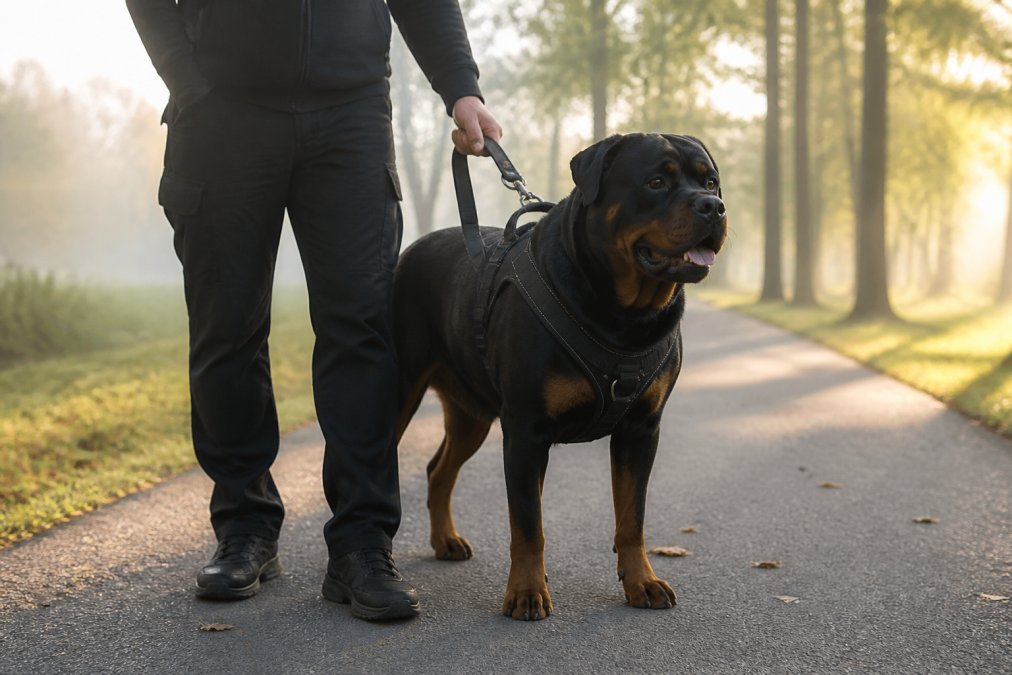
As a starting point, match gear to pulling style rather than breed alone:
- Sustained drafters (Bernese Mountain Dog, Newfoundland): high break strength plus a padded traffic handle
- Reactive lungers (German Shepherd, Belgian Malinois): locking carabiner and a second grip point
- Prey-driven sprinters (Husky, Greyhound): shock absorption plus a front-clip harness
Leash Length, Safety Features, and Comfort for Daily Walks
Leash length is a control trade-off, and the right number depends on where you walk and how much force your dog generates. A 4-foot leash gives you the most walking control and works best for training and busy streets, your hand stays close to the clip, so a lunge travels less distance before you can counter it. A 6-foot leash is the standard all-rounder and the length most trainers default to for general walks. Anything longer belongs in a park, not on a sidewalk: every extra foot of slack is extra distance your dog accelerates through before the leash goes tight.
For a strong puller, err shorter. A 4-foot leash paired with a traffic handle gives you two grip points within arm's reach, which is the configuration that keeps a sudden lunge from turning into a full-body jerk on your shoulder.
Safety Features Worth Paying For
High-visibility reflective stitching is the one upgrade worth paying for if you walk at dawn or dusk. It costs almost nothing to add and makes you visible to drivers. Beyond reflectivity, a few features matter specifically for pullers:
- A locking clip or carabiner so the gate can't be worked open by a twisting, thrashing dog.
- A swivel at the clip so the leash doesn't spiral into a twisted cord when your dog circles, a twisted leash concentrates load on one edge of the webbing.
- A padded traffic handle as a second grip point, not just a decorative loop.
- A visible color on the leash body; dark leashes disappear against pavement at night even with reflective thread.
Comfort: The Handle Is Where Walks Are Won or Lost
Comfort comes down to the handle. An ergonomic handle with padding reduces hand fatigue on long walks, and a swivel at the clip stops the leash from twisting into a spiral when your dog circles. Both matter more than most buyers expect on a daily-use leash.
A common pattern among owners of strong pullers is hand and wrist soreness that builds over weeks rather than appearing after one walk. The fix is usually two things: a padded handle wide enough to spread load across the palm instead of a thin cord cutting into the fingers, and a second grip point so you're not white-knuckling the end loop the entire walk. If you feel the leash digging into a single finger, the handle is too narrow for your dog's pull.
Maintenance and Cleaning: Making Gear Last
A durable leash stays durable only if you maintain it. The routine is short:
- Rinse after wet or muddy walks. Nylon and rope hold grit that abrades fibers from the inside; a quick rinse and air-dry slows that wear. Biothane just needs a wipe.
- Inspect stitching monthly. Run your thumb along both the handle seam and the clip attachment. Any fraying, loose thread, or stiff spot is a warning sign.
- Check the clip gate. It should snap closed flush with no side-to-side play. A gate that sticks open or wobbles is a replacement, not a repair.
- Retire the leash after a hard failure. If a seam has pulled or a clip has bent, don't trust the rest of the leash, the same load that damaged one point stressed the others.
Frequently Asked Questions
What is the best leash for a strong dog that pulls?
The best setup pairs a durable leash with a front-clip no-pull harness. A front-clip harness like the Proud Pet Shop No-Pull Adventure Harness ($37.99) redirects pulling force sideways, turning your dog back toward you instead of letting them drag forward. Combine that with a heavy-duty leash that has a traffic handle for close control in tight spots. This two-part system works better than any leash alone because it changes the physics of the pull, not just the strength of the material.
Are rope leashes or nylon leashes better for strong dogs?
Both work if the hardware matches the pull. Nylon webbing is lighter and easier to grip when wet, but it can fray over time with heavy pullers. Climbing rope resists abrasion and holds up to weather, though it can be harder to grip in rain. What matters more than the material is the clip: look for a locking carabiner or a reinforced swivel snap rated well above your dog's weight. A cheap clip on expensive webbing is still a failure point.
Should I use a bungee leash for a dog that pulls?
A bungee leash absorbs shock, which protects your shoulders, back, and your dog's joints during sudden lunges. It is a good fit for large dogs that surge forward, especially on runs or hikes. The trade-off is reduced precision: the stretch makes it harder to give quick, tight corrections during leash training. Many owners use a bungee leash for exercise and switch to a fixed-length leash for training sessions so the feedback stays consistent.
What is the safest leash length for training a strong puller?
A 4-foot to 6-foot fixed leash gives you the most control during training. Longer leashes let a strong dog build momentum before the leash goes taut, which makes stopping harder and puts more strain on your arm. A traffic handle near the clip lets you shorten the leash to a few inches when you need your dog close, like crossing a street or passing another dog. Save the long line for recall practice in enclosed spaces.
A strong puller exposes every weak point in cheap gear, from the handle seam to the clip gate. Proudpetshop stocks durable walking gear built for exactly that wear, including the No-Pull Adventure Harness with front-clip control, padded construction, and multi-point adjustment, all backed by a 30-day satisfaction guarantee and free shipping on orders over $50. Get started with Proudpetshop and put a setup on your dog that holds up walk after walk.