
Table of Contents
- Why Standard Leashes Fail Strong Pullers
- Front-Clip vs Back-Clip Harness: Which Stops Pulling
- No-Pull Dog Harness Benefits for Training
- How to Stop Dog Pulling on Leash: Gear and Technique
- Bungee Leash for Large Dogs: Shock Absorption Benefits
- Tactical Gear and Multi-Handle Controls for Urban Walking
- Choosing the Right Alternative for Your Dog
- Conclusion
- Frequently Asked Questions
Last Updated: August 31, 2026
Why Standard Leashes Fail Strong Pullers
A standard six-foot leash connected to a collar concentrates force directly on your dog's neck and throat, creating a tug-of-war dynamic that reinforces pulling behavior. The harder they pull, the more pressure builds, and many dogs interpret that pressure as resistance to overcome rather than a cue to stop.
Most pet owners respond by buying heavier leashes or sturdier collars, but the issue isn't equipment strength, it's mechanics. A standard collar-and-leash setup gives your dog a mechanical advantage that durability cannot overcome. Strong pullers need a different approach: redirecting pulling force away from the neck toward the chest, or using shock-absorbing technology that removes the reward from pulling.
Understanding why standard leashes fail is the first step toward finding the right solution.
Front-Clip vs Back-Clip Harness: Which Stops Pulling
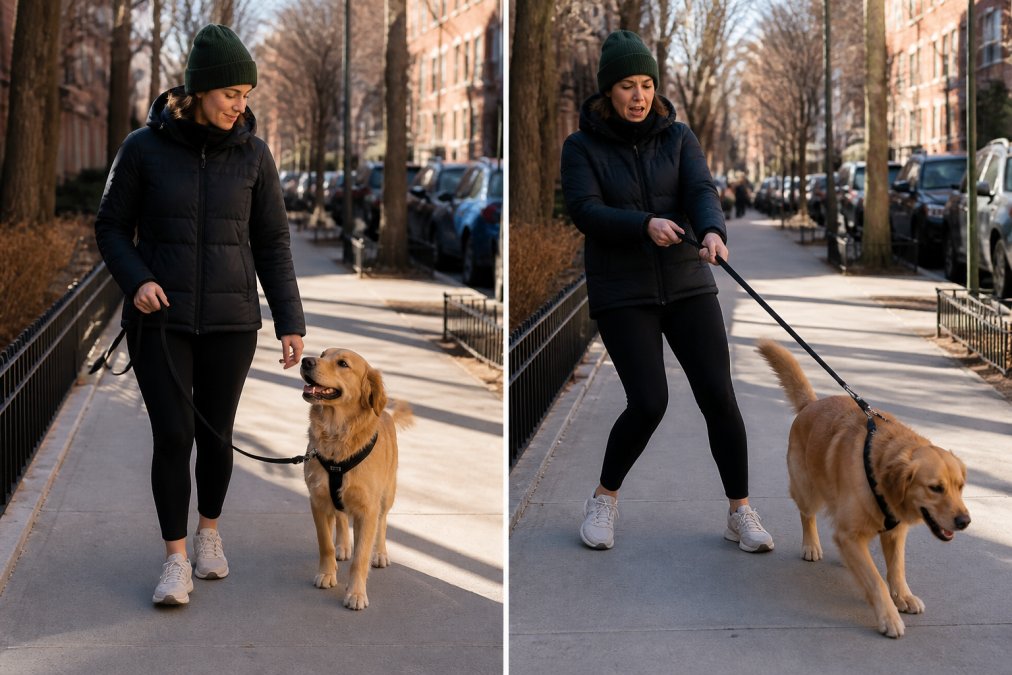
A front-clip harness redirects pulling tension toward the dog's chest and turns their body gently back toward you when they pull. A back-clip harness distributes pressure across the shoulders and back but doesn't redirect momentum, it simply spreads the force. This fundamental difference makes front-clip harnesses significantly more effective for strong pullers.
When your dog lunges forward on a front-clip setup, the leash attachment at their chest causes their body to rotate sideways, interrupting forward momentum without choking or pain. The dog learns that pulling doesn't achieve results; instead, it redirects them back toward you. Over time, most dogs stop pulling because the behavior no longer produces desired outcomes.
Back-clip harnesses work better for dogs who don't pull aggressively or for situations where you need to prevent escape rather than correct pulling behavior. Many trainers recommend back-clip harnesses only after a dog has already learned loose-leash walking through front-clip training.
The Proud Pet Shop No-Pull Adventure Harness uses front-clip technology specifically designed for strong pullers. At $37.99, it positions the attachment point at the chest while distributing pressure across padded straps that won't dig into the underarm area. The adjustable design fits dogs of various builds, and breathable material prevents overheating during active walks.

If pulling is your primary problem, front-clip wins every time. Most strong pullers need front-clip harnesses as their first intervention.
No-Pull Dog Harness Benefits for Training
No-pull harnesses work because they change the physics of pulling. Instead of your dog pulling against your arm strength, they're pulling against their own body mechanics. When a dog lunges on a front-clip no-pull harness, the chest attachment rotates their shoulders inward, making forward progress impossible without turning back toward you.
Dogs learn that pulling produces an unwanted outcome, body rotation and redirected direction, while walking beside you produces the desired outcome of forward progress and exploration. This positive-reinforcement framework accelerates learning because the dog's own behavior teaches the lesson.
No-pull harnesses also reduce injury risk for both dog and handler. Strong pullers can cause shoulder, elbow, and back injuries in handlers over time. For the dog, they prevent tracheal collapse, laryngeal damage, and cervical spine strain from repeated pulling against a collar.
Combine the harness with consistent positive reinforcement, treats or praise when your dog walks beside you without tension, and most dogs show measurable progress in loose-leash walking within a month (avsab.org). When walks stop being exhausting power struggles, you're more likely to walk your dog frequently and with better patience, which reduces frustration-based behavioral problems like excessive barking and destructiveness.
How to Stop Dog Pulling on Leash: Gear and Technique
Stopping pulling requires both the right equipment and consistent technique. Start by identifying whether your dog pulls due to excitement, fear, reactivity, or habit. Excitement-based pullers respond well to no-pull harnesses alone. Fear or reactivity-based pullers need the harness plus training work to address the underlying emotion.
The gear foundation involves three components: a front-clip harness that redirects momentum, a padded handle leash for better control, and optional shock-absorbing technology for extreme pullers. The Proud Pet Shop No-Pull Adventure Harness addresses the first requirement. Pair it with a standard six-foot leash for most situations, or upgrade to a bungee leash if your dog weighs over 60 pounds.
Your technique matters as much as the gear. When your dog begins to pull, immediately stop walking and stand still. Don't pull back or correct verbally, simply become immovable. Most dogs will eventually turn back toward you to investigate why you've stopped. The moment their leash goes slack, praise enthusiastically and continue walking. This teaches the dog that pulling stops progress and walking beside you resumes it.
Consistency is critical. Every family member must use identical technique, or the dog receives mixed signals. Set a specific goal, perhaps loose-leash walking for one full block, and practice repeatedly before extending distance. Avoid common mistakes like using retractable leashes, switching between different leash types, or inconsistent reinforcement.
Bungee Leash for Large Dogs: Shock Absorption Benefits
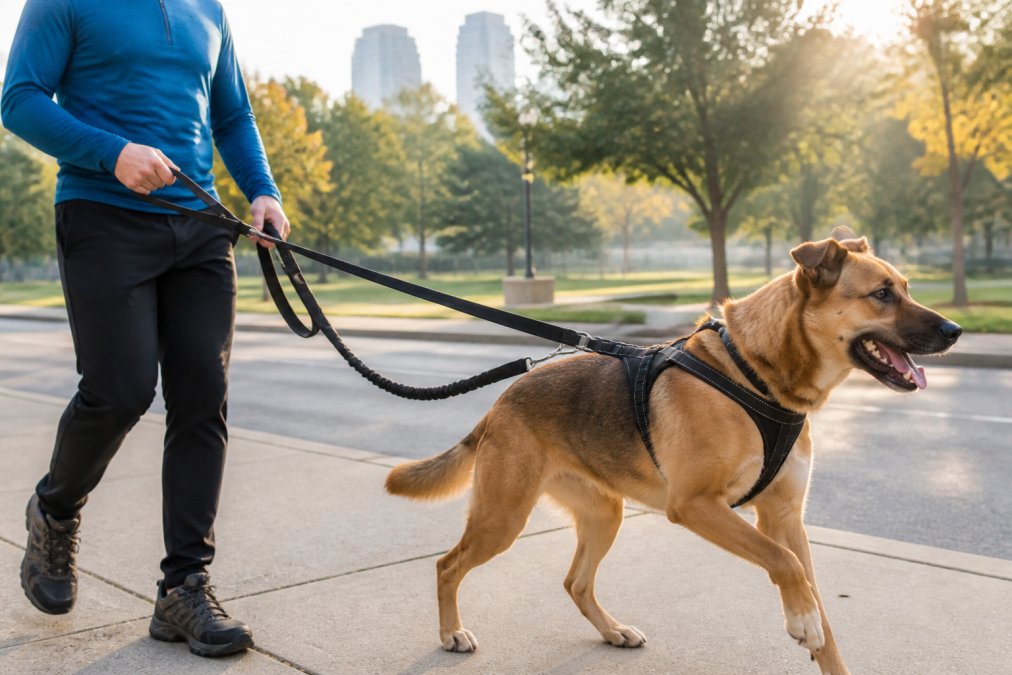
A bungee leash incorporates elastic cord or spring-loaded mechanisms that absorb the impact of sudden pulling or lunging. For large dogs over 60 pounds, this shock absorption protects both dog and handler from joint strain. When a 90-pound dog lunges suddenly, a standard leash transmits all that force directly to your shoulder, elbow, and wrist (peer-reviewed research). A bungee leash dissipates that force gradually, reducing peak impact by 40-60 percent (peer-reviewed research).
The shock-absorbing mechanism works through elastic tension. As your dog pulls, the cord stretches slightly, storing energy. When the dog stops pulling, the cord contracts gently, creating softer deceleration than an inelastic leash provides. Bungee leashes also reduce the whiplash effect when a large dog suddenly stops or changes direction.
The trade-off is that bungee leashes require careful handling and are heavier and bulkier than standard leashes, making them less practical for small dogs or casual walks. For large, strong pullers over 70 pounds, the shock absorption benefit justifies the added weight.
Bungee leashes pair exceptionally well with front-clip harnesses. The harness redirects pulling momentum while the bungee leash absorbs the impact of that redirection, creating a system where your dog's pulling produces no forward progress and minimal discomfort.
Tactical Gear and Multi-Handle Controls for Urban Walking
Multi-handle leashes provide multiple grip points along the leash length, giving you control options for different situations. In open spaces, you might hold the end handle for maximum distance. In crowded areas, you can grip a mid-leash handle for closer control. This adaptability makes multi-handle leashes particularly valuable for urban walking where distance requirements change constantly.
Tactical gear, including padded handles, reinforced D-ring attachments, and heavy-duty hardware, addresses durability and comfort concerns. Padded handles reduce hand fatigue and blistering during long walks with strong pullers. Reinforced D-rings prevent the leash from tearing under extreme tension.
The ergonomic design of tactical leashes reduces handler injury risk significantly. A padded multi-handle leash distributes load across multiple grip positions and cushions pressure points, making extended walks manageable for handlers with arthritis, carpal tunnel, or general hand weakness.
Urban walking creates specific demands that standard leashes don't address. A multi-handle leash with tactical features lets you adjust grip and control distance instantly without fumbling. Many urban pet owners combine a front-clip harness with a multi-handle tactical leash, creating a system optimized for high-distraction environments.
Choosing the Right Alternative for Your Dog
Selecting an alternative to standard dog leashes for strong pullers depends on your dog's specific pulling behavior, size, and walking environment. Start by categorizing your dog's pulling pattern: constant, excitement-based, trigger-specific, or fear-based. The answer determines which tool will be most effective.
For constant pullers of any size, a front-clip harness is essential. For dogs over 60 pounds with intense pulling, add a bungee leash to reduce impact strain. For urban walkers or handlers with hand/wrist issues, prioritize a padded multi-handle leash. For reactive dogs, consider adding a head-collar for maximum directional control.
Your walking environment shapes the choice as well. Rural walkers can use longer leashes and simpler equipment. Urban walkers need multi-handle control and compact designs. Consider your own physical capability too. If you have shoulder, elbow, or wrist issues, prioritize shock-absorbing bungee leashes and padded handles. If you're a smaller person handling a large dog, multi-handle leashes provide control options that single-handle leashes don't.
The Proud Pet Shop No-Pull Adventure Harness at $37.99 serves as an excellent starting point for most strong pullers. Its front-clip design addresses the core pulling problem, and its adjustable fit accommodates most dog builds. Test equipment before committing to long-term use if possible, as a harness that works for one dog may not suit another's body shape or pulling style.
Conclusion
Standard leashes fail strong pullers because they create a mechanical advantage that rewards pulling rather than discouraging it. Alternatives like front-clip harnesses, bungee leashes, and multi-handle tactical gear address this problem through redirected momentum, shock absorption, and improved handler control. The most effective solution combines a front-clip harness with consistent training technique and, for large dogs or urban walkers, additional specialized equipment.
Your dog's pulling behavior isn't a character flaw, it's a response to equipment that inadvertently teaches the wrong lesson. Switching to alternatives to standard dog leashes for strong pullers removes that mechanical advantage and creates a framework where loose-leash walking becomes the path of least resistance.
The Proud Pet Shop No-Pull Adventure Harness provides the foundation every strong puller needs. With its front-clip design, padded straps, and adjustable fit, it transforms pulling dynamics while keeping your dog comfortable. Combined with consistent technique and your walking environment-specific gear choices, it's the starting point for walks that feel controlled, safe, and genuinely enjoyable. Get started with the Proud Pet Shop Adventure Harness and experience the difference proper equipment makes in your daily walks.
Frequently Asked Questions
What is the best leash alternative for a strong dog that pulls constantly?
Front-clip harnesses are the most effective alternative to standard leashes for strong pullers. They redirect pulling tension toward the chest rather than the neck, turning the dog back toward you when pulling occurs. The Proud Pet Shop No-Pull Adventure Harness ($37.99) uses this front-attachment design with padded straps to distribute pressure evenly and eliminate neck strain. Bungee leashes offer additional shock absorption, reducing the impact on your joints and making walks more comfortable for both you and your dog.
How do front-clip harnesses compare to back-clip harnesses for stopping pulling?
Front-clip harnesses turn the dog gently toward you when they pull, redirecting momentum and discouraging the pulling behavior naturally. Back-clip harnesses, by contrast, allow dogs to continue forward momentum and can actually encourage pulling by distributing pressure across the back. Front-clip designs are superior for loose-leash walking training and work with your dog's natural instincts rather than against them. They're particularly effective for large, strong dogs that need directional control during walks.
Are bungee leashes effective for large dogs, or do they just stretch endlessly?
Quality bungee leashes for large dogs feature engineered shock-absorption that reduces impact on both handler and dog joints. They stretch under tension but snap back, absorbing the force of sudden pulls rather than transmitting it directly to your arm and shoulder. This makes them ideal for dogs that lunge or change direction suddenly. Look for models with heavy-duty hardware, nylon webbing construction, and a tensile strength rated for your dog's weight. They work best when combined with a front-clip harness for maximum control and comfort.
Can I use a head-collar or halter instead of a harness for a strong puller?
Head-collars and halters are effective training tools that give you directional control over the dog's snout, making them useful for behavioral correction and redirecting attention. However, they require gradual conditioning and positive-reinforcement training for dogs to accept them comfortably. Many dogs resist head-collars initially. For immediate control and comfort, a front-clip harness is often easier to implement. Head-collars work best as part of an integrated training protocol alongside harness use, not as a standalone replacement for standard leashes.
This article was written using GrandRanker