
Table of Contents
- Step 1: Prep the Cover and Remove Loose Debris
- Step 2: The Best Way to Remove Dog Hair from Car Upholstery
- Step 3: Machine Washing Your Pet Car Seat Cover
- Step 4: Hand Washing and Spot Cleaning for Quick Fixes
- Step 5: How to Deodorize Pet Car Seat Covers
- Step 6: Removing Pet Urine Stains from Car Seats
- Step 7: Drying, Reinstallation, and Maintenance Schedule
- Frequently Asked Questions
Last Updated: October 3, 2026
Step 1: Prep the Cover and Remove Loose Debris
Learning how to clean pet car seat cover fabric starts with one boring but vital step: get the dry mess off before any liquid touches it. Water turns loose hair and dirt into a paste that works deeper into the fibers. Once that happens, the job gets twice as hard.
Here is the order that works:
- Park in the shade and let the cover cool down.
- Take the cover off the seat if it is removable.
- Shake it outdoors, away from your car.
- Vacuum both sides with a handheld vacuum and an upholstery attachment.
- Check the seams and storage pockets, where debris hides.
Most covers need five to ten minutes of dry prep. That is it.
Step 2: The Best Way to Remove Dog Hair from Car Upholstery
The best way to remove dog hair from car upholstery is mechanical, not chemical. Hair clings to fabric through static and friction, so you need tools that grab and lift it, not soap.
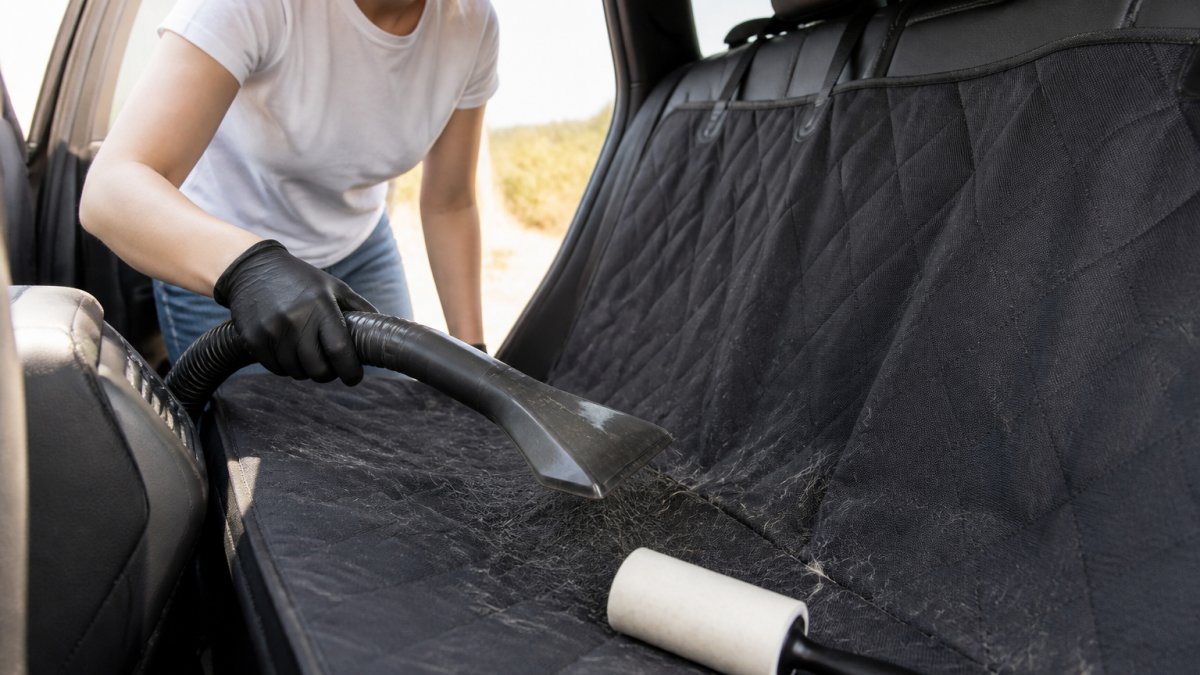
Here are the tools that actually work, ranked by how well they perform:
- Rubber gloves or a rubber brush: dampen slightly, then wipe in one direction. Static lifts the hair into clumps.
- Handheld vacuum with a rubber nozzle: best for large areas and deep seams.
- Lint roller: perfect for a quick pass before passengers get in.
- Squeegee: pulls embedded hair out of synthetic fibers fast.
Work in one direction. Scrubbing back and forth just pushes hair deeper.
Step 3: Machine Washing Your Pet Car Seat Cover
A machine washable cover is the easiest to care for, but "machine washable" does not mean every cover gets the same cycle. Canvas, polyester, and quilted covers behave differently in the drum, and treating them identically is how covers come out pilled, shrunken, or with a cracked waterproof backing. Match the cycle to the material first.
Read the care tag, then match the material
- Polyester and polyester blends: the most forgiving. Cold water, gentle cycle, mild detergent. These fibers resist shrinking and dry fast.
- Canvas (cotton or cotton-poly): heavier and more absorbent, so it holds more water and takes longer to dry. Use cold water and a gentle cycle, but expect a longer air-dry time and some softening over the first few washes.
- Quilted covers (fabric over a padded layer): the quilted stitching and inner batting are the weak points. A gentle cycle is fine, but a wash bag or pillowcase protects the stitching from snagging on the agitator.
- Waterproof-backed covers: the laminated backing is the part that fails first. Cold water only, no dryer, and no fabric softener, which leaves a residue that breaks down the coating.
The full process
- Shake off loose debris outside.
- Close all zippers and fasten straps so they do not snag.
- Place quilted or waterproof-backed covers inside a mesh wash bag or a pillowcase.
- Use cold water on a gentle cycle.
- Add a small amount of mild detergent. Skip bleach and fabric softener.
- Run an extra rinse cycle to flush out trapped soap.
Load size matters more than most people think
Wash the cover alone or with one or two similar-weight items. An unbalanced load bangs against the drum and stresses seams, and an overloaded drum does not let water and detergent circulate. If your machine has a bulky or bedding setting, that is usually a better fit than a standard normal cycle for a large cover.
Skip the dryer. Heat breaks down the waterproof coating and shrinks the fabric. Hang the cover to air dry instead. Air circulation does the rest.
Step 4: Hand Washing and Spot Cleaning for Quick Fixes
Spot cleaning handles most everyday messes in under ten minutes. You do not need to remove the cover for mud, drool, or a small accident.
Mix a few drops of pet-safe soap with cool water. Then:
- Dip a microfiber cloth and wring it out.
- Blot the stain from the outside in.
- Rinse the cloth and wipe away the soap.
- Press a dry towel over the area to soak up moisture.
For an all-over refresh, hand wash in a bathtub with cool water and mild detergent. Rinse until the water runs clear. This method protects fabric integrity better than any machine cycle.
Step 5: How to Deodorize Pet Car Seat Covers
Deodorizing starts with removal, not covering.
Start with a full wash using a gentle cycle and mild detergent. For odors that linger, add half a cup of white vinegar to the rinse cycle.
Then let the cover air dry in direct sun. Sunlight and air circulation kill the bacteria behind most smells.
For a quick refresh between washes, sprinkle baking soda over the dry cover. Let it sit for a few hours, then vacuum it up. Avoid heavy perfumes.
Step 6: Removing Pet Urine Stains from Car Seats
Removing pet urine stains from car seats takes speed. Urine soaks into padding within minutes, and once it dries, the smell sets in. Treat the area the same day if you can.
Proud Pet Shop RoadTrip Ride Guard →
Follow this sequence:
- Blot up as much liquid as possible with paper towels.
- Mix one part white vinegar with two parts cool water.
- Spray the area lightly. Do not soak it.
- Let it sit for five minutes.
- Blot dry with a clean towel.
- Repeat until the towel comes up clean.
For a stubborn stain or set-in odor, use an enzyme cleaner made for pet messes. Enzymes break down the uric acid that causes the smell. Test any cleaner on a hidden corner first, especially on dyed or non-abrasive fabrics.
If the cover is machine washable, pull it off and wash it after pre-treating. That is the only way to reach the underside.
Cleaning is not the same as disinfecting
Most guides stop at stain and odor removal. That is enough for a muddy paw print, but it is not enough after a sick pet, a diarrhea accident, or a parvovirus exposure. Cleaning removes visible soil and odor; disinfecting reduces the pathogens that cause illness. You usually need both, in that order, because disinfectants work poorly on top of organic matter.
A practical sequence after an illness or accident:
- Clean first with detergent and water to remove the organic load.
- Apply a disinfectant labeled for the surface and safe for the fabric. Follow the label's contact time; most need the surface to stay wet for several minutes, not a quick wipe.
- Rinse or wipe away residue if the label calls for it, especially on covers a pet will lie on.
- Wash the cover if it is removable, then air dry in direct sun.
What to use, and what to avoid
- Accelerated hydrogen peroxide cleaners are widely available and labeled for many hard and soft surfaces. Check the label for fabric compatibility.
- Quaternary ammonium disinfectants are common in veterinary settings. They are effective but can leave residue, so rinse thoroughly and keep pets off the cover until it is dry.
- Bleach will damage most dyed fabrics and can break down waterproof backings. Skip it on covers.
- Steam can sanitize some fabrics without chemicals, but high heat can also shrink or warp a waterproof backing. Test a hidden area first.
Odor that keeps coming back
If the smell returns after a wash, the source is usually the foam padding under the fabric, not the cover itself. Urine wicks through the cover into the seat foam, and no surface treatment reaches it. In that case, the cover is clean but the seat is not. An enzyme cleaner applied directly to the foam, followed by thorough drying, is the usual next step. For severe or repeated saturation, a professional interior detailer can extract the padding.
Step 7: Drying, Reinstallation, and Maintenance Schedule
Air dry every time.
Hang the cover over a shower rod, a clothesline, or two chairs. Flip it once so both sides dry.
Once dry, reinstall the cover and check that the non-slip backing sits flat against the seat.
| Task | Frequency | Time Needed |
|---|---|---|
| Shake out and vacuum loose debris | Weekly | 5-10 min |
| Spot clean small messes | As they happen | 5-10 min |
| Full wash (machine or hand) | Every 4-6 weeks | 30-60 min |
| Deep clean and deodorize | Every 2-3 months | 1-2 hours |
A consistent maintenance schedule beats one deep cleaning every six months. Five minutes a week keeps hair and odor from building up.
Hardware check: look at the straps, zippers, and non-slip backing each time you reinstall. Loose stitching or a stretched strap means the cover is not holding the seat the way it should.

That is the whole routine. Most of the work is prevention: a quick vacuum each week, a wash every month or so, and air drying every single time.
If you are starting from scratch, a cover built for real households makes the job easier. Proudpetshop stocks the RoadTrip Ride Guard, a machine washable pet car seat cover with a non-slip backing and built-in storage pockets.
Frequently Asked Questions
Can I use Dawn dish soap to clean cloth car seats?
Dawn dish soap can cut through grease, but it may strip protective coatings on waterproof fabric. For pet car seat covers, use a mild detergent or pet-safe soap instead. If you must use dish soap, dilute it heavily and rinse thoroughly. Test on a small area first to avoid discoloration or damage to the fabric integrity.
What is the best solution for cleaning car seat covers?
A mild detergent mixed with cold water is the safest option for most machine-washable covers. For spot cleaning, a 1:1 mix of white vinegar and water works well for odors and light stains. Avoid harsh chemicals like bleach, which can damage synthetic fibers and leave harmful residues for pets.
How to get dog pee smell out of fabric car seat?
First, blot up as much urine as possible. Then, mix a solution of equal parts water and white vinegar, spray generously, and let it sit for 10 minutes. Blot dry, then sprinkle baking soda to absorb residual odor. Vacuum after it dries. For deep cleaning, machine wash with an enzyme-based pet-safe detergent on a gentle cycle.
Is it safe to put dog car seat covers in the washing machine?
Yes, if the cover is labeled machine washable. Use a gentle cycle with cold water and mild detergent. Avoid hot water and high heat, which can shrink or damage waterproof fabric. Check the care tag first, and always air dry or tumble dry low to preserve the cover's shape and protective coating.
Cleaning a pet car seat cover is not hard, but it does reward a routine. Most pet parents wait until the smell is obvious, and by then the mess has soaked into the padding. Proudpetshop builds gear for people who would rather stay ahead of it. Our RoadTrip Ride Guard is machine washable, has a non-slip backing, and includes built-in storage pockets for travel essentials. Get started with Proudpetshop and keep your car clean without the guesswork.