
Table of Contents
- Why Dogs Chew the Leash in the First Place
- First Steps: What to Do the Moment Your Dog Grabs the Leash
- Positive Reinforcement and Dog Behavior Redirection Techniques That Work
- Puppy Leash Training Tips for Young Dogs
- Choosing a Chew-Proof Dog Leash and Other Equipment Alternatives
- Muzzle Training, Leash Handling, and Building a Calm Walk Routine
- Conclusion
- Frequently Asked Questions
Last Updated: October 2, 2026
Why Dogs Chew the Leash in the First Place
Dog leash chewing is one of the most common complaints from dog owners, and it rarely means your dog is stubborn or dominant. It usually signals something else: teething pain, boredom, excitement, or a simple lack of impulse control. At Proudpetshop, we hear from owners every week who are frustrated that a walk turns into a tug-of-war with the leash itself.
Understanding how to stop dog from chewing leash behavior starts with knowing why it happens. Once you identify the trigger, the fix gets much easier.
Puppy Teething and Developmental Biting
Puppies explore the world with their mouths, and teething makes their gums sore. A leash is soft, flexible, and right at mouth level, which makes it an easy target. Most puppies grow out of heavy mouthing as their adult teeth come in, but they need guidance along the way.
Boredom, Overstimulation, and Underlying Medical Causes
Not every leash chewer is a puppy. Adult dogs often grab the leash out of boredom on slow walks or overstimulation in busy places. A common mistake is assuming it's purely a training problem. In some cases, mouth pain, dental issues, or even allergies can drive the behavior. If your dog suddenly starts chewing the leash after years of calm walks, a vet visit is worth it.
First Steps: What to Do the Moment Your Dog Grabs the Leash
The first rule of dog leash chewing is simple: do not pull back. Tugging turns the leash into a toy and rewards the behavior with attention. Instead, stop moving and go quiet.
Here is what to do in the moment:
- Freeze and hold the leash still
- Avoid eye contact and talking
- Wait for your dog to release
- Mark the release with a calm "yes"
- Reward with a treat away from the leash
- Resume the walk only when all four paws are on the ground
The goal is to make chewing boring and calm behavior rewarding.
Positive Reinforcement and Dog Behavior Redirection Techniques That Work
Positive reinforcement works because it teaches your dog what to do instead of just what to avoid. Redirection means giving your dog an acceptable outlet for the same urge. A dog that wants to bite something gets a toy.
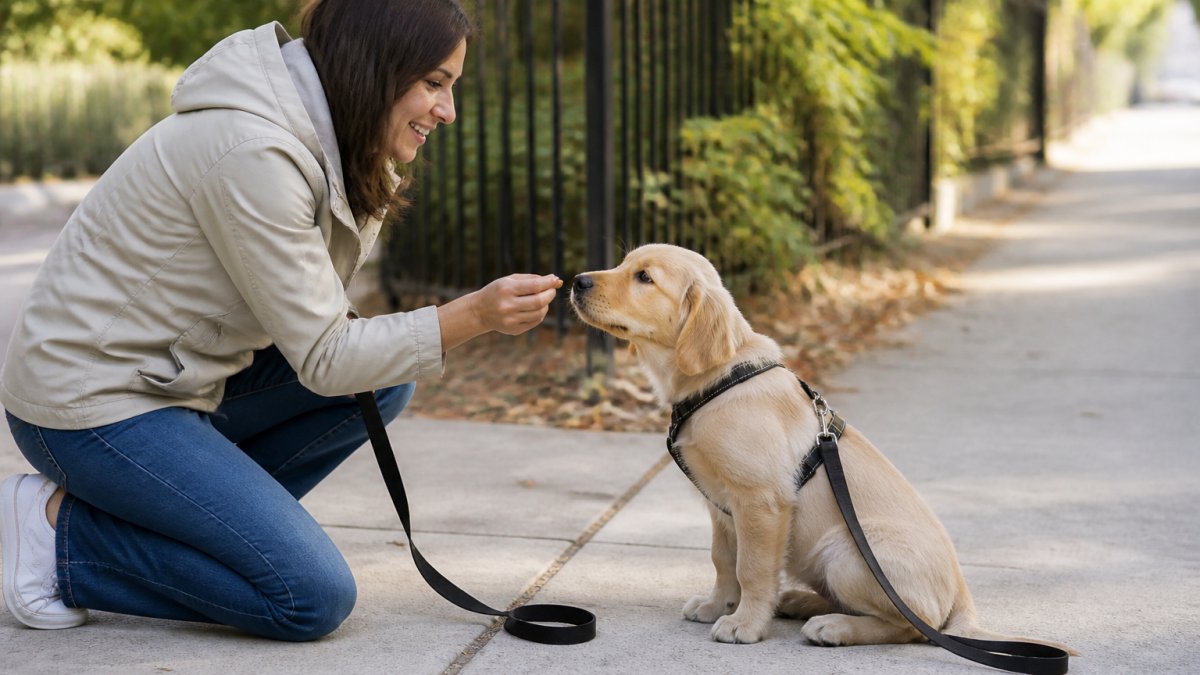
High-Value Treats and Verbal Cues
Keep treats your dog rarely gets, like small pieces of chicken or cheese, reserved for training walks. Pair a verbal cue like "leave it" or "drop" with the reward. Say the cue once, then reward the moment your dog looks away from the leash. Repeat this in short sessions. Consistency matters more than duration.
The Be a Tree Method
The "be a tree" method is exactly what it sounds like. The moment your dog grabs the leash, plant your feet, cross your arms, and stop. No talking, no tugging. The walk pauses until the behavior stops. Dogs learn fast that biting the leash ends the fun. The trick is staying boring longer than your dog stays interested.
Puppy Leash Training Tips for Young Dogs
Puppy leash training tips work best when sessions stay short and positive. Puppies have short attention spans, so five to ten minutes is plenty. End every session while your puppy is still succeeding.
A few things that help:
- Start indoors with no distractions
- Clip the leash on for short play sessions, not just walks
- Reward calm behavior before you even step outside
- Use a lightweight leash your puppy can't easily grip
- Keep walks short and build up slowly
The thing nobody tells you about puppy leash biting is that it often gets worse before it gets better. Around four to six months, teething peaks and mouthing spikes.
Choosing a Chew-Proof Dog Leash and Other Equipment Alternatives
A chew-proof dog leash is one of the most practical tools you can buy, but "chew-proof" is a spectrum, not a switch. The material you choose changes the sensory feedback your dog gets every time teeth meet the line, and that feedback is what actually drives the behavior. This is the angle most guides skip.
How Leash Material Changes Chewing Behavior
- Nylon webbing: Soft, textured, and slightly giving under pressure. It feels closest to a toy or a tug rope, which is why determined chewers shred it fast. Nylon also frays into strands that can be swallowed, so inspect it after every walk.
- Leather: Firmer and cooler to the mouth, with less give. Many dogs lose interest because it doesn't reward the bite with a satisfying squish. It's durable but not indestructible, a focused chewer can still notch it.
- Chain or chain-reinforced: Metal delivers an immediate, unpleasant vibration and a hard, cold surface. Most dogs mouth it once and pull back. The trade-off is weight and noise, and a fully chain leash can be harsh on your hands and your dog's neck if your dog lunges.
- Rope with a metal core: Combines a soft outer feel with a rigid inner stop. Good middle ground for dogs that need some texture but can't be trusted with pure nylon.
A practical rule: match the material to the trigger. A bored puppy mouthing for stimulation often quits when the texture stops being fun. A dog chewing from overstimulation may need the hard stop of chain. Rotate materials and watch which one your dog ignores.
Proud Pet Shop IQ Treat Puzzle →
Anti-Chew Deterrents: What's Safe on a Leash
Bitter sprays and gels are commonly used on furniture and bandages, and some owners apply them to leashes. A few cautions:
- Choose a product labeled for use on items your dog may mouth, and follow the label directions.
- Test on a small section first, some sprays discolor nylon or leave residue that transfers to your hands.
- Reapply after rain or washing, since most deterrents wash off.
- Never rely on taste alone. A deterrent buys you a few seconds to redirect; it does not teach an alternative behavior.
If your dog has a history of eating non-food items, talk to your veterinarian before using any topical deterrent, since ingestion of the product itself can cause stomach upset.
Equipment Alternatives Worth Trying
- Chain-reinforced leashes for heavy chewers
- Rope leashes with a metal core
- A head halter to reduce leash contact with the mouth
- A front-clip harness for better control
- A short traffic handle for close-range walks
For mental engagement between walks, a puzzle feeder gives your dog a job. The Proud Pet Shop IQ Treat Puzzle has adjustable difficulty and a non-slip base, and it's dishwasher-safe. It redirects oral fixation into problem-solving.

Muzzle Training, Leash Handling, and Building a Calm Walk Routine
Muzzle training is not punishment. A basket muzzle keeps everyone safe while you work on the behavior, and it lets your dog pant, drink, and take treats. Introduce it slowly with treats inside, and never rush the process. A muzzle is a management tool, not a fix, pair it with the redirection work above so your dog is learning a replacement behavior at the same time.
Age Changes the Plan
A teething puppy and a bored adult dog need different approaches, and most guides treat them as one problem.
- Puppies (roughly 3-7 months): Mouthing peaks with teething. The goal is relief plus redirection, frozen chew toys before walks, short sessions, and a lightweight leash the puppy can't easily grip. Expect the behavior to spike around 4-6 months and fade as adult teeth settle.
- Adolescents (roughly 6-18 months): Often testing boundaries and full of energy. The trigger is usually under-exercise or over-arousal, not pain. Longer sniff walks and a structured warm-up help more than any single cue.
- Adults (2 years and up): A sudden onset of leash chewing in a dog that never did it before is a flag, not a training problem. That's when a veterinary check matters most.
When to Rule Out a Medical Cause
Leash chewing can be the visible symptom of something physical. A common pattern is a dog that chews the leash, the leash clip, or anything near its mouth on walks. Consider a vet visit if you see:
- Sudden onset in an adult dog with no history of mouthing
- Drooling, dropping food, or chewing on one side
- Bad breath, loose teeth, or visible tartar
- Pawing at the mouth or reluctance to eat hard food
- Vomiting, diarrhea, or changes in appetite alongside the chewing
Dental pain, gum disease, and gastrointestinal discomfort can all present as oral fixation during walks. A veterinarian can rule these out before you invest weeks in training that can't address the root cause.
Leash Handling and a Calm Walk Routine
Keep slack in the line, hold the leash low, and avoid wrapping it around your hand. A calm walk routine looks like this:
| Step | What You Do | Why It Works |
|---|---|---|
| Warm-up | 2 minutes of calm walking in the yard | Sets a low-energy tone |
| Cue review | One "leave it" rep before the walk | Reminds your dog of the rule |
| Walk | Loose leash, frequent rewards | Builds leash manners |
| Cool-down | Sniff time or a puzzle feeder | Lowers arousal after the walk |
A slow-feeding setup can also help. The Proud Pet Shop Slow-Feeding System uses textured ridges and a suction base to turn mealtime into a calming activity, which supports the same calm behavior you're building on walks.

For scent-driven dogs, the Proud Pet Shop Sniffing Petal Mat hides kibble between felt petals and works natural foraging instincts. It's a simple way to burn off energy before a training session.

Conclusion
Leash chewing is frustrating, but it's a solvable behavior problem. The fix comes down to consistency, redirection, and the right gear. Proudpetshop carries durable, thoughtfully designed essentials backed by a 30-day satisfaction guarantee and free shipping on orders over $50. Get started with Proudpetshop and build calmer, easier walks with gear that holds up.
Frequently Asked Questions
Why does my dog chew on the leash during walks?
Most leash chewing comes from excitement, boredom, or teething rather than aggression. Puppies explore the world with their mouths, while adolescent and adult dogs often grab the leash when a walk feels too slow or too stimulating. Pain, dental issues, or a poor-fitting harness can also trigger it. Watch when it happens: if your dog bites the leash right as you clip it on, it is usually anticipation; if it happens mid-walk, overstimulation or boredom is more likely. Matching the cause to the fix saves weeks of guesswork.
Is there a chew-proof dog leash that heavy chewers cannot destroy?
No leash is truly indestructible, but some hold up far better than standard nylon webbing. Look for tightly woven materials, chain inserts at the clip end, or rope styles with reinforced stitching. Even a tough leash is a management tool, not a training solution, so pair it with redirection work. If your dog chews through every strap, keep a spare leash clipped to a harness so you always have a backup and can keep training sessions short and positive.
Do puppies grow out of leash biting on their own?
Many puppies reduce leash biting as teething ends around 6 to 8 months, but only if they learn what to do instead. Puppies who are never redirected often carry the habit into adolescence and adulthood. Start puppy leash training tips early: reward four paws on the ground, keep sessions to five minutes, and end before your puppy gets overstimulated. Consistency matters more than session length, and short daily practice beats one long weekend session.
How can I redirect my dog's attention when they start biting the leash?
Interrupt the grab before it becomes a game. Stop moving, hold the leash still, and wait for your dog to release. The moment the leash drops, mark it with a cheerful verbal cue and reward with a high-value treat. Then offer an appropriate outlet, such as a puzzle feeder or a sniff mat, so the oral fixation has somewhere to go. Practicing this sequence in your driveway first makes it far easier to use on a busy sidewalk.