
Table of Contents
- Why Most Dog Toys Fail Within a Week
- The Thumbnail Test: A 5-Second Check for Durable Dog Toys
- How to Choose Dog Toys by Chewing Style
- Safe Materials for Dog Chew Toys (and What to Avoid)
- Signs of Wear: When to Discard a Damaged Toy
- Indestructible Dog Toys for Aggressive Chewers: Setting Realistic Expectations
- Interactive vs. Solo Play: Matching Durability to Activity
-
A Simple Inspection Routine for Long-Lasting Toys
- Step 1: The Surface Scan for Micro-Cracks
- Step 2: The Flex Test for Structural Integrity
- Step 3: The Seam and Attachment Point Audit
- Step 4: The Thumbnail Test Re-Evaluation
- Step 5: The Odor and Residue Check
- Step 6: The Size Assessment
- When to Retire a Toy: The 5-Second Rule
- Building a Rotation Schedule
- Frequently Asked Questions
Last Updated: September 7, 2026
Why Most Dog Toys Fail Within a Week
The average dog toy doesn't survive its first weekend. The root cause is rarely quality control; it's a mismatch between the toy's design and your dog's chewing behavior. Understanding how to tell if dog toys are durable starts with recognizing that durability is a relationship between material, design, and your specific pet.
Many owners blame their dog for being "too destructive" when cheap toys fail within days. A common mistake is assuming thicker plastic or more stuffing equals better durability. In practice, the most durable toys are often the simplest ones, engineered with a single material and no weak attachment points.
The Thumbnail Test: A 5-Second Check for Durable Dog Toys
The fastest way to assess a toy's structural integrity is the thumbnail test, a method recommended by many veterinary professionals. Press your thumbnail firmly into the toy's surface. If the material indents easily or you can gouge out a piece, it will likely fail under your dog's bite force. A durable toy should resist indentation, feeling firm and slightly springy under pressure.
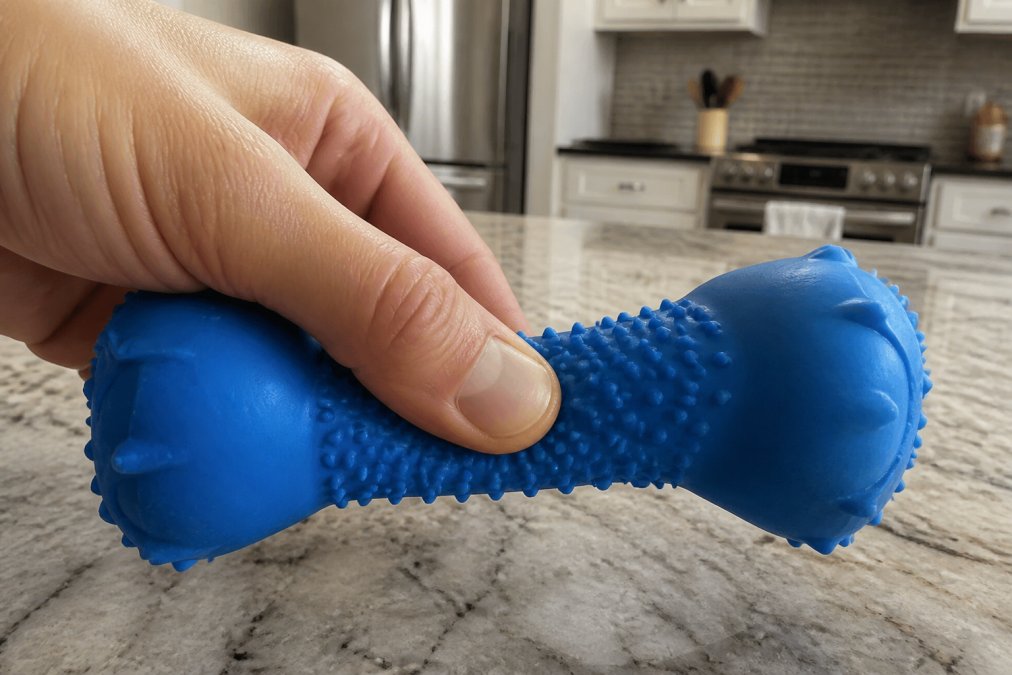
Toys that pass are typically made from dense natural rubber or reinforced nylon; those that fail are usually soft vinyl, thin latex, or low-density thermoplastics. Apply this test to every surface, including seams and protruding parts like ears or tails, these appendages are the first failure points and a primary choking hazard once detached.
How to Choose Dog Toys by Chewing Style
Matching the toy to your dog's chewing style is more important than any single material property. A toy that lasts for years with a gentle retriever might last exactly four minutes with a determined power chewer. The key is to assess your dog's bite force and persistence honestly, then select toys engineered for that specific intensity.
Light Chewers vs. Power Chewers
Light chewers typically mouth toys without applying sustained pressure. For them, plush toys with double-stitched seams and minimal stuffing can last a long time. Power chewers, however, require a different category entirely. They apply maximum jaw pressure and often work methodically to destroy a toy, targeting seams and weak points. For these dogs, look for solid rubber shapes without hollow chambers, or toys made from a single piece of dense material. Avoid anything with squeakers, as many power chewers will fixate on removing and swallowing the squeaker, creating a serious swallowing risk.
The 'Scent Test' Science
Toys with a strong synthetic odor often use lower-grade polymers that become brittle and splinter as they age. Volatile compounds that produce strong smells also weaken polymer chains, reducing elasticity over time. Natural rubber and food-grade nylon are inert and odor-free, correlating with their longer lifespan.
Safe Materials for Dog Chew Toys (and What to Avoid)
Durability isn't a single quality, it's a spectrum that varies dramatically by material. Understanding how each material fails helps you match a toy to your dog's bite force and chewing style. Here's a practical breakdown of the most common toy materials, ranked by their structural integrity and safety profile.
Natural Rubber: The Gold Standard for Power Chewers
Natural rubber, tapped from rubber trees and vulcanized for strength, offers the best balance of durability and safety. It's dense, slightly springy, and compresses under pressure rather than splintering. The key metric is durometer hardness, a Shore A rating between 50 and 70 indicates a firm but forgiving surface that withstands sustained jaw pressure (en.wikipedia.org). Toys below 40 Shore A are too soft and will tear quickly; above 80, they become brittle and can crack under impact.
Natural rubber fails predictably: it develops surface cracks that gradually deepen. These cracks are visible early, giving you a clear warning before the toy breaks apart. The material is also naturally non-toxic and free from BPA, phthalates, and lead, making it a safe choice for aggressive chewers who ingest small pieces.
Nylon: High Durability with a Hardness Trade-off
Dense nylon, often marketed as "indestructible" or "power chewer" grade, is engineered for maximum abrasion resistance. It's harder than rubber, typically measuring 80-90 on the Shore D scale, which makes it excellent for dogs that gnaw persistently. Nylon toys rarely tear; instead, they wear down slowly through friction, creating a rough, fibrous surface over time.
The trade-off is that nylon is unforgiving on teeth. Dogs that apply extreme pressure may experience tooth wear or fractures, particularly on the molars. Nylon also splinters if the toy is thin or has sharp edges, so inspect any nylon toy for stress fractures along its length. Choose solid, single-piece nylon shapes without hollow chambers, which concentrate stress at thin walls.
Rope and Fabric: The Hidden Risk of Fiber Ingestion
Cotton and polyester rope toys are popular for their dental benefits, but their durability is fundamentally different from rubber or nylon. Rope fails through fraying, and each loose fiber is a potential ingestion hazard. When fibers accumulate in the digestive tract, they can form a linear foreign body, a condition requiring surgical intervention. The American Veterinary Medical Association's guidance on toy safety advises discarding rope toys at the first sign of fraying, not when they look visibly damaged.
If you choose rope toys, limit them to supervised interactive play like tug-of-war, where you control the session and can inspect the rope afterward. Never leave a rope toy with a dog that chews unsupervised, as the fibers can wrap around teeth or the intestinal lining.
Materials to Avoid Entirely
Some materials fail so quickly or pose such significant risks that they should never be considered durable options:
- Brittle plastic: Shatters into sharp shards that can cause oral lacerations or intestinal perforation. Common in cheap squeaky toys and hard bones.
- Vinyl and latex: Soft, low-density polymers that tear easily and often contain plasticizers that leach out over time, creating a sticky surface that attracts dirt and bacteria.
- Rawhide: While not a synthetic material, rawhide softens when chewed and can be swallowed in large pieces, causing esophageal blockage. It also carries a risk of bacterial contamination during processing.
- Compressed rawhide alternatives: Some "dental chews" are made from gelatin or starch-based compounds that dissolve quickly, these are treats, not durable toys, and should be treated as consumables.
The Scent Test as a Material Quality Indicator
A quick way to vet material quality is the scent test. Toys with a strong chemical or "new plastic" odor are often made from lower-grade polymers that contain volatile plasticizers. These compounds weaken the polymer chains over time, making the material brittle and prone to cracking. High-quality natural rubber and food-grade nylon are nearly odorless because they lack these additives. If a toy smells strongly of chemicals, it's a sign that the material will degrade faster and may contain substances you don't want your dog ingesting.
Signs of Wear: When to Discard a Damaged Toy
Every toy has a finite lifespan, and knowing when to retire one is as important as the initial purchase. A worn toy is not just less fun; it becomes a safety hazard. The moment you notice a toy has lost its structural integrity, it should be removed from rotation.
Key discard criteria include:
- Surface cracks or punctures that expose inner material
- Fraying on rope toys or fabric edges, which can wrap around teeth or intestines
- Pieces that have broken off, no matter how small
- A change in texture, such as becoming sticky or overly hard
- Any foul odor that persists after washing, which indicates bacterial growth inside the material
Indestructible Dog Toys for Aggressive Chewers: Setting Realistic Expectations
The term "indestructible" is marketing, not engineering. No toy is truly indestructible, and claiming otherwise sets owners up for disappointment. For aggressive chewers, the goal is not a toy that lasts forever, but one that lasts longer than the dog's initial fixation phase. Many owners find that rotating between two or three highly durable toys extends their lifespan because the dog's interest shifts before any single toy receives sustained, destructive attention.
For the toughest cases, look for toys made from a single block of dense rubber, which distributes bite force across the entire surface rather than concentrating it at seams. The Proud Pet Shop Bite-Proof Sofa Bed, available at proudpetshop.com/products/waterproof-kennel-bite-resistant-and-scratch-resistant-all-season-removable-and-washable-sofa-dog-bed-pet-supplies for $161.99, uses a similar principle, with a dedicated bite-proof and scratch-proof fabric that withstands daily wear standard beds cannot endure. Structural integrity comes from the material itself, not from reinforcement patches that can be peeled off.

Interactive vs. Solo Play: Matching Durability to Activity
A toy's required durability also depends on whether it's used for interactive play with you or solo entertainment. Interactive play, like tug-of-war, puts enormous stress on the toy's center and handles. Solo play, such as chewing or fetching, concentrates stress on the toy's ends and surfaces.
For interactive play, prioritize toys with a single, thick handle and no loose parts. For solo play, consider puzzle feeders that engage your dog's brain rather than their jaw. The American Kennel Club's guidance on dog enrichment notes that mental stimulation can be as tiring as physical exercise, and a well-designed puzzle toy redirects chewing energy into problem-solving. The Proud Pet Shop IQ Treat Puzzle, available at proudpetshop.com/products/proud-pet-shop-iq-treat-puzzle for $34.99, is designed for exactly this purpose, converting snack time into active playtime where your pet must nudge and paw to release treats, which reduces destructive chewing by providing a focused outlet for their energy.

A Simple Inspection Routine for Long-Lasting Toys
A weekly inspection is the difference between catching a structural failure early and discovering it after your dog has swallowed a piece. This routine takes under three minutes and focuses on the specific failure points where toys break.
Step 1: The Surface Scan for Micro-Cracks
Run your fingers slowly across every surface, applying light pressure. You're feeling for micro-cracks, hairline fractures invisible to the eye that indicate the material is losing elasticity. Natural rubber develops these first at stress points where the toy flexes during chewing. If you feel any roughness or catch a fingernail on a surface irregularity, the toy has begun to fail.
For nylon toys, check for a chalky or powdery texture, which indicates surface degradation from UV exposure or repeated washing. This powdering precedes splintering and means the toy should be retired.
Step 2: The Flex Test for Structural Integrity
Bend the toy gently in both directions. A durable toy should flex and return to its original shape without creasing or whitening. A white stress mark, called "stress whitening", indicates polymer chains have begun to break down, preceding a full crack. For hollow rubber toys, squeeze the entire surface, listening for air escaping, which indicates a puncture.
Step 3: The Seam and Attachment Point Audit
Seams and attached parts, ears, tails, legs, squeakers, are the first failure points. Apply firm pressure to each seam, attempting to pull it apart. If you feel any give or see gaps, the adhesive or stitching has weakened. For toys with squeakers, press firmly on the chamber; if you feel the squeaker moving or hear it rattling, the surrounding material has stretched, making it a choking hazard.
Step 4: The Thumbnail Test Re-Evaluation
Repeat the thumbnail test from your initial purchase. A toy that once resisted indentation but now dents easily has lost its structural integrity, often due to repeated saliva exposure and bacterial breakdown. The material can no longer distribute bite force effectively, so the toy will fail faster.
Step 5: The Odor and Residue Check
Smell the toy and run a white cloth over its surface. A clean toy should have no odor and leave no residue. A foul smell indicates bacterial growth inside the material, which can occur even in rubber toys if saliva seeps into micro-cracks. A sticky or oily residue suggests plasticizers are leaching out, a sign the material is degrading.
Step 6: The Size Assessment
Measure the toy against your dog's mouth. If it fits entirely inside, it is now a choking hazard, regardless of its structural condition. This is especially important for toys that wear down gradually, like nylon bones, which can shrink to a dangerous size while still appearing intact.
When to Retire a Toy: The 5-Second Rule
If any inspection step reveals a problem, retire the toy immediately. Do not wait for visible damage, a micro-crack today becomes a torn piece tomorrow. The cost of replacing a toy is minimal compared to the emergency vet bill for an intestinal blockage, which can range from $2,000 to $5,000.
Building a Rotation Schedule
Rotate between two or three durable toys on a daily basis. This prevents any single toy from receiving sustained, destructive attention and allows each toy to dry completely between uses, reducing bacterial growth. A rotation also keeps your dog engaged, novelty reduces the intensity of chewing on any one item.
Frequently Asked Questions
What is the toughest dog toy material?
Natural rubber and dense nylon are among the toughest materials for durable dog toys. Natural rubber offers some flexibility, which helps it withstand bite force without cracking, while nylon is rigid and resists punctures. Avoid brittle plastic, which splinters, and thin latex, which tears quickly. For aggressive chewers, look for toys made from a single piece of material rather than glued layers, as seams are often the first point of failure.
How can I tell if a dog toy is safe for my pet?
Check that the toy is made from non-toxic materials and is size-appropriate for your dog to prevent a choking hazard. Perform the thumbnail test: if your nail leaves a deep dent, the toy is too soft. Inspect for small parts like squeakers or eyes that can be pulled off. Discard any toy showing signs of wear and tear, such as fraying or splintering, to avoid a swallowing risk.
How long do dog toys last?
There is no universal timeline because it depends on your dog's chew intensity and the toy's material density. A durable dog toy for a light chewer might last months, while the same toy could fail in minutes with an aggressive chewer. Instead of tracking time, inspect toys regularly for mechanical damage. Remove a toy once it shows cracks, fraying, or missing pieces, regardless of how new it is.
Are there any truly indestructible dog toys?
No toy is truly indestructible. A determined dog with a high bite force can eventually damage almost any material. The goal is to find toys with high chew resistance that last longer and provide mental stimulation. Rotate toys to keep your dog interested. Always supervise play and replace damaged toys to ensure pet safety.
Choosing the right toy for your dog doesn't have to be a cycle of disappointment and wasted money. The challenge is matching the toy's design to your dog's real chewing behavior, then staying vigilant about wear and tear. At Proudpetshop, we stock only durable, thoughtfully designed gear that holds up to real households, backed by a 30-day satisfaction guarantee and free shipping on orders over $50. Get started with Proudpetshop and find toys that survive the first week, and many more after it.