
Table of Contents
- Why Hardwood Floors Are Dangerous for Senior Dogs
- Signs of Mobility Issues in Senior Dogs
- How Slippery Surfaces Accelerate Joint Damage and Arthritis
- How to Help a Dog With Arthritis on Hardwood Floors
- Best Traction Solutions for Senior Dogs
- Why Non-Slip Rugs Restore Confidence and Mobility
- Creating a Safe Path: Strategic Rug Placement for High-Traffic Areas
- Conclusion
- Frequently Asked Questions
Last Updated: September 3, 2026
Why Hardwood Floors Are Dangerous for Senior Dogs
Hardwood floors look beautiful in a home, but they present a serious mobility challenge for aging dogs. As dogs enter their senior years, their joints weaken, their muscles atrophy, and their confidence on slippery surfaces diminishes. A senior dog on a polished hardwood floor has almost no surface friction or grip, their paws slide, their back legs slip out from under them, and the effort required to maintain balance exhausts them quickly.
The problem isn't just discomfort. Every slip, every moment of struggling to find purchase, every near-fall creates micro-injuries to joints already compromised by arthritis or age-related stiffness. Over time, these repeated slips accelerate joint damage and can trigger acute injuries like muscle strains or ligament tears. Senior dogs stop moving confidently. They avoid certain rooms. They lose the mobility that keeps them healthy and engaged.
This is where non-slip rugs on hardwood floors become essential. They restore traction, reduce strain on aging joints, and give senior dogs the stability they need to move through your home without fear. At Proudpetshop, we understand that senior pet comfort isn't optional, it's foundational to quality of life in the final years.
Signs of Mobility Issues in Senior Dogs
Recognizing mobility problems early is critical. Many senior dogs show subtle signs before a dramatic incident forces you to act. Watch for hesitation when entering a room with hardwood flooring, reluctance to climb stairs, or a visible change in gait where the back legs seem to shuffle or drag slightly. Some dogs will stand at the edge of a hardwood floor and refuse to cross it, even to reach their owner or food bowl.
Other warning signals include limping that appears and disappears, stiffness after rest that takes several minutes to improve, difficulty rising from a lying position, or a hunched posture when standing. You might notice your dog spending more time on carpeted areas or tile and avoiding hardwood rooms entirely. Some senior dogs develop a swaying gait or cross their hind legs awkwardly as they walk, which indicates weakness or neurological issues related to balance.
Pain is often silent in dogs. They won't tell you their joints hurt. Instead, they'll change their behavior. A dog that once bounded up stairs now takes them one at a time. A dog that loved following you from room to room now stays in one spot. These behavioral changes are your clearest signal that mobility is declining and environmental modifications are needed.
How Slippery Surfaces Accelerate Joint Damage and Arthritis
The mechanics of joint damage on slippery surfaces are straightforward but serious. When a senior dog's paws slip on hardwood, their muscles must work harder to compensate for the lack of grip. This constant muscular compensation creates inflammation in the joints, particularly in the hips, knees, elbows, and lower back. Over weeks and months, this inflammation becomes chronic arthritis.
Arthritis in senior dogs is progressive. It doesn't improve on its own. Each slip, each moment of instability, each time your dog's legs slide out from under them, adds microtrauma to cartilage that's already thinning with age. The body responds to this repeated stress by producing more inflammation, which triggers pain, which reduces movement, which causes muscle atrophy, which reduces stability further. It's a downward spiral.
The connection between slippery floors and accelerated arthritis is documented in veterinary orthopedic practice (avma.org). Vets consistently report that senior dogs living on slippery flooring without traction support develop arthritis symptoms earlier and more severely than those with adequate grip. A senior dog on hardwood without rugs is essentially living in a constant state of microtrauma, their joints are being stressed with every step.
What makes this particularly insidious is that the damage happens silently. Your dog isn't screaming in pain. They're just struggling. They're working harder than they should to do basic things like walk across a room or get up from a nap. By the time you notice significant arthritis symptoms, months or years of preventable damage may have already occurred.
How to Help a Dog With Arthritis on Hardwood Floors
The most direct intervention is eliminating the slippery surface through non-slip rugs, runners, and strategic placement. But this is part of a broader approach to supporting an arthritic senior dog. Start by creating a "safe path" through your home, the routes your dog uses most frequently should have continuous traction support. This means placing rugs in hallways, at the bottom of stairs, in front of the water bowl, and in any room where your dog spends significant time.
Beyond rugs, orthopedic support matters enormously. A quality orthopedic bed reduces stress on joints during rest, which is when a senior dog spends most of their day. The Proud Pet Shop Comfort Den XL, designed specifically for larger dogs up to 80 pounds, provides high-density orthopedic foam that relieves pressure on sensitive joints. This isn't just comfort, it's active joint protection during the 18-20 hours per day your senior dog is resting.

Temperature management also helps. Warm environments reduce stiffness in arthritic joints. Cold, hard floors worsen arthritis symptoms. Rugs provide insulation and warmth that a bare hardwood floor cannot. Some owners use heated beds or blankets in addition to rugs, which can significantly improve comfort and mobility in senior dogs.
Physical activity matters, but it must be appropriate. Low-impact movement like short, frequent walks on surfaces with good traction helps maintain muscle mass and joint flexibility. High-impact activity or forced exercise on slippery floors causes more damage than benefit. The goal is to support movement that your dog initiates naturally, not to push them into activity.
Best Traction Solutions for Senior Dogs
The most effective traction solutions for senior dogs come down to surface friction and non-slip backing. Yoga mats are a popular DIY option, they're affordable, washable, and provide decent grip. Carpet remnants from flooring stores work well too and often cost very little. The key is ensuring the mat or rug has a non-slip backing that won't slide on the hardwood floor itself. A rug that moves when your dog steps on it creates more danger, not less.
Commercial non-slip rugs and runners designed specifically for pet owners offer more durability and better aesthetics than DIY solutions. These rugs typically feature rubberized non-slip backing, washable materials, and sizes that fit common hallways, entryways, and room transitions. They're designed to stay put even under the movement of multiple pets.
Floor runners, long, narrow rugs that cover hallways and high-traffic areas, are particularly effective for creating continuous safe paths through your home. A dog can move from one room to another without encountering bare hardwood. This continuous traction reduces the mental and physical stress of navigating slippery transitions.
Some owners use adhesive non-slip tape or paw grip products applied directly to the hardwood floor, but these are temporary solutions and can damage finish. Rugs and runners are the most practical, reversible, and effective approach. They also provide insulation and warmth, which adds additional benefit for arthritic joints.
The ideal setup combines multiple traction solutions: non-slip rugs in high-traffic areas, a runner covering the main hallway, and strategically placed mats in front of food and water bowls, at the base of stairs, and in sleeping areas. This creates a network of safe, stable surfaces your senior dog can navigate with confidence.
Why Non-Slip Rugs Restore Confidence and Mobility
A senior dog that slips repeatedly becomes anxious about movement. They lose confidence. They avoid rooms. They stop following their owner around the house. This psychological impact is as significant as the physical one. A dog that's afraid to move becomes less active, which accelerates muscle loss, which reduces stability further, which increases fear. Confidence and mobility are linked.
Non-slip rugs break this cycle. The moment a senior dog feels stable ground beneath their paws, their behavior changes. They walk with their head up instead of looking down nervously at the floor. They move more freely. They're willing to follow you from room to room again. They'll climb stairs they've been avoiding. They'll get up from rest without that moment of struggle and uncertainty.
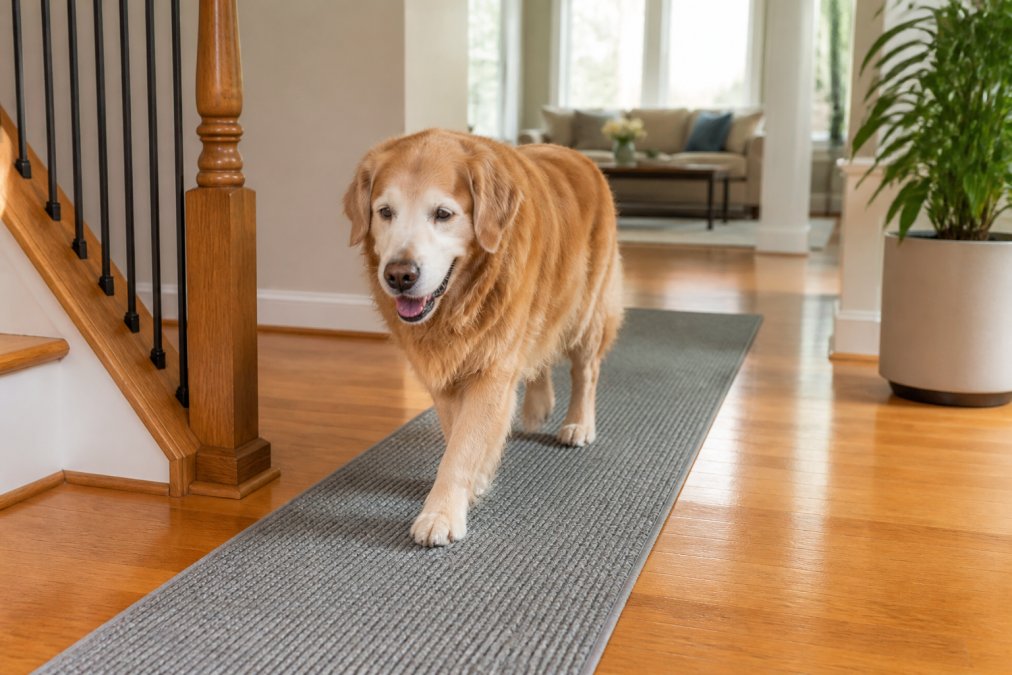
This restoration of confidence is measurable in behavior. Owners consistently report that within days of adding non-slip rugs, their senior dogs move more, interact more, and seem happier. The physical benefits, reduced joint stress, fewer slips, less muscle strain, are real. But the psychological benefit of regaining confidence and independence is equally important.
For senior dogs, mobility equals quality of life. A dog that can move comfortably through the home, that doesn't fear slipping, that can access all areas without anxiety, is a dog that's still engaged in family life. Non-slip rugs provide that foundation. They're one of the most cost-effective, immediate interventions you can make for a senior dog's wellbeing.
Creating a Safe Path: Strategic Rug Placement for High-Traffic Areas
The most effective approach is thinking in terms of pathways rather than individual rooms. Map out where your senior dog moves most frequently: from their bed to the water bowl, from the kitchen to the living room, up the stairs, to the back door. These are the critical routes that need continuous traction support.
Start with the main hallway if you have one. A floor runner covering the full length eliminates the transition from room to room and creates a safe corridor your dog will use repeatedly. In the kitchen, place a non-slip mat in front of food and water bowls, many senior dogs struggle to eat or drink on slippery floors. At the base of stairs, a mat or runner is essential. If your dog sleeps in a particular room, ensure that room has adequate rug coverage, especially around the sleeping area where they stand when waking.
High-traffic areas like entryways and the path to the back door are critical. These are places where your dog naturally moves quickly, and slipping is most likely. A well-placed rug here prevents injuries and gives your dog confidence to move at a normal pace.
The goal is seamless traction. Avoid leaving gaps where your dog must cross bare hardwood between rugs. These transitions are where slips happen. If you have multiple dogs, ensure the path is wide enough for both to move comfortably without competition for the rug space.
Consider your home's layout and your dog's specific movement patterns. Every senior dog is different. Some struggle most on stairs, others on hallways. Some avoid certain rooms entirely. Use your observation of your dog's behavior to guide rug placement. The most effective setup is one that aligns with where your senior dog actually moves.
A quality non-slip rug from Proudpetshop, placed strategically through your home, creates a network of safe surfaces that gives your senior dog the traction they need to move with confidence and stability. Combined with an orthopedic bed like the Proud Pet Shop Calming Donut Bed for rest and recovery, you're providing comprehensive support for mobility and joint health.

Conclusion
Senior dogs on hardwood floors face a genuine mobility crisis. Without traction, every step becomes a balance challenge that stresses aging joints, accelerates arthritis, and erodes confidence. The solution is straightforward: non-slip rugs that restore surface friction, combined with orthopedic support during rest.
According to veterinary orthopedic guidelines from the American Animal Hospital Association, environmental modifications like non-slip flooring are among the most cost-effective interventions for managing mobility in senior dogs. Research from the Canine Arthritis Management study published through veterinary journals demonstrates that dogs living in homes with adequate traction support show significantly slower progression of arthritis symptoms compared to those on slippery flooring.
The best traction solutions combine commercial non-slip rugs with strategic placement that creates continuous safe paths through your home. The Proud Pet Shop Comfort Den XL provides orthopedic support during rest, addressing the other half of the equation. Together, these interventions give your senior dog the stability, confidence, and joint protection they need to maintain quality of life.
Your senior dog's mobility and independence matter. Non-slip rugs aren't a luxury, they're a fundamental part of responsible senior dog care. Start by identifying your dog's most-used pathways, place rugs strategically, and watch your senior dog regain the confidence to move freely through your home again.
Frequently Asked Questions
How do non-slip rugs prevent senior dogs from slipping on hardwood floors?
Non-slip rugs increase surface friction between your dog's paw pads and the floor, providing the traction needed for stable footing. The backing prevents the rug from sliding, and the textured surface grips the dog's nails and paw pads, reducing the risk of slips and falls that can cause strains, sprains, and joint injuries in aging pets.
What are the signs my senior dog is struggling with traction on hardwood floors?
Watch for hesitation before walking, visible stiffness when standing, bunching or splaying of the hind legs, loss of balance, reluctance to use stairs, or taking longer to get up from lying down. These are common signs of mobility issues in senior dogs. If your dog avoids certain rooms or moves more slowly on hardwood, that's a clear signal traction is a problem.
Can non-slip rugs help a dog with arthritis on hardwood floors?
Yes. Non-slip rugs reduce the strain on arthritic joints by providing stable footing and reducing the effort needed to maintain balance. This is especially important for dogs with arthritis, as slipping forces them to engage muscles and joints differently to stay upright, accelerating stiffness and pain. Proper traction allows arthritic dogs to move more naturally and with less compensation.
What's the best way to place non-slip rugs in my home for a senior dog?
Cover high-traffic areas where your dog walks daily: hallways, entryways, and paths to food and water bowls. Layer rugs in rooms where your dog spends the most time. Use rug pads underneath to prevent shifting. Consider runners in hallways and smaller rugs in front of doors. Strategic placement creates a 'safe path' that minimizes time spent on slippery surfaces while maintaining normal movement patterns.
Senior dogs deserve to move through their homes without fear or pain. Get started with Proudpetshop's orthopedic bedding and comfort solutions designed specifically for aging pets, and create the traction and support your senior dog needs to thrive.
This article was written using GrandRanker