
Table of Contents
- Why Accurate Measurements Matter for Travel Carriers
- What You'll Need Before Measuring
- How to Measure Dog for Airline Crate: Step-by-Step
- Airline-Approved Dog Carrier Dimensions and Requirements
- Understanding Under-Seat Pet Carrier Size Requirements
- Soft-Sided vs. Hard-Sided Carriers: Sizing Differences
- Common Mistakes to Avoid When Measuring
- Choosing the Right Carrier for Your Dog's Size
- Frequently Asked Questions
Last Updated: September 19, 2026
Why Accurate Measurements Matter for Travel Carriers
To measure dog travel carrier fit properly, getting your dog's measurements right isn't just about convenience. It's the difference between a safe, comfortable trip and a stressful experience that leaves your pet anxious or confined.
A carrier that's too small restricts movement and increases stress; one too large lets your dog slide around during turbulence. The right fit keeps your pet secure, calm, and safe during transit.
The most common mistake is guessing at size instead of taking actual measurements. Owners assume their dog is "medium" or "small" without checking the numbers, then the carrier arrives and doesn't fit properly.
Airlines have strict regulations about in-cabin pet carriers. Your measurements determine whether your dog qualifies to travel under the seat or goes in cargo. Getting this wrong means expensive last-minute changes or having to leave your pet behind.
What You'll Need Before Measuring
Gather these tools:
- A soft measuring tape (flexible, not rigid metal)
- A bathroom scale or veterinary scale
- A flat surface like a kitchen counter
- A notebook or phone to record numbers
- High-value treats for cooperation
A soft measuring tape is essential, rigid tapes don't bend around your dog's body and give false readings. If you don't have one, use string and measure it against a ruler afterward.
A bathroom scale works for most dogs; use a veterinary scale for dogs under 5 pounds. Measure in the morning when your dog is calm, and have high-value treats ready.
How to Measure Dog for Airline Crate: Step-by-Step
Taking accurate measurements takes about ten minutes. The real challenge is keeping your dog calm and still long enough to get reliable numbers.
Pre-Measurement Preparation: Setting Your Dog Up for Success
Choose a quiet time when your dog is naturally calm, early morning, after a walk, or after a meal. Set up in a distraction-free room with good lighting. Have high-value treats (chicken, cheese, or training treats) ready to reward calm standing.
Measuring Nose-to-Tail Length
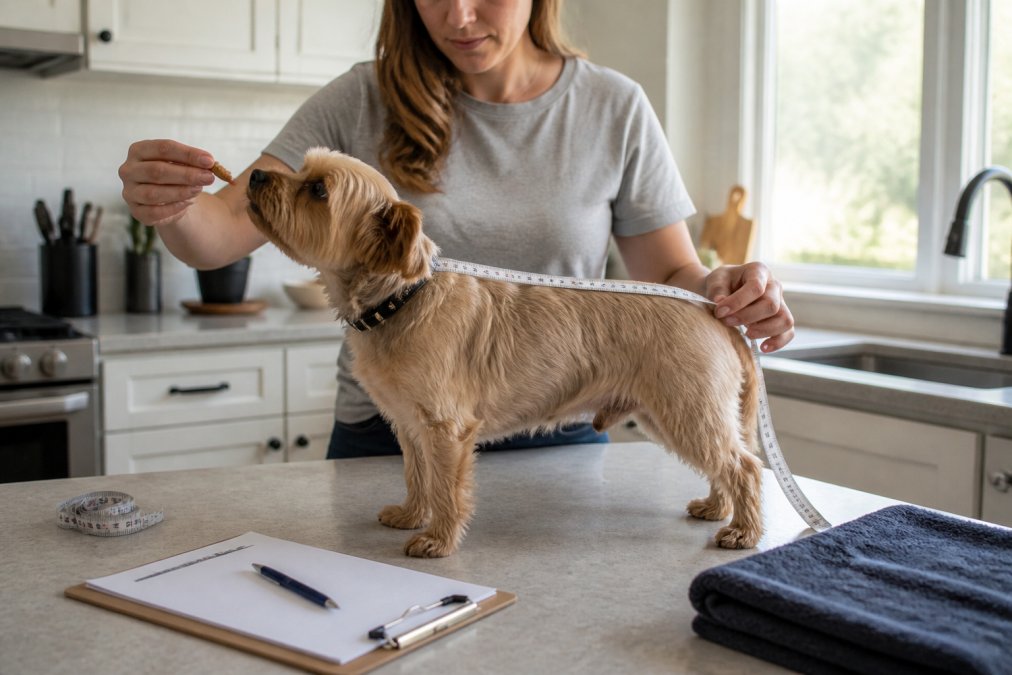
The nose-to-tail measurement is the longest dimension your dog needs inside the carrier. This determines whether your dog fits lengthwise.
Get your dog to stand naturally with all four legs under their body. Place the measuring tape at the tip of the nose and run it along the spine to the base of the tail (not the tip). If your dog won't stand still, measure in sections: nose to shoulder, shoulder to hip, hip to tail base. Write down the number immediately. Common error: measuring to the tail tip instead of the base, carriers don't account for tail length.
Measuring Shoulder Height
Shoulder height tells you how tall your dog is from the ground up. This is the vertical clearance your dog needs inside the carrier.
Have your dog stand with all four legs under their body. Measure from the floor to the highest point of the shoulder blade (the bony ridge where the front leg meets the body). Don't measure to the head or neck. You want at least one inch of clearance above the shoulder for comfort during travel.
Weighing Your Dog for Carrier Capacity
Place your dog on a scale and record the weight in pounds. Weigh in the morning before meals for consistency. For dogs under 5 pounds, use a veterinary scale. Weigh your dog alone without clothes, harness, or collar; if your dog will wear gear during travel, weigh that separately and add it to your dog's weight.
Airline-Approved Dog Carrier Dimensions and Requirements
Most airlines allow one pet per passenger in a soft-sided carrier under the seat with typical dimensions of 18 inches long by 14 inches wide by 8 inches tall. Weight limits typically max out at 15 to 20 pounds for in-cabin carriers. Check your specific airline's website before booking. If your dog exceeds in-cabin limits, cargo travel is the only option, which is more expensive and stressful for pets.
Understanding Under-Seat Pet Carrier Size Requirements
Under-seat carriers are the most practical option for air travel. They keep your dog close and avoid the stress of cargo hold travel.
When you measure dog travel carrier requirements, most aircraft have under-seat dimensions of about 18 inches long by 14 inches wide by 8 inches tall. Soft-sided carriers compress to fit these spaces. A 16-inch-long dog needs a carrier at least 17 or 18 inches long to allow for movement. Always check your airline's specific dimensions before buying. The Proud Pet Shop TrailFold Carrier comes in three sizes with a sizing guide on the product page.

Soft-Sided vs. Hard-Sided Carriers: Sizing Differences
Soft-sided and hard-sided carriers have different sizing rules. Understanding the difference helps you choose the right one for your travel needs.
Soft-sided carriers compress to fit under airline seats; interior space is slightly less than exterior dimensions. Hard-sided carriers don't compress and offer more protection. For in-cabin travel, soft-sided is better, they fit under seats more easily and are less intimidating for anxious dogs. If your dog is at the size limit, soft-sided compression might make the difference.
Common Mistakes to Avoid When Measuring
Most measuring errors come from rushing or measuring the wrong body parts. But the biggest mistakes are often breed-specific, different dog body shapes require different measurement approaches.
Universal Measuring Mistakes
The biggest mistake is measuring to the tip of the tail. The tail isn't part of your dog's body length for carrier purposes. Measure to the base of the tail where it connects to the spine. This is non-negotiable for accurate carrier sizing.
Another common error is measuring a relaxed or slouched dog. Your dog should be standing straight with all four legs under their body. A stretched-out or hunched posture gives false measurements. If your dog naturally slouches, gently encourage a neutral stance before measuring.
Some owners measure around the widest part of the ribcage instead of the actual length. Length is nose to tail base. Width is around the chest. You need both measurements, but they serve different purposes.
Don't estimate based on your dog's breed. Two Labs can have very different measurements. One might be 22 inches long and 65 pounds. Another might be 20 inches and 55 pounds. Measure your actual dog, not a breed standard.
Weighing your dog in clothes, a harness, or a collar adds unnecessary weight. Weigh your dog without gear. If your dog wears a harness during travel, add that weight separately to your total.
Recording measurements wrong happens more than you'd think. Write them down immediately. Don't try to remember them later. Take photos of the numbers on your scale and tape measure.
Breed-Specific Measurement Challenges
Different body shapes require different measurement strategies. Understanding your dog's body type helps you measure accurately and choose a carrier that actually fits.
Long-bodied breeds (Dachshunds, Corgis, Basset Hounds): These breeds have disproportionately long bodies relative to their height. The nose-to-tail measurement is often much longer than their shoulder height, which means they need carriers that prioritize length over height. When measuring, be extra careful to get the full nose-to-tail length because even an inch short will result in a carrier where your dog can't stretch out. Measure in sections if your dog won't hold still for the full length. For these breeds, a carrier that's 18 inches long but only 10 inches tall might work, whereas a square carrier would be too cramped. Check carrier interior dimensions carefully, don't assume a carrier labeled "medium" will accommodate a long-bodied dog of that weight.
Tall, narrow breeds (Greyhounds, Whippets, Italian Greyhounds): These breeds have disproportionately tall bodies relative to their length.
Measurement Verification
After you've taken all measurements, verify them by checking against your dog's actual proportions. If your dog's nose-to-tail length is 18 inches but the shoulder height is 22 inches, something is wrong, the height can't exceed the length. Remeasure before moving forward.
Choosing the Right Carrier for Your Dog's Size
Once you have your measurements, matching them to a carrier is straightforward. Your dog's dimensions determine which carriers will work.
Frequently Asked Questions
Can a 25 lb dog fit under an airline seat in an approved carrier?
Most airline-approved under-seat carriers accommodate dogs up to 15-20 lbs. A 25 lb dog typically exceeds standard under-seat dimensions and may require a cabin-size approved travel crate or cargo hold transport. Always check your specific airline's weight and dimension requirements before booking, as policies vary. Measure your dog's exact dimensions and compare them to the airline-approved carrier specifications to confirm eligibility for in-cabin travel.
What are the standard airline-approved dog carrier dimensions?
Most airlines allow soft-sided carriers measuring approximately 17-19 inches long, 12-13 inches wide, and 8-10 inches tall for under-seat placement. Hard-sided airline-approved travel crates typically range from 19-24 inches long depending on size category. Airlines require carriers to fit completely under the seat in front of you with no protruding parts. Check your specific airline's website for exact dimensions, as requirements vary. The Proud Pet Shop TrailFold Carrier comes in three sizes (S, M, L) designed to fit various pet dimensions while maintaining ventilation and safety.
How do I know if my dog is too big for an under-seat carrier?
If your dog cannot stand, turn around, or lie down comfortably inside the measured carrier dimensions, they're too large for under-seat travel. Measure your dog's nose-to-tail length, shoulder height, and weight. If any measurement exceeds standard under-seat limits (typically under 20 lbs, 19 inches long, 10 inches tall), your dog will need a larger cabin or cargo hold approved travel crate. Many larger dogs require cargo hold transport, which involves different safety protocols and airline regulations.
Should I measure my dog while standing or sitting?
Always measure your dog while standing in a natural, relaxed position. This gives accurate dimensions for travel carriers, which require dogs to stand, turn, and lie down. Sitting measurements won't reflect the full height your dog needs when standing. Take measurements on a flat surface without any head tilt or stretched posture. For the most accurate fit, measure multiple times and use the largest dimension to ensure your dog has adequate standing room and proper ventilation inside the carrier.
Accurate measurements take ten minutes and prevent hours of frustration later. The right carrier keeps your dog safe and comfortable during travel. Proudpetshop offers carriers in multiple sizes designed around actual dog measurements, with a 30-day satisfaction guarantee if the fit isn't right. Get your measurements today, match them to a carrier that fits, and travel with confidence knowing your dog has the space and security they need.