
Table of Contents
- What Makes a Dog Harness Durable
- Materials and Construction Quality in Durable Dog Harnesses
- Heavy Duty Dog Harness for Large Dogs
- Escape-Proof Design Considerations
- How to Measure a Dog for a Harness
- Testing Durability: What Real-World Conditions Reveal
- Frequently Asked Questions
Last Updated: September 24, 2026
What Makes a Dog Harness Durable
A durable dog harness is built to withstand daily pulling, outdoor adventures, and years of active use without tearing, fraying, or losing its structural integrity. The most durable dog harness combines heavy-duty materials, reinforced stitching, and thoughtful design that distributes force evenly across the dog's body rather than concentrating pressure at weak points.
Durability depends on three core elements: base material quality, construction method, and design that handles your dog's specific stresses. A harness for a calm 15-pound dog won't survive a 70-pound puller.
Harnesses typically fail at stress concentration points: where straps meet hardware, where padding edges fray, or where stitching crosses under load. Understanding these failure points helps identify which harnesses will actually hold up.
Materials and Construction Quality in Durable Dog Harnesses
The material you choose determines how your harness performs under stress and exposure. Heavy-duty nylon webbing with reinforced stitching is the industry standard for durable dog harnesses because it resists abrasion, handles moisture, and maintains its strength when wet or dry.
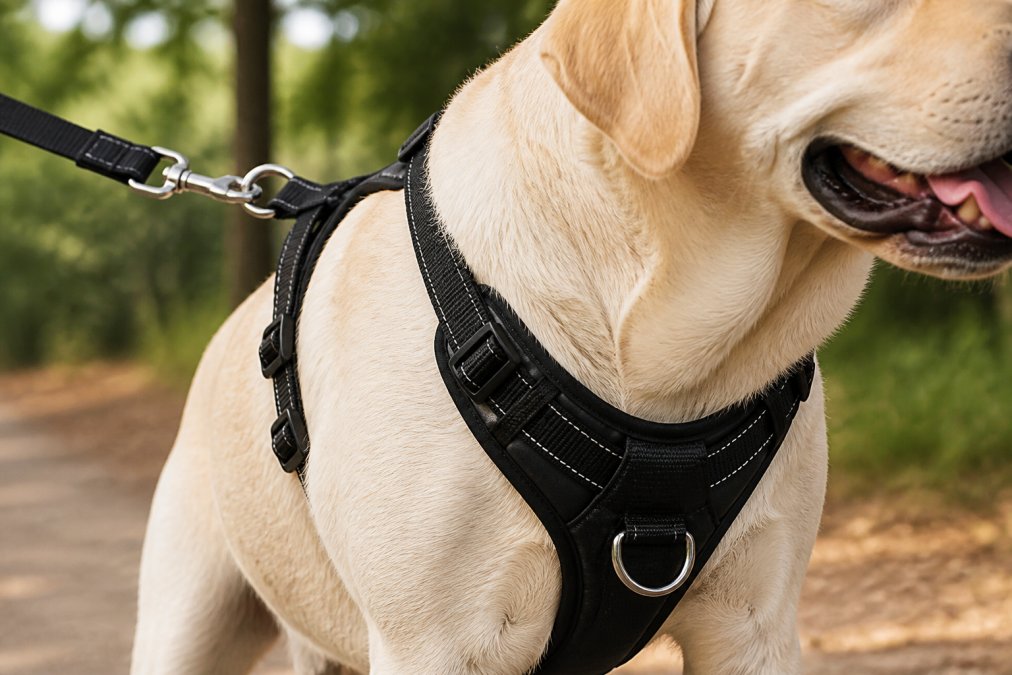
Look for nylon with tensile strength ratings above 1,000 pounds per inch. Lower-quality harnesses use thin nylon or polyester blends that degrade quickly under UV exposure.
The best padding is breathable and strategic: at the chest plate, girth areas, and neck interface, combined with moisture-wicking material. Quality padding maintains cushioning after many wash cycles; budget harnesses use low-density foam that compresses quickly. Premium harnesses use padding that resists compression.
Metal hardware should be stainless steel or powder-coated steel, not zinc alloy. Check that hardware is welded or riveted, not glued.
A durable dog harness uses reinforced thread with redundant stitching patterns. Double stitching means if one line fails, the second holds. Premium harnesses use a higher number of stitches per inch with bonded polyester thread; lower-quality harnesses use fewer stitches per inch with standard thread that unravels in washing machines.
Heavy Duty Dog Harness for Large Dogs
Large dogs generate significant pulling force and body weight that concentrates stress differently. A heavy duty dog harness for large dogs must handle both initial pulling force and sustained pressure.
The chest plate, the front panel across your dog's chest and shoulders, should be at least 3-4 inches wide and constructed from doubled or tripled webbing to distribute pulling force across a larger area.
Girth measurement must be generous enough that the harness doesn't ride up or shift during pulling. Adjustment points should allow precise customization without creating weak spots where webbing bunches.
Front-clip attachment is important for heavy duty dog harness for large dogs because it redirects pulling force forward and to the side, reducing peak force and making the system more stable.
Look for harnesses with both front-clip and back-clip attachment points for flexibility depending on your dog's behavior and walking situation.
Escape-Proof Design Considerations
An escape-proof harness prevents slipping or backing out, a critical safety feature for some dogs and high-value pets.
The neck opening should be snug but not restrictive. The best escape-proof designs use adjustable neck straps and a chest plate that prevents rotation and catches when the dog tries to back out.
The girth straps, the parts that wrap around the body, must be adjustable but not so loose that they allow forward slipping. A common escape method is for dogs to step their front legs out of the harness. Escape-proof designs prevent this by using a Y-shaped configuration where the two front legs are separated by internal webbing or by positioning the girth straps high enough that stepping forward isn't possible.
Buckle security matters. Look for harnesses with quick-release buckles that are secure but not so easy to open that a dog can manipulate them. Velcro closures alone are not sufficient, they wear out and lose grip over time. Metal buckles with secondary safety straps provide better security.
Test the escape-proof design by gently trying to pull the harness off the dog while it's properly fitted. There should be resistance at multiple points. If the harness comes off easily, it's not truly escape-proof.
Proud Pet Shop No-Pull Adventure Harness →
How to Measure a Dog for a Harness
Proper fit is non-negotiable for both comfort and durability. A poorly fitting harness creates stress concentration points and chafing that accelerates wear. Learning how to measure a dog for a harness ensures you get the right size the first time.

Start with neck circumference. Measure around your dog's neck where a collar normally sits, using a soft measuring tape. Add one inch to this measurement, you should be able to fit one finger between the harness and your dog's neck when it's fastened. This is your neck circumference target.
Next, measure girth measurement, the circumference around your dog's body at the widest point of the rib cage. This is typically just behind the front legs. Measure snugly but not so tight that you compress the rib cage. You should be able to fit one to two fingers between the measuring tape and your dog's body.
Some harnesses also specify chest measurement. This is the circumference at the widest point of the chest, typically at the front of the rib cage where the chest plate sits. Measure this the same way, snug but not compressive.
Write down all three measurements: neck circumference, girth measurement, and chest measurement. Compare these to the sizing chart provided by the harness manufacturer. Different brands size differently, so don't assume a "large" from one brand matches a "large" from another.
If your dog is between sizes, choose the larger size and use the adjustment straps to tighten it. It's easier to tighten an oversized harness than to force an undersized one to fit properly. An undersized harness will chafe and fail faster.
Testing Durability: What Real-World Conditions Reveal
The true test of a durable dog harness isn't laboratory conditions, it's what happens after months of regular use, after exposure to mud and rain, and after many pulling incidents. Real-world durability testing reveals what marketing claims don't. A harness that looks sturdy in a product photo may have hidden weak points that only show up under sustained use.
The most common failure points are where webbing meets hardware, where stitching lines cross, and at the edges of padded sections where material can fray. However, durability isn't just about how long a harness lasts before failure, it's also about whether that harness can be repaired or replaced under warranty, which extends its effective lifespan significantly.
Weather resistance matters. A harness that handles rain and sun exposure without degrading will last longer than one that absorbs moisture, develops mildew, or becomes brittle from UV exposure. After washing, a durable harness should dry quickly and maintain its structural integrity. Poor-quality harnesses can lose tensile strength after repeated washing cycles.
The padding should maintain its shape and cushioning through extended use. Cheap padding compresses permanently after a few months and stops providing protection. Quality padding springs back and continues supporting your dog's body even after heavy use.
Reflective trim should remain visible and not fade significantly after exposure to sunlight. This is both a durability indicator and a safety feature for evening walks.
Check attachment points regularly during the first month of use.
Leveraging Warranties and Repair Options as a Durability Strategy
Frequently Asked Questions
What dog harness do vets recommend for durability?
Veterinarians typically recommend harnesses with front-clip designs that distribute pressure across the chest rather than the neck, reducing tracheal strain. Look for harnesses with reinforced stitching, padded chest panels, and hardware rated for your dog's weight. The Proud Pet Shop No-Pull Adventure Harness ($37.99) features a padded front-clip design with reflective stitching and breathable lining, addressing the durability and safety concerns vets prioritize for active dogs.
Is there a dog harness that won't come off?
Truly escape-proof harnesses combine multiple security features: adjustable straps at the neck and girth, quick-release buckles with secondary locking mechanisms, and chest plates that prevent slipping. Measure your dog's neck circumference and girth accurately before purchase, then test the fit with two fingers fitting snugly between the harness and skin. Harnesses with reinforced D-rings and sturdy buckle security are less likely to fail under pulling pressure, which is a common escape trigger.
What makes a harness durable enough for hiking and rough terrain?
Hiking harnesses need abrasion-resistant webbing, tensile-tested hardware, and reinforced stitching at stress points like D-rings and attachment clips. Weather-resistant materials prevent degradation from moisture and UV exposure. Post-wash structural integrity matters too, quality harnesses maintain their shape and strength after repeated cleaning. Look for harnesses with load-bearing capacity rated well above your dog's weight and padding that prevents chafing during extended wear on trails.
How do I know if a harness will actually last longer than a cheap alternative?
Durable harnesses use higher-grade webbing with greater tensile strength, reinforced stitching at all pressure points, and hardware rated for sustained pulling force. Inspect the chest plate for thickness and the D-rings for secure welding or riveting. Check warranty terms and return policies, reputable brands like Proud Pet Shop offer 30-day satisfaction guarantees because they stand behind durability. Compare the weight-to-strength ratio: a heavier harness often indicates better material quality and construction, not just bulk.