
Table of Contents
- Why Pet Carrier Choice Matters for Apartment Dwellers and Travelers
- Soft-Sided vs. Hard-Sided vs. Collapsible: Which Carrier Type Fits Your Life
- Pet Carrier Size Guide: Measuring Your Pet and Matching Dimensions
- Airline-Approved Pet Carrier Requirements and Under-Seat Fit
- How to Get a Pet Used to a Carrier: Acclimation and Stress Reduction
- Compact Pet Carrier for Small Spaces: Storage and Daily Setup
- Essential Features: Ventilation, Safety, Comfort, and Portability
- Cleaning, Maintenance, and Long-Term Care
- Frequently Asked Questions
Last Updated: October 20, 2026
Why Pet Carrier Choice Matters for Apartment Dwellers and Travelers
Choosing the right pet carrier for apartment and travel transforms how you live with your pet and move through the world with them. For apartment dwellers, a carrier that collapses flat or stores compactly saves precious closet space. For travelers, the wrong carrier means stress for your pet, rejected boarding at the airline gate, or a carrier that arrives at your destination damaged.
The carrier that fits your apartment might not meet airline requirements. The durable hard-sided carrier might be too bulky for urban living. The lightweight sling works for quick trips but not for eight-hour flights.
The real challenge isn't finding a pet carrier, it's finding one that solves both problems without forcing you to compromise. This guide covers the carrier types that actually work for dual-purpose living, how to measure your pet correctly, what airlines actually require, and the features that separate a carrier your pet tolerates from one they're calm inside.
Soft-Sided vs. Hard-Sided vs. Collapsible: Which Carrier Type Fits Your Life
Each carrier type brings different trade-offs. Understanding what each excels at helps you avoid buying the wrong one twice.
Soft-Sided Carriers: Flexibility and Portability
Soft-sided carriers offer flexibility that appeals to apartment dwellers. They compress into tighter spaces than hard-sided alternatives and often weigh less, making them easier to carry by hand or shoulder strap.
The trade-off is durability under stress. Soft-sided carriers work well for pets under 15 lbs who remain calm during transport. If your pet thrashes, claws at the material, or you're moving between multiple locations frequently, the fabric can tear or the seams can separate. Many soft-sided carriers are not airline-approved for checked baggage, though some meet under-seat requirements.
Common mistake: assuming a soft-sided carrier is automatically more comfortable for your pet. Comfort depends on padding quality, ventilation, and how secure your pet feels inside, not the material alone.
Hard-Sided Carriers: Durability and Airline Compliance
Hard-sided carriers are built to last. They resist scratching, don't tear, and survive being dropped or sat on. Most hard-sided carriers meet airline requirements for both checked and under-seat travel, making them the standard choice for frequent flyers.
The downside is storage. A hard-sided carrier takes up closet or garage space year-round. If you live in a small apartment, a large hard-sided carrier becomes a furniture piece you're constantly working around. They also weigh more, which matters if you're carrying the carrier by hand for extended distances.
Best for: pets over 15 lbs, frequent air travel, or households with multiple pets rotating through the same carrier.
Collapsible and Expandable Carriers: Space-Saving Solutions
Collapsible carriers flatten nearly to nothing when empty, solving the apartment storage problem entirely. Some expand slightly when in use, giving your pet a bit more room without taking up much space when stored.
The catch: collapsible carriers sacrifice some structural rigidity. They work well for short trips and calm pets, but they're not ideal for long travel or anxious pets who push against the walls. Most don't meet airline requirements, they're designed for car rides, vet visits, and neighborhood walks.
Proudpetshop's Sidekick Sling ($28.99) represents this category well. It's designed for hands-free carrying of pets up to 15 lbs, stores flat, and includes a breathable panel for ventilation during short outings. It's not built for cross-country flights, but it's perfect for apartment dwellers who need occasional mobility without permanent storage overhead.

Pet Carrier Size Guide: Measuring Your Pet and Matching Dimensions
Sizing is where most pet owners go wrong. A carrier that's too large feels insecure to your pet. One that's too small restricts movement and causes stress. The right size lets your pet stand, turn around, and lie down comfortably.
Measure your pet from nose to tail base. Add 2-4 inches to that measurement, that's your minimum carrier length. Measure from paw pads to the top of the head or ears, whichever is higher. Add 2 inches.
For apartment living, many owners choose carriers one size smaller than the ideal to save space. This works only if your pet travels less than four hours at a time. Anything longer, and your pet becomes uncomfortable.
The Proud Pet Shop TrailFold Carrier comes in three sizes (S, M, L) and includes a removable, washable pad. This matters for apartment dwellers because you can clean the carrier between uses without disassembly, keeping odors and hair contained.

Common sizing mistake: buying based on your pet's current weight alone. A young dog will grow. An older pet might lose weight but still need the same floor space for comfort.
Airline-Approved Pet Carrier Requirements and Under-Seat Fit
Airlines have specific requirements, and they vary by carrier. Before purchasing any carrier, verify the airline's pet policy directly on their website, policies change, and outdated information online costs you money and stress.
Most airlines require carriers to fit under the seat in front of you, typically measuring no more than 17-18 inches long, 10-12 inches wide, and 8-10 inches high. Soft-sided carriers have an advantage here because they compress slightly. Hard-sided carriers must fit these exact dimensions.
Check three things:
- Carrier dimensions from the manufacturer
- Your airline's specific under-seat measurements
- The airline's material requirements (some ban soft-sided carriers for checked baggage)
Individual airlines regulate pet carriers. This means a carrier approved by one airline might not be approved by another. If you travel with multiple airlines, you need a carrier that meets the most restrictive requirements.
Many pet owners discover this at the airport, resulting in rejected carriers or expensive last-minute purchases. Measure your carrier against your airline's specs before booking travel.
How to Get a Pet Used to a Carrier: Acclimation and Stress Reduction
A pet that panics inside a carrier creates stress for you both. Acclimation takes time, but it's the single most effective way to reduce travel anxiety.
Start weeks before travel. Leave the carrier open in your apartment with treats inside. Let your pet explore it at their own pace. Reward them for entering voluntarily. Close the door for 10 seconds while they're inside, then open it.
Never force your pet into the carrier or use it as punishment. The goal is to make the carrier feel like a safe space, not a cage. This takes patience, expect 2-4 weeks of gradual introduction.
Proud Pet Shop TrailFold Carrier →
Common mistake: waiting until travel day to introduce the carrier. Your pet's first experience shouldn't be a stressful airport or vet clinic.
Once your pet is comfortable inside, practice short trips. A 10-minute car ride, then a 20-minute one. This builds confidence. By the time you travel, the carrier is familiar, not terrifying.
During travel, keep the carrier in a quiet space when possible. Cover it partially with a blanket to reduce visual stimulation. Speak calmly to your pet. Avoid sudden movements.
Compact Pet Carrier for Small Spaces: Storage and Daily Setup
For apartment dwellers, a compact pet carrier for small spaces isn't just convenient, it's essential. A carrier that requires permanent shelf space creates friction every time you need access to that shelf.
Collapsible carriers solve this by storing flat in a closet corner or under a bed. Soft-sided carriers with handles compress into a bag-like shape. Hard-sided carriers, unfortunately, don't compress, they need a dedicated storage area.
If you choose a hard-sided carrier for durability and airline compliance, consider storing it in a garage, under-bed storage container, or a closet rod using a hanging organizer. The goal is access without constant visibility.
For daily use in an apartment, the Proud Pet Shop Sidekick Sling ($28.99) eliminates storage entirely. It's a crossbody sling that holds pets up to 15 lbs and stores in a closet like a jacket. The breathable panel keeps your pet cool during neighborhood walks or vet visits.
Daily setup matters too. If your carrier requires assembly, you'll use it less. Soft-sided carriers with handles are ready to go. Collapsible carriers pop open instantly. Hard-sided carriers are ready immediately but take space.
Essential Features: Ventilation, Safety, Comfort, and Portability
Four features separate a functional carrier from one your pet actually tolerates.
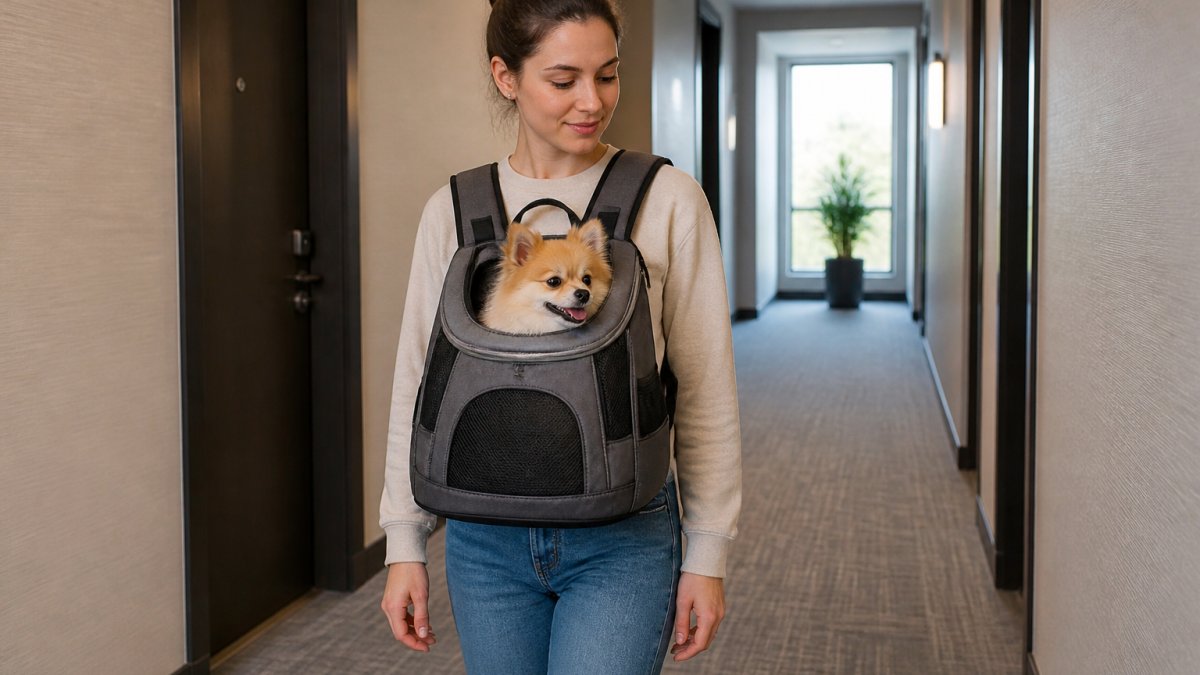
Ventilation keeps your pet calm. Mesh panels on multiple sides ensure air circulation. A carrier with mesh only on the front will overheat your pet during travel.
Safety features prevent escape and injury. Secure closures matter, zippers that lock, latches that don't rattle loose, or velcro that holds firmly.
Comfort includes padding on the base, a washable liner, and enough height for your pet to stand without crouching. A removable, washable pad matters because it collects odors and hair.
Portability means the carrier is actually usable. Shoulder straps distribute weight evenly. Handles are padded to prevent hand fatigue. For backpack-style carriers, adjustable straps fit different body sizes. A carrier that hurts to carry won't get used.
The Proud Pet Shop TrailFold Carrier includes all four. Extensive mesh panels on sides and front ensure ventilation. A dedicated safety leash attachment keeps your pet contained. The removable, washable pad handles odor and hair.
Cleaning, Maintenance, and Long-Term Care
A carrier that's difficult to clean becomes a source of odor and bacteria. This matters in apartments where space is shared and smells linger.
Remove the washable pad regularly and clean it. Most pads can be hand-washed or machine-washed on gentle cycle. Air-dry to prevent shrinkage.
For soft-sided carriers, spot-clean with a cloth and mild detergent. Avoid soaking, which can damage seams. Air-dry completely before storing to prevent mold.
Store carriers in a dry space. Moisture encourages mold and odor.
Inspect the carrier monthly for damage. Torn mesh, loose seams, or cracked plastic should be repaired or replaced. A damaged carrier isn't safe for your pet.
| Carrier Type | Cleaning Frequency | Drying Time | Storage Space |
|---|---|---|---|
| Soft-sided | Weekly spot-clean, monthly deep clean | 4-6 hours air-dry | Compact, hangs or folds |
| Hard-sided | Monthly deep clean | 2-3 hours air-dry | Requires dedicated shelf or closet |
| Collapsible | Weekly spot-clean | 2-3 hours air-dry | Minimal, stores flat |
Choosing a pet carrier for apartment and travel requires balancing durability, compliance, and space. Soft-sided carriers offer flexibility for apartments but sacrifice some durability.
The best choice depends on your specific situation. If you travel frequently by air, prioritize airline compliance and durability.
Proudpetshop offers options across all three categories. The TrailFold Carrier ($34.99) combines durability with ventilation and washable components, making it suitable for both apartment storage and travel.
Frequently Asked Questions
What type of pet carrier is best for apartment living and travel?
Soft-sided carriers work best for most apartment dwellers because they fold flat for storage and are lightweight for travel. Collapsible carriers save even more space when not in use. If you fly frequently, prioritize a hard-sided or airline-approved soft-sided carrier that meets under-seat dimensions. The Proud Pet Shop TrailFold Carrier ($34.99) combines portability with airline-compliant sizing, making it suitable for both everyday apartment use and air travel with small dogs or cats.
How do I know if my pet carrier is airline-approved?
Check your airline's website for specific pet carrier requirements, dimensions, weight limits, and material restrictions vary by carrier. Most airlines require carriers to fit under the seat in front of you, typically 17-19 inches long, 9-10 inches wide, and 9-10 inches tall. Soft-sided carriers with ventilation mesh and secure closures are generally accepted. Before booking, confirm your airline's policy and measure your carrier against their specifications to avoid travel delays.
How do I get my pet used to a carrier before travel?
Start acclimation 2-3 weeks before travel. Leave the carrier open in your home with treats or toys inside, allowing your pet to explore at their own pace. Gradually increase time spent inside, first with the door open, then closed for short periods. Take short trips around your home, then short car rides. Use positive reinforcement: praise, treats, and calm handling. Never force your pet into the carrier. This gradual process reduces travel anxiety and escape attempts during actual trips.
What measurements do I need to take to choose the right carrier size?
Measure your pet's length (nose to base of tail), height (top of head to floor when standing), and width (side to side). Your carrier should allow your pet to stand, turn around, and lie down comfortably. Compare these measurements against carrier size charts, most brands offer S, M, and L options. A carrier that's too small causes stress and discomfort; one that's too large reduces the sense of security. Always verify dimensions in inches before purchasing, and allow 2-3 inches of extra space for comfort.