
Table of Contents
- What Makes Pet Supplies for Active Dogs Actually Reliable
- Quick Comparison: Proud Pet Shop Gear for High-Energy Dogs
- Durable Dog Hiking Gear: What Survives Trail Use
- How to Choose a Dog Harness for Hiking
- Waterproof Dog Collars for Active Dogs: Safety and Tracking
- Recovery, Feeding, and Grooming Gear That Keeps Up
- Frequently Asked Questions
Last Updated: September 12, 2026
What Makes Pet Supplies for Active Dogs Actually Reliable
Most gear fails at predictable points. Reliable pet supplies for active dogs share three traits: hardware rated above your dog's pulling force, materials that resist abrasion and water, and a fit that distributes load across the body rather than the throat. At Proudpetshop, owners tell us the same story: they replaced three cheap harnesses before finding one that held.
Failure Points to Check Before You Buy
The weak link is rarely the webbing. It's the connection point. According to American Kennel Club guidance on walking gear, a collar that sits high on the neck concentrates force directly on the trachea when a dog lunges, which is why front-clip harnesses exist.
Check these three points before spending money:
- The clip. A locking carabiner or welded D-ring holds under load. Stamped metal clips bend open at roughly half their stated break strength once worn.
- The stitching. Look for bar-tack reinforcement at every stress point, not single-line stitching, the cheapest insurance a manufacturer can add, and the most commonly skipped.
- The adjustment hardware. Plastic sliders that creep under tension mean a harness that fits at the trailhead and hangs loose a mile in.
Quick Comparison: Proud Pet Shop Gear for High-Energy Dogs
Every item below targets a specific failure mode rather than a generic "durable" claim, with transparent pricing and no inflated list prices.
| Product | Price | Best For | Standout Feature |
|---|---|---|---|
| No-Pull Adventure Harness | $37.99 | Dogs that lunge on leash | Front-clip redirects pulling force to the chest |
| Cooling Recovery Mat | $28.99 | Post-hike overheating | Water-activated gel, no freezer or power needed |
| Smart Finder Tag | $34.99 | Off-leash trail dogs | Waterproof clip-on with real-time range alerts |
| Bite-Proof Sofa Bed | $161.99 | Destructive chewers | Bite-proof, scratch-proof, waterproof cover |
| IQ Treat Puzzle | $34.99 | Mental stimulation indoors | Adjustable difficulty, dishwasher safe |
| RoadTrip Ride Guard | $34.99 | Travel to trailheads | Non-slip backing, built-in storage pockets |
| Quiet Nail Grinder | $28.99 | Nail-averse dogs | Low-vibration motor reduces handling stress |
| Deshedding Vacuum Kit | $59.99 | Heavy seasonal shedders | Captures fur directly into a canister |
| Automatic Feeder | $159.99 | Multi-pet households | Four scheduled meals, portion control |
Durable Dog Hiking Gear: What Survives Trail Use
Trail conditions punish gear in ways a neighborhood walk never will: granite abrasion, creek crossings, and sudden lunges at wildlife. Durable dog hiking gear must handle all three without a single point of catastrophic failure.

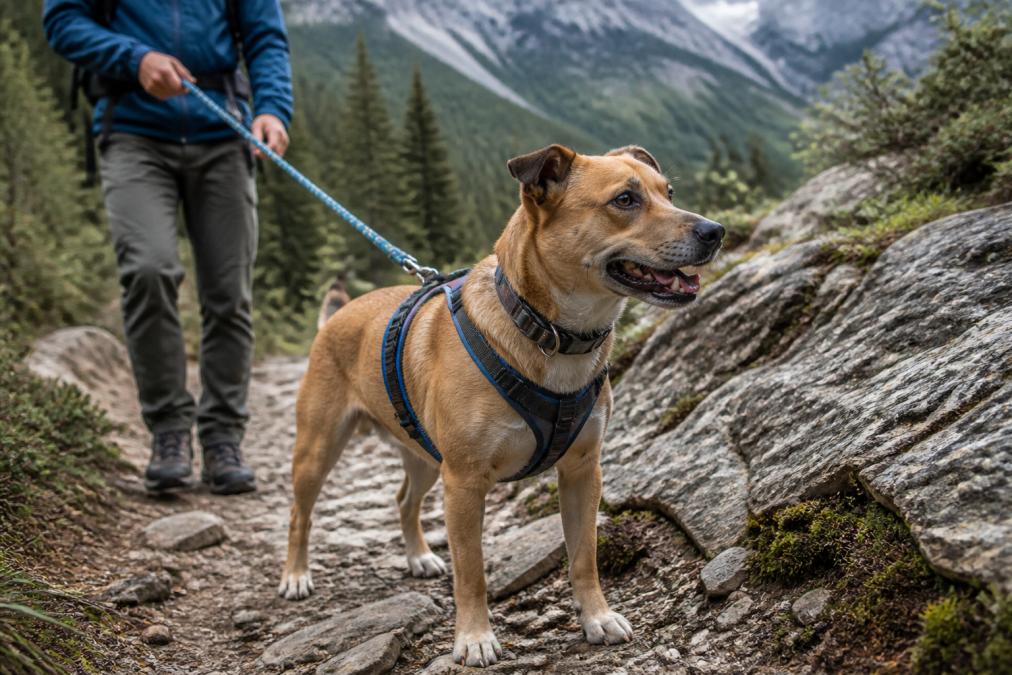
The single most useful spec to compare is weight-to-strength ratio. A harness that weighs 180 grams but holds 400 pounds of pull outperforms a heavier one with the same rating, because less mass means less chafing on a long climb. The Pet Food Institute's guidance on active dog care notes that working and sporting breeds have different endurance needs than companion dogs, which is why fit matters as much as material.
Proudpetshop's No-Pull Adventure Harness comes in XS to XL with a padded, breathable lining, so a dog can wear it all day without hot spots. Its front-clip configuration turns the dog gently back toward you when it pulls, which matters more on a narrow switchback than a sidewalk.
How to Choose a Dog Harness for Hiking
Choosing a dog harness for hiking is a force-management decision, not a style preference. The right harness redirects the load your dog generates, spreads it across the chest and shoulders, and keeps hardware loaded in line with its rated direction. Get any of those wrong and it will rub, rotate, or fail at the clip.
Estimate your dog's pulling force, not its weight. A motivated dog can briefly generate a load well above its body weight during a lunge, a 60-pound shepherd hitting the end of a leash on a squirrel is not producing 60 pounds of force. That's why "rated for dogs up to 80 pounds" tells you almost nothing; you want hardware and webbing rated for the load, not the dog.
Clip position, and what each one actually does
- Front-clip. The leash attaches at the chest, so pulling turns the body sideways instead of driving forward. Best for lunging and reactive dogs, and on narrow switchbacks where you cannot afford to be dragged.
- Back-clip. The leash attaches between the shoulder blades. Comfortable for dogs that already walk on a loose leash, but it gives a committed puller a mechanical advantage, the dog can lean in and tow.
- Dual-clip. Two attachment points, chest and back. Run a single leash with a double-ended clip, or two leashes for finer control. Best for high-prey-drive dogs that are calm on the flat and explosive at the sight of wildlife.
Fit tolerance matters more than material
Measure chest girth at the widest point behind the front legs, then again after a meal and after a swim. Two fingers of slack under the chest strap is the working maximum; anything more and a determined dog can back out entirely. Look for webbing keepers or locking sliders rather than plain plastic tri-glides, the most common source of mid-hike fit drift.
Weight-to-strength ratio
This is the spec most guides skip. A harness that weighs 180 grams but holds 400 pounds of pull outperforms a heavier one with the same rating, because every extra ounce is mass your dog carries up a climb and mass that chafes the coat. For a multi-day trip or a thin-coated dog, it's the difference between a harness that disappears under the fur and one that leaves hot spots by mile six.
Hardware direction and failure sequencing
Most harness failures happen where the webbing meets the hardware. A welded D-ring loaded in line with its weld is strong; the same ring loaded sideways can deform. Stamped metal clips bend open at roughly half their stated break strength once the spring wears, which is why locking carabiners and welded rings are worth the weight penalty on a pulling dog. Bar-tack stitching at every stress point, not single-line stitching, is the cheapest reinforcement a manufacturer can add and the most commonly skipped.
Pairing gear with training
A harness gives you mechanical control; it does not teach your dog to walk calmly. The ASPCA's position on humane training equipment recommends pairing any no-pull device with positive reinforcement rather than relying on the gear alone. In practice that means rewarding the dog for checking in and for slack in the leash, not just for stopping the pull. A martingale-style collar or a head collar can supplement a harness for leash-reactive dogs, but neither replaces training, and a head collar in particular needs a slow introduction before it goes on a trail.
Matching the harness to the puller
Choose by pulling force, not breed size. A casual puller, a young dog still learning leash manners, does fine in a padded back-clip harness with a front-clip option for training days. A committed puller, a working breed, scent hound, or any dog with high prey drive, needs a front-clip or dual-clip design with welded hardware and bar-tack stitching. A reactive dog that lunges needs the same hardware plus a fit tight enough that the harness cannot rotate under a sudden sideways load.
Waterproof Dog Collars for Active Dogs: Safety and Tracking
A waterproof collar is not a luxury on wet trails, it is a tracking requirement, because a collar that stretches, fades, or holds odor stops doing its job. Nylon webbing absorbs water, swells, and loses dimensional stability, so a collar that fit snugly on a dry morning can be a size too loose after two creek crossings. Biothane and coated webbing do not absorb water, which is why they hold their fit through repeated soakings and are the material of choice for dogs that swim, wade, or work in wet conditions.
What actually makes a collar waterproof
Waterproofing is a property of the webbing and the hardware, not the marketing copy. Look for:
- Coated or rubberized webbing. Biothane, coated nylon, and PVC-coated webbing shed water rather than absorbing it. They wipe clean, resist odor, and do not stretch under load when wet.
- Non-corroding hardware. Stainless steel or anodized aluminum buckles and D-rings resist rust. Plated hardware looks fine for a season and then pits, which is when a D-ring starts to deform under load.
- Welded or forged attachment points. A welded D-ring loaded in line with its weld is strong; a stamped ring loaded sideways can open. On a wet trail, hardware is the first thing to fail, not the webbing.
Visibility is a safety feature, not a style choice
Reflective stitching and high-visibility webbing matter most in the two windows when drivers and trail users are least likely to see you: the hour before sunrise and the hour after sunset. Reflective thread returns light directly to its source, so it reads as a bright line to a headlamp but looks almost invisible in daylight. High-visibility colors, blaze orange, chartreuse, reflective silver, increase contrast against foliage and trail surfaces. For a dog that ranges ahead off-leash, a reflective collar plus reflective leash is the minimum; a clip-on light or light-up tag adds an active signal that doesn't depend on someone else pointing a light at your dog.
Tracking tags and what they actually do
A clip-on tracking tag pairs with a companion app and alerts you when your dog leaves a set range, useful on off-leash trails, but no substitute for a collar that stays on and stays visible. Look for a waterproof housing rated for immersion, battery life measured in weeks rather than hours, and a clip that won't work loose in heavy cover. A tag that falls off in the first creek crossing is worse than no tag, because it gives false confidence.
Failure points to check before you trust a collar on the trail
The same three points that matter on a harness matter on a collar:
- The buckle. A metal side-release buckle or a stainless steel buckle holds under load. A plastic buckle that has been frozen and thawed repeatedly can crack at the latch.
- The D-ring. Welded or forged, not stamped. Stamped rings bend open at roughly half their stated break strength once worn.
- The stitching. Bar-tack reinforcement at the D-ring and buckle, not single-line stitching. This is the cheapest insurance a manufacturer can add and the most commonly skipped.
Matching the collar to the activity
A casual walker does fine in a standard nylon collar with reflective stitching. A swimmer or dog that works in wet conditions needs coated webbing and non-corroding hardware. A dog that ranges off-leash needs the same waterproof collar plus a tracking tag with a secure clip and a battery that lasts your longest outing. The collar is the foundation; the tag is the accessory.
Recovery, Feeding, and Grooming Gear That Keeps Up
Recovery matters as much as the walk. A dog that overheats after a summer hike needs cooling fast, and the Cooling Recovery Mat activates with water alone, no freezer or outlet required. Its chew-resistant cover survives the dog that tests it, which is more than most gel pads manage.

Feeding and grooming gear faces the same durability test. The Bite-Proof Sofa Bed's bite-proof, scratch-proof woven cover is removable and machine washable, so mud and accidents don't end its life. The Deshedding Vacuum Kit pulls loose fur into a canister instead of back into the air, and the Quiet Nail Grinder's low-vibration motor makes trims less of a wrestling match.
For multi-pet households, the Automatic Feeder schedules up to four meals a day with portion control, removing the guesswork when you're hiking and someone else is feeding.
Active dogs expose weak gear faster than any review can, so the real test is whether hardware, stitching, and materials hold up under load, not whether the marketing copy sounds convincing. Proudpetshop stocks gear built around those failure points, from the No-Pull Adventure Harness to the Cooling Recovery Mat, with free shipping on orders over $50 and a 30-day satisfaction guarantee. Get started with Proudpetshop and gear that keeps up with your dog instead of giving out on the trail.
Frequently Asked Questions
What features make pet supplies for active dogs reliable?
Look for reinforced stitching at stress points, metal hardware instead of plastic, and materials matched to your dog's habits. A no-pull harness with a front-clip attachment spreads force across the chest instead of the throat. Waterproof collars resist odor and fraying. Beds with bite-proof covers survive chewing. Reliable pet supplies for active dogs also come with a satisfaction guarantee, so you can test durability without risk.
How often should I replace my dog's adventure gear?
Inspect gear monthly and replace it when you spot frayed webbing, bent hardware, or stretched stitching. A harness used daily on trails may last 12 to 18 months before the padding compresses or the clip weakens. Collars exposed to water and mud degrade faster. Beds and mats typically last longer if the cover is machine washable. Replace any item immediately after a hard fall or a near-miss with a clip failure.
Are heavy-duty leashes necessary for all active dogs?
Not every active dog needs a heavy-duty leash, but strong pullers and dogs over 50 pounds benefit from one. A leash rated for 400 to 600 pounds of break strength gives a safety margin if your dog lunges. Lighter leashes work for calm walkers. Pair a heavy-duty leash with a front-clip harness for the most control. The leash alone will not stop pulling; it just prevents breakage.
What safety gear is essential for hiking with a dog?
Start with a well-fitted harness that has a front clip and reflective stitching for visibility. Add a waterproof collar with an ID tag and a GPS tracker for off-leash areas. Bring a cooling mat for rest stops on hot days, and a car seat cover to protect your vehicle on the drive home. A treat puzzle can keep your dog occupied at camp. Pack water and a collapsible bowl for hydration.