
Table of Contents
- Understanding the Signs of Gastric Torsion in Dogs
- GDV in Dogs Symptoms: The Visual Warning Signs
- Dog Bloat Risk Factors: Breeds, Age, and Lifestyle
- Immediate Actions to Take When You See Symptoms
- Prevention and the Best Slow Feeder Bowl for Dogs
- Myths vs. Facts About Gastric Torsion Prevention
- Conclusion: Acting Fast Saves Lives
- Frequently Asked Questions
Last Updated: September 28, 2026
Understanding the Signs of Gastric Torsion in Dogs
Gastric torsion is a sudden, life-threatening condition in which a dog's stomach fills with gas and rotates on its axis, cutting off blood supply and trapping air. Recognizing the signs of gastric torsion in dogs within the first hour or two can mean the difference between a routine emergency visit and a fatal outcome. This guide from Proudpetshop walks through the visual warning signs, the risk factors that raise a dog's odds, and the exact steps to take when something looks wrong.
The condition is formally called gastric dilation-volvulus (GDV), and it progresses faster than almost any other canine emergency. A dog that seems uncomfortable at dinner can be in cardiovascular collapse by midnight.
Below, we break down what each symptom looks like in practice, which dogs face the highest risk, and how feeding habits and gear choices factor into prevention.
What Is Gastric Dilation-Volvulus (GDV)?
Gastric dilation-volvulus is a condition where the stomach distends with gas or fluid and then twists on its supporting ligaments, trapping contents and compressing surrounding blood vessels.
The "dilation" part is the bloating. The "volvulus" part is the rotation, and it's what turns a painful stomach into a systemic crisis. When the stomach rotates, it can cut off the blood supply to its own wall, leading to ischemia and eventually necrosis of the stomach tissue. The spleen, which sits adjacent to the stomach, often gets dragged along and can suffer the same fate.
Two phases matter here. In early dilation, the stomach is stretched but not yet twisted, and decompression may still be possible. Once volvulus occurs, surgery is the only path forward. That window between the two phases is narrow, often measured in minutes to a couple of hours.
For a clinical overview of how veterinary teams classify and treat the condition, the American Veterinary Medical Association resources on GDV offer a solid starting reference.
Why Bloat Is a Medical Emergency
Bloat becomes an emergency the moment the stomach rotates, because rotation triggers a cascade the body cannot reverse on its own. The distended stomach presses against the diaphragm, which restricts breathing and produces the shallow, rapid panting owners often notice first. Blood flow back to the heart drops, perfusion falls, and the dog slides toward shock.
This is why veterinarians treat suspected GDV as a triage priority. A dog in this state can deteriorate from uncomfortable to critical within an hour. There is no home remedy, no position that relieves it, and no amount of waiting that improves the outcome.
GDV in Dogs Symptoms: The Visual Warning Signs
GDV in dogs symptoms follow a recognizable pattern, and most owners describe the same handful of signs in the same rough order. The trouble is that early signs look like ordinary stomach upset. Here's what separates the two.
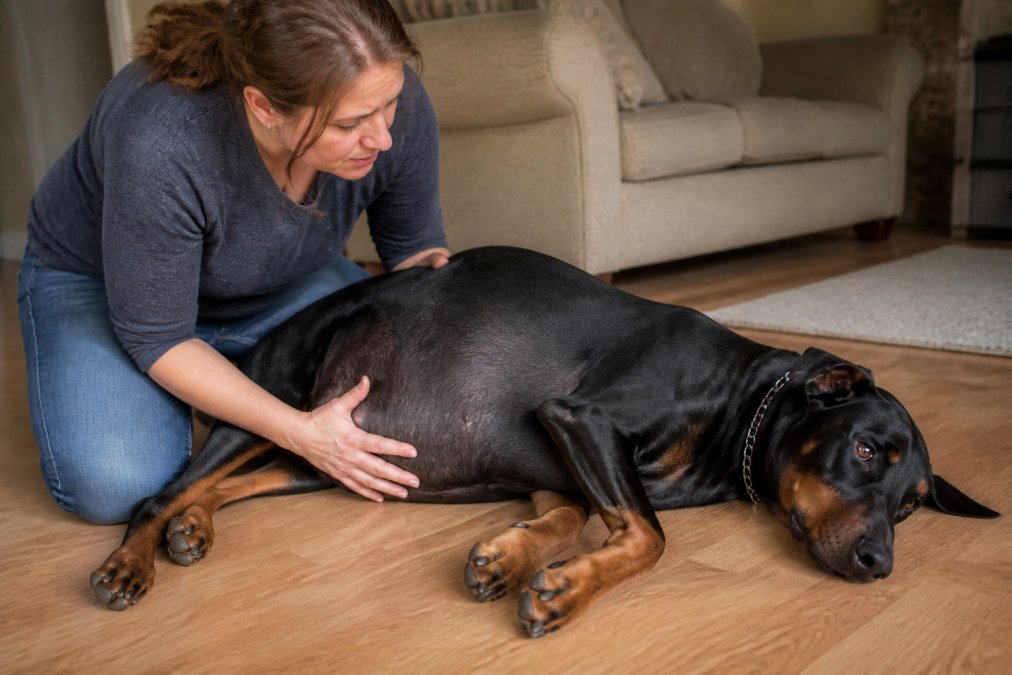
The most reliable early signal is a dog that tries to vomit and produces nothing. That single behavior, paired with a firm or swollen belly, is the classic presentation.
Non-Productive Retching and Hypersalivation
Non-productive retching is the hallmark sign of GDV: the dog heaves and gags repeatedly but brings up nothing, or only foam and saliva.
Owners often mistake this for a dog trying to clear a hairball or an upset stomach. The distinction is that true retching in GDV repeats in cycles and never resolves. Alongside it, hypersalivation is common. The dog drools heavily, sometimes strings of thick saliva, because the distended stomach triggers nausea the body cannot relieve through vomiting.
Watch for the combination: retching plus drooling plus a belly that looks or feels tight. Any two of those three together warrant a call to an emergency vet.
Distended Abdomen and Restlessness
A distended abdomen that feels tight, drum-like, and painful to the touch is the second major warning sign of gastric torsion.
Proud Pet Shop Automatic Feeder →
The swelling is usually most visible just behind the rib cage. In deep-chested dogs, it can be subtle at first and dramatic within a short time. The dog may pace, refuse to lie down, or shift position constantly, unable to get comfortable. Some press their belly to the floor or look back at their flank.
Other signs that cluster with these include:
- Excessive panting and shallow breathing
- Restlessness that escalates rather than settles
- Lethargy and weakness as shock develops
- Pale or discolored gums
- A rapid heart rate, or tachycardia, that owners can sometimes feel through the chest wall
If a dog's gums look pale or gray, that points to poor perfusion and cardiovascular collapse. That dog needs to be in a car heading to an emergency clinic immediately.
Dog Bloat Risk Factors: Breeds, Age, and Lifestyle
Dog bloat risk factors cluster around body shape, age, and how a dog eats. Deep-chested breeds top the list, including Great Danes, German Shepherds, Standard Poodles, Weimaraners, and Boxers. A deep, narrow rib cage gives the stomach more room to rotate, which is why conformation matters so much here.
Age plays a role too. Risk rises as dogs move into middle age and beyond. Eating habits matter as well: dogs that gulp food quickly, eat one large meal per day, or eat from a raised bowl have historically been flagged as higher risk, though guidance on raised bowls has shifted over the years. Eating fast is the factor owners can most directly influence.
| Risk Factor | Why It Matters | What You Can Change |
|---|---|---|
| Deep-chested breed | More room for the stomach to rotate | Nothing, but monitor closely |
| Eating one large meal daily | Rapid stomach filling and gas | Split into 2-3 smaller meals |
| Gulping food | Swallows air along with kibble | Use a slow feeder or foraging mat |
| Advancing age | Tissue elasticity and ligament strength decline | Increase vigilance |
| Vigorous activity after meals | Mechanical stress on a full stomach | Rest for 30-60 minutes after eating |
Stress and anxiety around mealtimes can compound the problem in dogs that already eat fast.
Immediate Actions to Take When You See Symptoms
If you suspect GDV, call your emergency veterinary clinic while you're getting the dog into the car. Do not wait to see if symptoms pass, and do not attempt to relieve the swelling yourself.
- Call the emergency vet and describe the symptoms in plain terms: retching, swollen belly, restlessness.
- Keep the dog calm and restrict movement. Do not let them run or jump.
- Do not press on or massage the abdomen. You can worsen the situation.
- Do not offer food, water, or any home remedy.
- Transport immediately, even if the dog seems to settle for a moment.
Prevention and the Best Slow Feeder Bowl for Dogs
Prevention centers on slowing how fast a dog eats and reducing the volume of air swallowed at each meal. Splitting daily food into two or three smaller portions, avoiding strenuous activity right after eating, and feeding from a bowl designed to force slower consumption all reduce the mechanical stress on a full stomach.
Prophylactic Gastropexy and Lifestyle Changes
Prophylactic gastropexy is a preventive surgery in which the stomach is permanently attached to the abdominal wall to prevent rotation, and it is typically discussed for high-risk, deep-chested breeds.
Myths vs. Facts About Gastric Torsion Prevention
Several persistent myths cause owners to relax when they shouldn't.
Conclusion: Acting Fast Saves Lives
The hardest part of GDV is that the early signs look like an ordinary upset stomach, and the condition punishes hesitation. Retching that produces nothing, a tight swollen belly, and a dog that can't settle are the trio that should send you to the car.
Frequently Asked Questions
What are the early warning signs of gastric torsion in dogs?
Early signs include restlessness, excessive panting, and hypersalivation. Your dog may try to vomit but nothing comes up, a key sign called non-productive retching. The abdomen may look distended or feel tight. As the condition progresses, you might see shallow breathing and a rapid heart rate. If you notice these signs, especially the retching, seek emergency veterinary care immediately. Early recognition of gastric torsion signs greatly improves the chance of survival.
Which dog breeds are most prone to gastric torsion?
Deep-chested breeds are at the highest risk. This includes Great Danes, German Shepherds, Standard Poodles, and Boxers. Dog bloat risk factors also include age over seven, a thinner body condition, and a history of the condition in first-degree relatives. While any dog can develop bloat, owners of these breeds should be especially vigilant and discuss preventive measures with their veterinarian.
Can a dog survive GDV without surgery?
No. Gastric torsion is a life-threatening emergency that requires immediate veterinary intervention. Without surgery to untwist the stomach and perform a gastropexy to secure it, the condition is fatal. The stomach twisting cuts off blood supply, leading to tissue death and shock. If you suspect GDV in dogs symptoms, every minute counts. Call your vet or the nearest emergency animal hospital and get your dog there as fast as possible.
What is the difference between bloat and gastric torsion?
Bloat refers to the stomach filling with gas or fluid and expanding. Gastric torsion, or volvulus, is when the bloated stomach twists on its axis. Bloat alone is painful but can sometimes be treated. Torsion is far more dangerous because the twist traps gas, cuts off blood flow, and causes rapid cardiovascular collapse. The signs of gastric torsion in dogs are similar to bloat but more severe and progressive, always requiring emergency surgery.