
Table of Contents
- Why Dog Collars Break So Easily: The Main Causes
- Buckle and Hardware Failures
- Material Breakdown in Nylon and Leather
- Signs of Dog Collar Wear and Tear to Watch For
- How to Choose a Dog Collar for Pullers
- Heavy Duty Dog Collars: What Actually Makes Them Stronger
- Collar Maintenance and Care Tips That Extend Lifespan
- Conclusion: Matching Gear to Your Dog's Real Pulling Power
- Frequently Asked Questions
Last Updated: September 12, 2026
Why Dog Collars Break So Easily: The Main Causes
Dog collars break so easily because the failure almost never happens in the webbing. It happens at the buckle, the D-ring, or the stitching that holds them together. At Proudpetshop, we've inspected enough returned and worn-out collars to know that most "sudden" breaks were visible weeks in advance.
The exact phrase "why do dog collars break so easily" gets searched thousands of times a month, usually right after a walk goes sideways. The answer is rarely one dramatic flaw. It's a slow accumulation of small stresses that peak at the worst possible moment.
Three forces do most of the damage:
- Tensile load. A dog hitting the end of a leash at speed generates far more force than its body weight. A 60-pound dog lunging can momentarily load a collar with several times that.
- Cyclic fatigue. Every walk flexes the webbing and works the buckle. Thousands of small cycles wear material faster than one big pull.
- Environmental decay. UV light, salt, mud, and repeated wetting break down nylon fibers and corrode metal hardware.
The American Kennel Club's guidance on collar and harness fit stresses that proper fit and the right hardware matter more than a thick strap. That matches what we see in practice: a well-built 1-inch collar outlasts a poorly built 2-inch one every time.
Buckle and Hardware Failures
Buckles and hardware fail before the strap does, and the reason is load concentration. All the force from a pull funnels through two or three small contact points: the buckle prong, the D-ring weld, and the rivet or stitch holding them.
The most common hardware failures:
- Bent or snapped prongs. Cheap stamped metal deforms under a hard lunge and never seats properly again.
- D-ring pull-out. A welded ring that wasn't fully fused opens under load, releasing the leash entirely.
- Corroded springs. Salt water and mud seize the spring mechanism inside a side-release buckle, so it pops open mid-walk.
- Rivet shear. Rivets that replace stitching at stress points can shear clean through.
A common mistake is assuming a metal buckle is automatically stronger than plastic. A poorly cast metal buckle fails more dramatically than a well-molded acetal side-release. The material matters less than the manufacturing quality. Look for solid, not hollow, construction and a D-ring that's welded, not just bent wire.
Material Breakdown in Nylon and Leather
Nylon and leather break down through completely different mechanisms, and knowing which one you own changes how you maintain it. Nylon fails from UV exposure and abrasion. Leather fails from moisture and loss of oils.
Nylon webbing is strong when new, but sunlight degrades the polymer chains over months. A collar that lives on a dog who's outside daily fades and weakens at the same rate. Abrasion from a rough buckle or a dog scratching adds to it. The fibers fray from the outside in, which is why the damage is visible if you look.
Leather has the opposite problem. It gets stronger with age if cared for and brittle if neglected. Repeated wetting and drying draws out the natural oils, and the leather cracks at the fold points, usually right where the collar bends around the buckle. A leather collar that's never conditioned will crack before it wears through.
Signs of Dog Collar Wear and Tear to Watch For
The signs of dog collar wear and tear are easy to spot once you know where to look. Most breaks announce themselves two to three weeks ahead of time.
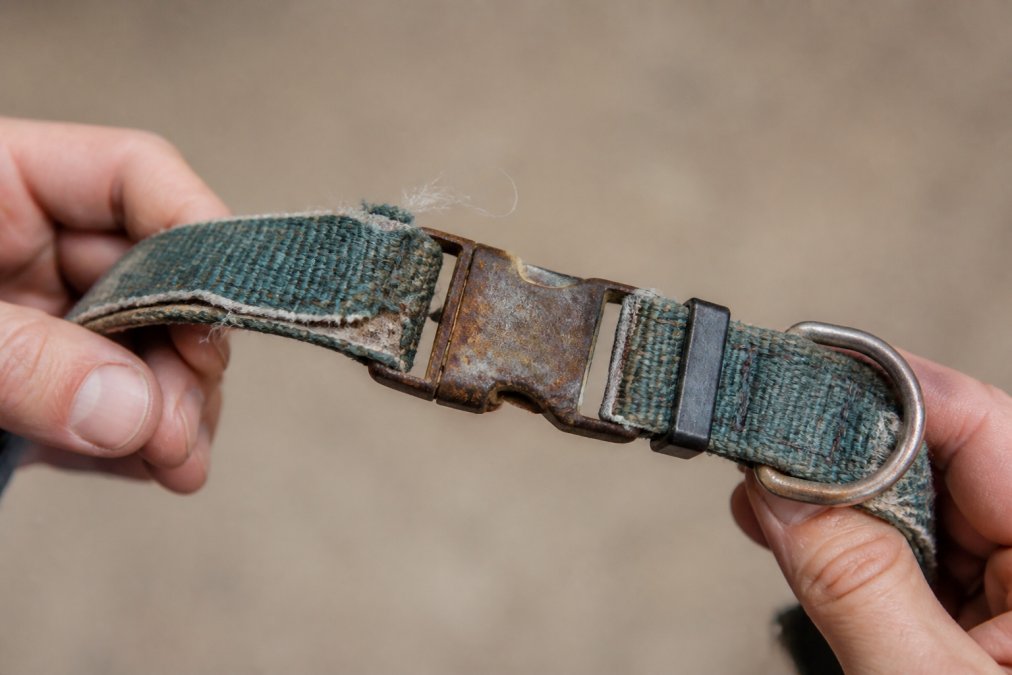
Run this check monthly:
- Frayed or fuzzy edges along the webbing, especially near the buckle
- Visible rust, pitting, or discoloration on metal hardware
- Stretched or loose stitching at the D-ring attachment
- Cracks or dryness in leather at the fold points
- A buckle that no longer clicks firmly or feels loose
- Faded color, a sign of UV degradation in nylon
- Any sharp edge where the D-ring meets the strap
The ASPCA's pet safety and equipment resources recommends retiring any collar with compromised hardware immediately rather than waiting for a full failure. If you spot two or more items on that list, replace the collar now. Don't wait for the walk where it matters.
How to Choose a Dog Collar for Pullers
Choosing a collar for a dog that pulls comes down to three specs: hardware strength, width, and fit. Everything else is marketing.
Start with the hardware. A welded stainless-steel D-ring and a solid metal or high-quality side-release buckle handle load far better than stamped alternatives. Next, match width to size. A wide collar spreads force across more of the neck, which matters for strong pullers.
Fit is where most owners get it wrong. You should fit two fingers snugly between the collar and the neck. Too loose and the collar slides, chafes, and catches on things. Too tight and it restricts breathing and causes irritation.
For serious pullers, though, a collar alone isn't the answer.
When a Harness Beats a Collar for Strong Pullers
A harness beats a collar for strong pullers because it moves pressure off the throat and onto the chest and shoulders. For a dog that lunges, that's a safety issue, not a comfort preference.
The American Veterinary Medical Association's pet care resources notes that pressure on the neck from a pulling dog can affect the trachea and thyroid area over time. A front-clip harness redirects that force entirely.
The Proud Pet Shop No-Pull Adventure Harness is built exactly for this. The front-clip design turns a pulling dog gently back toward you instead of letting it drag, and the padded chest panel spreads load across the shoulders rather than the throat. At $37.99, it's the single upgrade that solves most pulling problems a collar can't.

Heavy Duty Dog Collars: What Actually Makes Them Stronger
Heavy duty dog collars are stronger because of four things: welded hardware, bar-tacked stitching, wider webbing, and a design that doesn't concentrate load at one point. Thickness alone proves nothing.
Here's what separates a genuinely heavy duty collar from a thick-looking one:
| Feature | Weak Collar | Heavy Duty Collar |
|---|---|---|
| D-ring | Bent wire, unwelded | Welded stainless steel |
| Stitching | Single row | Bar-tacked at stress points |
| Buckle | Stamped, hollow | Solid metal or quality acetal |
| Webbing | Thin, single-layer | Wide, tightly woven |
| Load path | Concentrated at one point | Spread across multiple |
What most guides miss is the load path. A collar can have a great D-ring and still fail if all the force lands on two stitches. Bar-tacking, the dense zigzag stitching at attachment points, is the quiet feature that separates collars that last from collars that don't.
Collar Maintenance and Care Tips That Extend Lifespan
Basic maintenance can double a collar's working life, and it takes minutes a month. The goal is to slow the three killers: UV, moisture, and abrasion.
- Rinse after wet or muddy walks. Fresh water removes salt and grit that abrade fibers from the inside.
- Air-dry fully. Never store a damp collar in a closed bag or bin.
- Condition leather every few months. A dedicated leather conditioner replaces oils that moisture strips out.
- Rotate two collars. Alternating gives each one recovery time and lets you inspect the other.
- Store out of direct sun. UV degrades nylon even when the collar isn't being worn.
- Check hardware monthly. A drop of lubricant on buckle springs keeps them clicking cleanly.
A common mistake is treating a collar as permanent equipment. It's a wear item, like a leash or a pair of walking shoes. Plan to replace it on a schedule rather than waiting for failure.
Conclusion: Matching Gear to Your Dog's Real Pulling Power
The honest answer to why dog collars break so easily is that most collars are matched to a dog's size, not its pulling power. A calm 70-pound dog and a lunging 40-pound dog put completely different loads on the same hardware, and the collar doesn't know the difference.
If your dog pulls, the fix isn't a thicker collar. It's the right gear for the actual force involved. Proudpetshop stocks durable, thoughtfully designed gear built for real households, backed by a 30-day satisfaction guarantee, free shipping on orders over $50, and fast tracked shipping so you're not waiting weeks to solve a problem that shows up on every walk.
Get started with Proudpetshop and match your dog's gear to how it actually moves, not just how much it weighs.
Frequently Asked Questions
What is the most durable material for a dog collar?
Nylon webbing with reinforced stitching and metal hardware holds up better than thin leather or plastic-buckled collars. Look for a collar with a welded D-ring and a metal buckle rather than a plastic side-release clasp, especially for dogs over 30 pounds that pull. Heavy duty dog collars built with these materials resist stretching, fraying, and sudden buckle failure far longer than basic options.
How often should you replace your dog's collar?
Inspect the collar monthly and replace it every 12 to 18 months for average dogs, or sooner if you notice fraying, a bent D-ring, or a buckle that no longer clicks firmly. Dogs that swim, roll in dirt, or pull hard may need a new collar every 6 to 12 months. Catching signs of dog collar wear and tear early prevents a break during a walk.
Why does my dog's collar buckle keep snapping?
Plastic side-release buckles are the most common failure point, especially on collars rated for dogs under 30 pounds but used on stronger dogs. Repeated tension from pulling weakens the plastic tabs until they crack. A collar with a metal buckle or a front-clip harness that redirects pulling force away from the neck solves this problem for most owners.
Are plastic side-release buckles safe for large dogs?
For large dogs that pull, plastic buckles are a weak link. The plastic fatigues under repeated load and can snap without warning during a sudden lunge. If you prefer the convenience of a quick-release buckle, choose one rated for your dog's weight and pair it with a harness. A no-pull harness like the Proud Pet Shop No-Pull Adventure Harness ($37.99) moves pressure off the neck and reduces strain on any buckle.