
Table of Contents
- What Determines Whether Expensive Dog Leashes Are Worth It
- The Real Cost-Per-Use Math Behind Premium Leashes
- Durable Dog Leash Materials: Leather vs. Webbing vs. Rope
- Best Dog Leash Hardware Types: Where Clip Failure Happens
- Signs of Wear and When to Replace a Dog Leash
- Safety Testing and Ergonomic Benefits You Pay For
- The Verdict: Are Expensive Dog Leashes Worth It for Your Dog?
- Frequently Asked Questions
Last Updated: September 9, 2026
What Determines Whether Expensive Dog Leashes Are Worth It
Whether expensive dog leashes are worth it comes down to cost per year of reliable use versus replacing cheap ones repeatedly, or worse, the cost of a mid-walk failure. A premium leash is a safety tool first and an accessory second. The real differentiator is rarely the brand name, it is material quality, hardware integrity, and stitching that holds up under real pulling behavior.
Most budget leashes fail in predictable ways: the clip bends, the webbing frays, or the stitching unravels within months. Assuming all nylon webbing is the same is a mistake; the difference in tensile strength and abrasion resistance between a $10 leash and a premium one is substantial. The expensive dog leashes worth considering are built with hand-stitched seams, weather-resistant coatings, and hardware rated for your dog's actual weight.
The Real Cost-Per-Use Math Behind Premium Leashes
The cost-per-use analysis changes the argument entirely. A $15 leash that lasts six months before the clip fails costs $2.50 per month. A premium leash priced at $60 that lasts five years or more costs $1.00 per month, and it never puts your dog at risk of slipping loose near traffic.
| Leash Type | Typical Lifespan | Replacement Cycle | Cost Per Month |
|---|---|---|---|
| Budget nylon | 6-12 months | 1-2 per year | Higher over time |
| Mid-range webbing | 1-2 years | Every 1-2 years | Moderate |
| Premium leather or reinforced webbing | 3-5+ years | Rarely replaced | Lowest long-term |
The Total Cost of Ownership Over Five Years
A five-year comparison paints a clearer picture. If you buy a $15 leash and it fails every eight months, you will purchase roughly 8 leashes over five years. That is $120 in total spending, plus the inconvenience of a mid-walk failure each time. A $60 premium leash that lasts five years costs $60 total, saving you $60 in direct replacement costs. But the gap widens when you factor in the cost of a single failure event.
A broken clip or snapped seam means an uncontrolled dog near a road or another animal. If a leash failure results in a vet bill from traffic or a fight, that single incident can exceed the price of a premium leash many times over.
The Repair and Repairability Factor
A growing consideration in the premium market is repairability. Many budget leashes are not designed to be repaired; when the stitching fails or the clip bends, the entire leash goes in the trash. Premium manufacturers, particularly those making leather leashes, often offer repair services or sell replacement hardware. A leather leash with a replaceable clip and a stitched handle can have its hardware swapped out for a few dollars, extending the life of the main body indefinitely.
This "right to repair" approach changes the cost-per-use calculation. A $70 leather leash needing a $10 hardware replacement every three years can last a decade or more, $90 total, or $0.75 per month. The environmental impact of throwing away a worn leash every few months also favors a durable option that stays out of a landfill.
The Hidden Cost of Disposable Gear
The environmental cost of disposable gear is rarely factored into the purchase decision. A budget leash that lasts six months and is thrown away contributes to the estimated 300,000 tons of pet waste products that end up in landfills each year (the EPA). A premium leash that lasts five years or more reduces that waste stream by a factor of ten. For eco-conscious owners, this is not a minor consideration; it is a primary driver of the purchase decision.
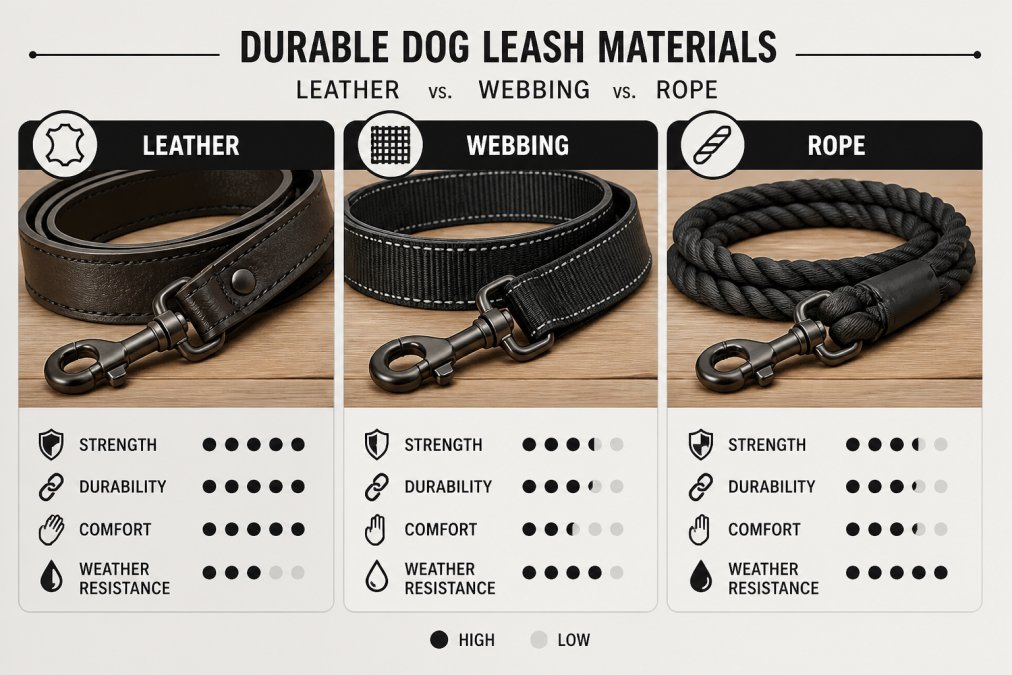
Durable Dog Leash Materials: Leather vs. Webbing vs. Rope
When comparing durable dog leash materials, each option has a distinct trade-off between strength, comfort, and maintenance. Leather offers classic durability and develops a comfortable grip over time, but it requires conditioning to stay supple and can degrade if soaked repeatedly. Full-grain leather with hand-stitched seams is the gold standard for longevity, though it is heavier and less weather-resistant than synthetics.
Nylon webbing is the practical everyday choice. High-density webbing with bartacked stitching resists abrasion and dries quickly. The catch is that not all webbing is equal: cheap webbing has a loose weave that catches dirt and frays, while premium webbing is tightly woven with UV protection.
Rope leashes, often made from climbing-grade materials, excel in tensile strength and are popular for heavy pullers. They are lightweight and dry fast, but the texture can cause friction burns on your hands during a sudden lunge. For most owners, a reinforced webbing leash offers the best balance of control, comfort, and durability for everyday carry.
Best Dog Leash Hardware Types: Where Clip Failure Happens
The best dog leash hardware types are those rated for tensile strength well above your dog's weight, because the clip is the weakest link in the entire system. Most leash failures occur at the hardware junction, not along the webbing itself. A bolt snap or a locking carabiner made from solid brass or stainless steel resists bending and corrosion far better than a stamped metal clip found on budget leashes.
The swivel mechanism is another critical point. A leash without a swivel causes the webbing to twist and tangle, creating uneven wear and stressing the stitching. A quality swivel allows free rotation, reducing tangles and prolonging the material's life.
When evaluating hardware, check the weight rating stamped on the clip and compare it to your dog's pulling force, not just their body weight. A 40-pound dog pulling hard can generate force well above its standing weight. Choosing hardware with a break strength of several times your dog's weight provides a safety margin that cheap clips simply do not offer.
Signs of Wear and When to Replace a Dog Leash
Knowing when to replace a dog leash is as important as buying a good one, because even premium materials eventually wear out. Inspect your leash before every walk, especially if your dog pulls or chews on the handle. Run your fingers along the entire length of the webbing or leather, feeling for frayed fibers, thin spots, or cuts.
The hardware deserves the same scrutiny. A clip that sticks, a swivel that no longer turns freely, or any visible rust or corrosion is a sign that the mechanism is compromised. Pay close attention to the stitching where the leash attaches to the clip and the handle; loose or broken threads here mean the structural integrity is failing, even if the rest of the leash looks fine.
A reasonable replacement cycle for a daily-walk leash is every one to two years for budget gear, while a premium leash with proper care can last three to five years or longer. If you notice any of these signs, replace the leash immediately, regardless of age.
Safety Testing and Ergonomic Benefits You Pay For
What you are actually paying for in a premium leash is the engineering and testing that goes into safety and comfort. Reputable manufacturers rate their leashes for break strength and test the hardware under repeated stress, data that budget brands rarely publish. This engineering matters because a leash is a control tool, and control fails when a component gives way under sudden tension.
The Data Behind the Price Tag
Most budget leashes do not publish load-testing data. A dog's pulling force is not equal to its body weight: a 40-pound dog lunging after a squirrel can generate 120 to 160 pounds for a split second (peer-reviewed research). If the hardware is rated for a static load of 50 pounds, that sudden dynamic load can exceed the metal's yield strength, causing it to bend or fail.
Premium manufacturers typically test their hardware to a break strength that is 3 to 5 times the recommended dog weight. For example, a leash marketed for dogs up to 60 pounds might have a clip with a published break strength of 300 pounds. This margin accounts for dynamic loads, corrosion weakening the metal over time, and manufacturing variances. When you see a weight rating stamped on a clip, it is usually the safe working load, not the breaking point. The safe working load is typically one-third to one-fifth of the ultimate break strength (osha.gov).
What Testing Actually Looks Like
A common pattern among reputable manufacturers is to test hardware in three ways: static load testing, dynamic drop testing, and cyclic fatigue testing. Static load testing applies a steady, increasing force until the component fails. Dynamic drop testing simulates a sudden jerk by attaching a weight and dropping it to create an impact load. Cyclic fatigue testing repeatedly applies and releases a load to simulate years of normal walking, which is how a swivel mechanism or a spring-loaded clip eventually wears out.
Budget leashes rarely undergo cyclic fatigue testing. A clip that works on day one can fail after 10,000 cycles because the spring weakens or the metal fatigues. Premium manufacturers that publish test protocols give you a verifiable standard, not just a marketing claim.
Ergonomic Design as a Health Investment
The other hidden value is ergonomic design. A padded or contoured handle distributes pressure across your hand, reducing strain with a strong puller and protecting your long-term joint health. A comfortable grip also improves communication with the dog, letting you hold the leash steadily without constantly adjusting.
For owners with arthritis, carpal tunnel syndrome, or chronic hand pain, handle design is a functional necessity. A standard 5/8-inch flat nylon leash concentrates pulling force into a narrow band across your palm; a 2-inch neoprene or leather pad spreads that force over a larger area, reducing peak pressure. Some premium leashes offer molded grips that follow the hand's natural curve, reducing the need to grip tightly.
Matching the Leash to the Dog's Build
For owners of specific breeds, requirements differ. A brachycephalic breed like a bulldog should never wear a collar-attached leash for pulling, so a well-built harness paired with a durable leash is essential. High-energy working breeds need hardware that withstands sudden bursts of speed.
A giant breed like a Great Dane or a Mastiff generates forces that standard hardware is not designed to handle. A leash rated for a 60-pound dog is not appropriate for a 150-pound dog that can pull with over 400 pounds of force. For these breeds, look for hardware rated for 500 pounds or more, and consider a leash made from climbing-grade rope or reinforced webbing with a published break strength. The premium market exists because these specifications matter, and the difference between a leash that holds and one that fails is not visible at a glance.
The Verdict: Are Expensive Dog Leashes Worth It for Your Dog?
The answer depends on your dog and walking habits, but for most owners, investing in a quality leash is the right call. If you walk a calm dog on quiet sidewalks a few times a week, a mid-range leash will serve you fine. If you have a strong puller, walk in urban areas with traffic, or hike regularly, the expensive dog leashes worth buying are those with verified break strength, solid hardware, and ergonomic handles.
The deciding factor is the cost of failure. A leash that breaks during a walk is not just a wasted purchase; it is a safety incident waiting to happen. When you compare the monthly cost of a premium leash against the risk of a cheap one failing, the premium option wins on both economics and peace of mind.
We stock gear that meets this standard: durable materials, tested hardware, and designs built for real households with active pets. Every product is backed by a 30-day satisfaction guarantee and free shipping on orders over $50, so you can try a quality leash without the risk. If you are tired of replacing worn-out gear, start with a leash built to last and see the difference in your daily walks.
Frequently Asked Questions
Do expensive dog leashes actually last longer than budget options?
Usually, yes, when comparing the same material type. A $15 nylon leash and a $40 nylon leash from the same factory may perform identically, but a premium leash typically uses thicker webbing, hand-stitched seams, and stronger hardware. The measurable difference shows up in cost-per-use: a $40 leash lasting five years costs about $0.02 per walk, while a $10 leash replaced every six months costs four times more annually. Check the tensile strength rating and stitching quality before buying.
What are the best dog leash hardware types for strong pullers?
For strong pullers, look for solid brass or stainless steel hardware rather than chrome-plated zinc, which can crack under repeated stress. A bolt snap with a rotating swivel mechanism reduces torque on the clip and prevents twisting. Rated break strength matters more than brand: choose hardware rated for at least double your dog's body weight. Avoid stamped metal clips that feel thin or have visible seams, as these are common failure points during sudden lunges.
How often should you replace a dog leash for safety?
Inspect your leash before every walk and replace it at the first sign of damage. Nylon webbing should be replaced when you see frayed edges, melted fibers, or a stretched, weakened section near the handle. Leather needs replacement when it develops cracks, becomes stiff, or shows thinning at stress points. Hardware should be swapped if the spring feels weak, the clip sticks, or you notice rust. A well-maintained premium leash lasts three to five years with daily use.
Is a leather dog leash better than nylon or rope?
Each material serves a different purpose. Leather offers the best longevity and develops a comfortable grip over time, but it requires conditioning and is not ideal for water play. Nylon webbing is weather-resistant, lightweight, and easy to clean, making it the best all-around choice. Rope leashes provide excellent abrasion resistance and float, which suits hiking and water sports. Your choice should match your dog's environment and your maintenance willingness, not just the price tag.
Choosing a leash is a decision about safety, comfort, and long-term value, not just a quick purchase. The cheapest option often costs more in the long run, both in replacements and in risk. Get started with Proudpetshop and find a durable, well-tested leash that holds up to your dog's daily adventures.