
Table of Contents
- What Makes an Orthopedic Bed Work for Large Senior Dogs
- Best Dog Bed Materials for Joint Support
- Low-Entry Dog Bed for Senior Dogs: Accessibility and Ease of Movement
- How to Measure a Dog for a Bed: Getting the Right Size and Weight Capacity
- Water-Resistant Orthopedic Dog Bed: Durability, Covers, and Long-Term Care
- Top Orthopedic Beds for Large Senior Dogs: Feature Comparison
- Pressure Relief, Weight Distribution, and Recovery Support
- Common Mistakes When Choosing an Orthopedic Bed for Senior Dogs
- Frequently Asked Questions
Last Updated: October 16, 2026
What Makes an Orthopedic Bed Work for Large Senior Dogs
Understanding the best orthopedic bed features for large senior dogs, specialized foam support, accessible design, and durable construction, helps you choose a bed that truly addresses aging canines' needs.
The core principle is pressure relief. On a standard bed, a large dog's weight concentrates on pressure points like hips, shoulders, and elbows, aggravating joint pain.
Entry height matters as much as foam quality. Many senior dogs struggle to jump onto elevated beds or climb out of deep surfaces.
Durability separates quality orthopedic beds from cheap imitations.
Best Dog Bed Materials for Joint Support
The materials inside your dog's bed determine whether it relieves joint pain or just feels comfortable for a few weeks. Two foam types dominate: high-density foam and memory foam.
High-Density Foam vs. Memory Foam
High-density foam provides firm, consistent support without conforming closely to your dog's shape. It resists compression and holds its structure for years, preventing sinking for large senior dogs that shift positions frequently, and its firmness helps dogs with severe arthritis stand up.
Memory foam molds to your dog's contours, distributing weight across a larger area and reducing pressure points more dramatically than high-density foam alone. For senior dogs with moderate joint pain who stay in one position, it improves comfort significantly.
Many premium beds combine both: a memory foam top for comfort and pressure relief, with a high-density base for durability and support. The Proud Pet Shop Comfort Den XL uses high-density orthopedic foam selected to relieve pressure on sensitive joints while resisting the compression that degrades cheaper beds within months.

Foam Thickness and Compression Resistance
Foam thickness determines how long a bed stays supportive.
Compression resistance is measured in pounds per cubic foot (PCF): high-density foam runs 3-5 PCF, memory foam 4-6 PCF. Higher ratings resist compression better and hold shape longer.
Test firmness by pressing your hand into the foam: it should sink slightly but meet noticeable resistance. If your hand sinks deeply with little support underneath, density is too low for a large dog.
Low-Entry Dog Bed for Senior Dogs: Accessibility and Ease of Movement
A low-entry dog bed for senior dogs removes the barrier that keeps many aging canines off elevated surfaces.
The ideal entry height is 4-6 inches, letting a large dog step on with their front legs and slide their rear legs up to lie down, far less demanding than jumping.
Edge design matters too. A firm, defined edge is easier to step onto than a sloped or soft one.
Non-slip bases keep the bed from sliding when your dog moves or stands. A bed that shifts under their weight creates instability and makes getting up harder.
How to Measure a Dog for a Bed: Getting the Right Size and Weight Capacity
Choosing the right size prevents your dog from being cramped or left without adequate support. Proper measurement takes a few minutes and dramatically improves the odds your dog will use the bed.
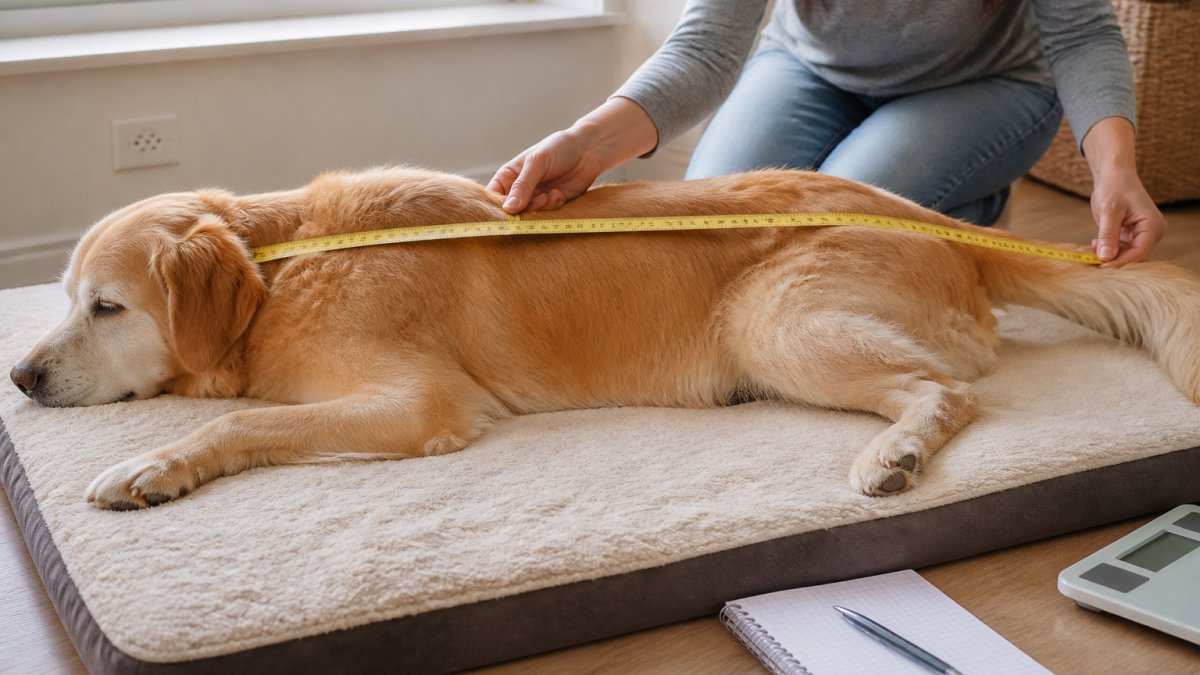
Measure length by placing your dog in a natural lying position and measuring from nose tip to tail end.
Measure width by checking how much space your dog occupies lying on their side, from one side of the body to the other, including legs.
Weight capacity is non-negotiable. A bed rated for 60 pounds compresses excessively under an 80-pound dog, negating its orthopedic benefits.
| Measurement | How to Measure | What It Determines |
|---|---|---|
| Length (nose to tail) | Place dog in lying position, measure tip of nose to tail end | Minimum bed length needed; add 6-12 inches for comfort |
| Width | Measure across dog's body when lying on side | Bed width to accommodate stretched-out position |
| Current weight | Use a veterinary scale for accuracy | Baseline for weight capacity selection |
| Entry height needed | Observe how easily your dog steps onto furniture | Ideal bed height (4-6 inches for most senior dogs) |
Water-Resistant Orthopedic Dog Bed: Durability, Covers, and Long-Term Care
A water-resistant orthopedic dog bed for large senior dogs protects your investment and maintains hygiene. Senior dogs are prone to incontinence accidents, and any bed lacking moisture protection absorbs urine, creating odor and bacterial growth. Water-resistant construction is essential, not a luxury.
Waterproof Liners and Removable Covers
The most effective beds use a waterproof liner against the foam core with a removable fabric cover on top.
Look for polyurethane or vinyl-based liners, which are genuinely waterproof. Lower-quality beds use "water-resistant" covers that repel water initially but eventually absorb moisture; true waterproof liners block liquid indefinitely.
Removable covers should be machine-washable on a gentle or warm cycle; hand-wash or dry-clean covers are impractical. The Comfort Den XL's removable cover is designed for standard machine washing.
Non-Slip Bases and Floor Protection
A non-slip base prevents the bed from sliding and protects flooring from scratches and moisture transfer.
Check that the non-slip material covers the entire bottom, not just corner patches. Full coverage distributes weight evenly and prevents shifting, which matters for large dogs over 80 pounds whose concentrated pressure can overwhelm small patches.
Proud Pet Shop Comfort Den XL →
Moisture transfer is a real concern: a bed without a bottom waterproof barrier can absorb humidity from damp floors and wick it into hardwood or carpet, causing odor and potential mold.
Top Orthopedic Beds for Large Senior Dogs: Feature Comparison
Proudpetshop offers multiple orthopedic options designed to address different senior dog needs and living situations.
| Bed Model | Best For | Weight Capacity | Key Features | Price |
|---|---|---|---|---|
| Comfort Den XL | Large senior dogs with arthritis | Up to 80 lbs | 7-inch high-density foam, waterproof cover, bolster sides, non-slip base | $149.99 |
| CloudLift Bed | Dogs needing temperature regulation | Large/Extra Large sizes | Breathable mesh, elevated design, chew-resistant frame, indoor/outdoor use | $99.00 |
| Waterproof Pet Sofa | Small-to-medium senior dogs | Up to 55 lbs | Wood frame, plush cushion, waterproof lining, non-slip legs | $156.99 |
| Bite-Proof Sofa Bed | Active dogs prone to chewing | Large/XL | Bite-proof fabric, waterproof, removable washable cover, all-season use | $161.99 |
| Calming Donut Bed | Senior dogs with anxiety | Small/Medium/Large | Raised rim for head/neck support, plush filling, self-warming properties | $39.99 |
The Comfort Den XL is the top choice for most large senior dogs because it combines genuine orthopedic support with practical senior-dog features.

The CloudLift Bed ($99.00) suits senior dogs that overheat easily or spend time outdoors.
The Waterproof Pet Sofa ($156.99) is best for smaller senior dogs (up to 55 lbs) that need the combination of elevation and moisture protection.
The Bite-Proof Sofa Bed ($161.99) addresses a specific problem: senior dogs that still chew destructively despite their age.
Pressure Relief, Weight Distribution, and Recovery Support
Pressure relief is the defining characteristic of orthopedic beds.
High-density foam and memory foam distribute weight across a broader surface area, reducing peak pressure at any single point.
Weight distribution also affects spinal alignment. A dog lying on an uneven surface develops compensatory muscle tension as their body tries to stabilize itself. This tension perpetuates joint pain and stiffness.
Recovery support extends beyond pain management. Senior dogs recovering from surgery, injury, or illness benefit enormously from beds that minimize movement during rest.
Common Mistakes When Choosing an Orthopedic Bed for Senior Dogs
The biggest mistake is confusing "orthopedic" marketing with actual orthopedic support.
Choosing a bed based solely on price leads to disappointment. Budget beds ($30-50) rarely include genuine orthopedic foam or waterproof protection.
Overestimating your dog's jumping ability leads to choosing beds that are too high.
Ignoring waterproofing is a critical error for senior dogs.
Choosing the wrong size creates usability problems.
Choosing the right orthopedic bed for your large senior dog requires understanding what orthopedic support actually means and how specific design features address aging dogs' needs.
Frequently Asked Questions
What is the best orthopedic bed for a senior dog?
The best orthopedic bed for a senior dog combines high-density foam for joint support, a low-entry design for easy access, and a waterproof cover for durability. Look for beds with bolster sides to cradle the head and neck, weight capacity matching your dog's size, and non-slip bases to prevent sliding. The Comfort Den XL ($149.99) delivers these features for dogs up to 80 lbs with removable, machine-washable covers and raised bolster sides that reduce pressure on sensitive joints.
How thick should an orthopedic bed be for a large dog?
Large senior dogs benefit from beds with 4-7 inches of foam thickness. Thicker foam distributes weight more evenly and resists compression flattening over time. High-density foam maintains its shape longer than standard padding, so a 7-inch bed with quality foam often outlasts a 10-inch bed with low-density filling. Check the product specifications for foam density (measured in pounds per cubic foot) rather than relying on thickness alone, denser foam provides better long-term support.
Are memory foam beds good for older dogs?
Memory foam can be beneficial for senior dogs because it contours to the body and reduces pressure points. However, memory foam alone may not provide enough firmness for large dogs needing maximum joint support. The best orthopedic beds combine memory foam with a high-density foam base layer to balance comfort and support. This dual-layer approach prevents the bed from bottoming out while still cushioning sensitive joints, making it ideal for aging dogs with arthritis or stiffness.
How do I choose the right bed size for my senior dog?
Measure your dog from nose to tail tip while lying down, then add 6-12 inches for comfortable stretching. For large senior dogs, choose a bed at least 36-48 inches long and 24-36 inches wide. Check the weight capacity, it should exceed your dog's current weight by 10-15 lbs to account for the bed's support surface and prevent sagging. Senior dogs often sprawl more when resting, so a slightly oversized bed reduces strain on joints during movement and sleep.
What features should I look for in an orthopedic bed for a large senior dog?
Prioritize high-density foam (3-5 lbs per cubic foot), a weight capacity matching or exceeding your dog's size, low-entry design (under 8 inches tall), bolster sides for head and neck support, waterproof or water-resistant covers, removable and washable fabrics, and non-slip bases. These features address common senior dog needs: joint pain relief, ease of movement, accident containment, and long-term durability. A bed like the Comfort Den XL includes all these elements for large dogs.
How can I make it easier for a senior dog to get on and off a bed?
Choose a low-entry orthopedic bed with a height under 8 inches to reduce the jump or climb required. Beds with gradually sloped sides or bolster edges provide footholds and support during entry and exit. Placing the bed on a non-slip surface prevents sliding when your dog pushes off. Some owners add a ramp or steps nearby for extra assistance. Elevated beds like the CloudLift ($99.00) keep dogs off cold floors while maintaining accessibility, and the raised design often feels easier to access than floor-level beds.
What's the difference between orthopedic and regular dog beds?
Orthopedic beds use high-density or memory foam specifically engineered to distribute weight evenly and reduce pressure on joints, while regular beds typically have low-density padding that compresses quickly. Orthopedic beds resist flattening and maintain support over months of use, whereas standard beds often sag after a few weeks. For senior dogs with arthritis, joint pain, or mobility issues, the difference in comfort and recovery is significant. Orthopedic beds cost more upfront but last longer and provide therapeutic benefit.
Can an orthopedic bed help with arthritis or post-surgery recovery?
Yes. A quality orthopedic bed reduces pressure on arthritic joints by distributing weight evenly across the foam surface, which can decrease stiffness and improve mobility. After surgery, proper support accelerates healing by minimizing strain during rest. High-density foam and bolster sides help senior dogs move more comfortably on and off the bed. While a bed alone does not treat arthritis, combining it with veterinary care, exercise, and nutrition creates an environment that supports recovery and daily comfort for aging dogs.