
Table of Contents
- Crossbody Pet Sling vs Front-Hugging Backpack for Small Dogs
- How to Measure a Dog for a Carrier
- Crossbody Pet Slings: Hands-Free Simplicity for Quick Trips
- Front-Hugging Backpacks: Versatility for Longer Adventures
- Ergonomic Dog Carrier for Small Dogs: What Your Back Needs
- Dog Carrier Safety Standards and What to Check
- Sling vs Backpack: Key Differences at a Glance
- Choosing the Right Carrier for Your Small Dog
- Frequently Asked Questions
Last Updated: September 26, 2026
Crossbody Pet Sling vs Front-Hugging Backpack for Small Dogs
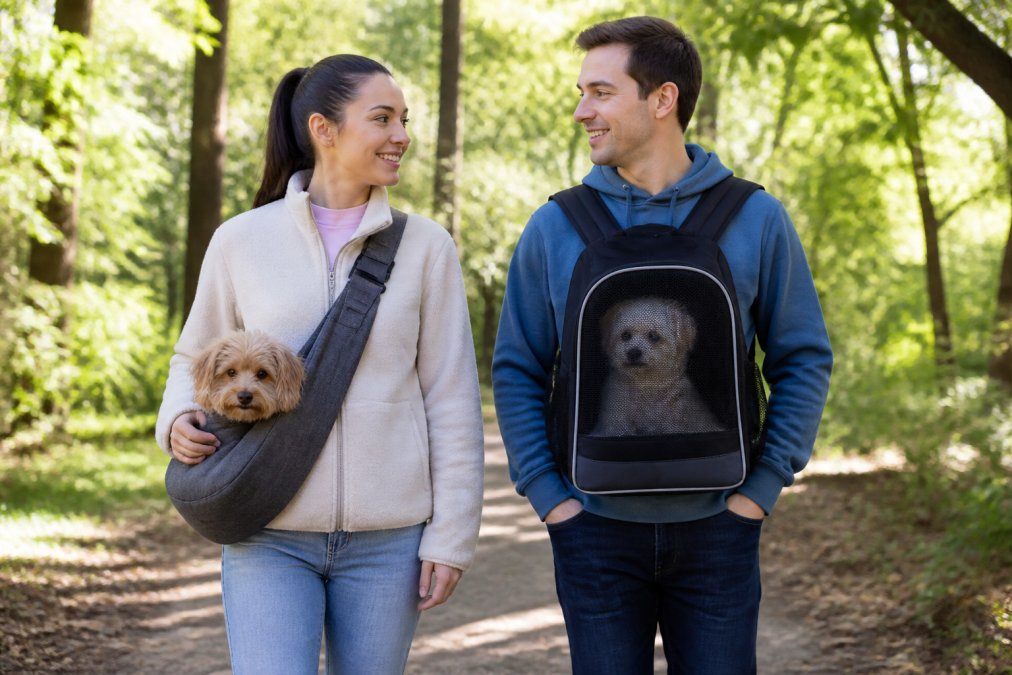
Choosing between a crossbody pet sling vs front backpack for small dogs depends on your lifestyle, your dog's comfort, and your physical needs. Both offer hands-free carrying but solve different problems: weight distribution, ventilation, ease of use, and long-term comfort.
A crossbody pet sling positions your small dog against one side of your body, distributing weight across a single shoulder and your torso. A front-hugging backpack, by contrast, spreads the load evenly across both shoulders and your back, with adjustable straps and often lumbar support. The choice isn't about which is objectively better, it's about which fits your routine.
How to Measure a Dog for a Carrier
Know your dog's dimensions before choosing a carrier. Too snug stresses your dog; too loose creates safety risks.
Measure body length (nose to tail base), height (head to ground), and weight. Most small dog carriers accommodate pets up to 15 pounds.
A quality carrier should allow your dog to stand, turn around, and lie down comfortably. If measurements near the upper limit, size up. A slightly loose fit beats cramped.
Crossbody Pet Slings: Hands-Free Simplicity for Quick Trips
A crossbody pet sling is a fabric pouch that drapes across your body, cradling your dog against one side. It's lightweight, packable, and perfect for quick errands or neighborhood walks.
The Proud Pet Shop Sidekick Sling holds pets up to 15 pounds, features a breathable panel, and uses a soft buckle closure with adjustable strap for most body sizes.

Best for urban commuting and neighborhood outings
Crossbody slings excel for quick trips: coffee runs, visits, short walks. Your hands stay free and your dog stays close, which many pets find calming.
Urban dwellers appreciate slings because they fold into a backpack or tote without taking up much space.
Slings work best for trips under an hour. Beyond that, single-shoulder weight distribution becomes noticeable, especially with heavier dogs.
Weight distribution and comfort for the owner
All weight rests on one shoulder and one side of your torso. Over time, this creates neck strain and uneven muscle engagement. If you have shoulder or back issues, a sling may aggravate them.
You unconsciously lean to compensate, throwing off spinal alignment. Fine for short trips, not ideal for longer outings or daily use.
Front-Hugging Backpacks: Versatility for Longer Adventures
A front-hugging backpack is a structured carrier worn on your front. Your dog sits in a secure compartment with mesh ventilation, padded shoulder straps, and often a waist belt for lumbar support.
The Proud Pet Shop TrailFold Carrier features adjustable shoulder straps, breathable mesh panels, removable washable pad, external storage pockets, and interior safety leash attachment in three sizes (S, M, L). Wear front-facing for bonding or back mode for longer hikes.

Adjustable straps and lumbar support
Front-hugging backpacks distribute weight across both shoulders and hips, keeping your spine neutral and muscles engaged symmetrically. Carrying a 15-pound dog for two hours feels manageable because the load is shared.
Lumbar support prevents slouching from uneven weight distribution, especially important if you have back sensitivity.
Adjustable straps let you dial in the fit. Tighter straps reduce strain; looser straps shift weight further from your spine. Finding your sweet spot takes a few minutes.
Breathable mesh and ventilation for pet safety
Mesh panels on sides and front allow continuous airflow, keeping your dog cool on warm days or during activity.
Proud Pet Shop Sidekick Sling →
Extensive mesh prevents heat buildup, critical because dogs regulate temperature less efficiently than humans. Non-ventilated carriers can cause overheating within minutes.
A safety leash attachment prevents escape or injury if your dog shifts or panics.
Ergonomic Dog Carrier for Small Dogs: What Your Back Needs
Poor carrier design creates real pain over weeks and months. Even 10 pounds shifts your center of gravity and increases spinal load.
Human ergonomics: weight distribution and posture. An ergonomic dog carrier distributes weight evenly, maintains natural posture, and reduces moment arm (distance between load and spine). Front-hugging backpacks engage both shoulders and often include waist support, preventing neck strain, shoulder impingement, and lower back strain. A sling concentrates weight on one shoulder, triggering pain within weeks of daily use. The TrailFold's adjustable straps reduce strain on your lumbar spine.
Dog orthopedics: spinal support and weight distribution. Small dogs have proportionally delicate spinal columns. A poorly designed carrier that sags can misalign your dog's spine, contributing to early-onset disc disease in breeds like Dachshunds, Corgis, and Chihuahuas. A rigid carrier with internal support prevents sagging and keeps your dog's spine neutral. The TrailFold's rigid frame and padded interior support maintain spinal alignment during movement.
Temperature regulation and metabolic stress. Heat-trapping carriers force your dog's body to work harder, compounding stress over time. Extensive mesh ventilation keeps core temperature stable and reduces physiological load.
Long-term comfort and injury prevention. A quality front-hugging backpack with rigid structure, lumbar support, and breathable ventilation prevents pain and injury for both you and your dog. The TrailFold's removable, washable pad reduces bacterial growth and odor, important for dogs with sensitive skin or ear infection prone conditions.
Dog Carrier Safety Standards and What to Check
Not all carriers meet the same safety benchmarks. When evaluating any carrier, look beyond marketing claims to understand what actually prevents injury.
Buckle and closure integrity. A secure closure system prevents accidental opening during movement or if your dog shifts weight. Soft buckles or zippers should operate smoothly without catching fabric. Test the closure 10-15 times before purchasing; a buckle that sticks or feels loose under pressure is a red flag. Plastic buckles rated for at least 50-pound load capacity are standard; metal buckles offer higher durability for daily use. A failed closure doesn't just mean your dog escapes, it means a sudden weight shift that can throw you off balance, especially on stairs or uneven terrain.
Safety tether or leash attachment inside the carrier. This is non-negotiable for active dogs. An interior tether keeps your dog from jumping or lunging if the carrier opening fails. The tether should be short enough (6-8 inches) to prevent your dog from reaching the carrier's edge, but long enough to allow them to shift position. Check that the attachment point is reinforced with extra stitching or a metal D-ring; a tether sewn to thin fabric will tear under panic or sudden movement.
Breathable materials and heat dissipation. Mesh panels should cover at least 40% of the carrier's surface area, positioned on sides and front to create cross-ventilation. Single-panel mesh designs (front only) create dead zones where air doesn't circulate. Look for multi-layer mesh that allows airflow while preventing your dog's claws or teeth from catching. On hot days above 75°F, a carrier without adequate mesh can trap heat and raise your dog's core temperature by 2-3°F within 20 minutes, enough to trigger heat stress in small breeds.
Reinforced stitching at stress points. Examine shoulder straps, attachment points, and seams before buying. Stress points should show double or triple stitching, with thread color matching the fabric (a sign of intentional reinforcement, not a repair). Fraying edges or loose threads indicate the carrier was not quality-tested. Seams should sit flat and even; puckered or wavy seams suggest the fabric was pulled during manufacturing and may fail under load.
Removable, washable interior pad. This is a hygiene feature that separates premium carriers from basic ones. A non-removable pad traps bacteria, urine, and odor.
Sling vs Backpack: Key Differences at a Glance
| Feature | Crossbody Sling | Front-Hugging Backpack |
|---|---|---|
| Best for | Quick trips under 1 hour | Longer outings and hiking |
| Weight distribution | Single shoulder | Both shoulders + waist |
| Hands-free | Yes | Yes |
| Ventilation | Basic breathable panel | Extensive mesh panels |
| Lumbar support | No | Often included |
| Storage | Minimal | Multiple external pockets |
| Portability | Very compact | Larger, more structured |
| Price range | Budget-friendly | Mid-range |
| Dog comfort | Good for short trips | Better for extended wear |
Choosing the Right Carrier for Your Small Dog
Start with your routine. How often do you carry your dog? How long are typical outings? When deciding between a crossbody pet sling vs front backpack, if you're doing five-minute trips to the vet or quick walks around the neighborhood, a sling like the Sidekick Sling works fine and costs less.
Frequently Asked Questions
What is the difference between a crossbody pet sling and a front-hugging backpack?
A crossbody pet sling wraps diagonally across your body for quick trips and urban commuting, keeping your hands completely free and distributing weight to one shoulder. A front-hugging backpack uses both shoulder straps for balanced weight distribution, offers more storage pockets, and works better for longer hikes or outdoor adventures. Slings prioritize simplicity; backpacks prioritize ergonomic support and versatility.
How do I measure a dog for a carrier to ensure proper fit?
Measure your dog's length from the base of the neck to the base of the tail, and measure chest girth at the widest point. Check the carrier's size chart against these measurements, your dog should have room to stand, turn, and lie down comfortably without excess space that causes shifting. Most carriers list weight capacity and size categories (S, M, L) to match your pet's dimensions accurately.
Are front-facing carriers safe for small dogs during hiking or outdoor activities?
Yes, when they meet safety standards and include a secure tether attachment inside the main compartment. Front-facing carriers with breathable mesh panels, adjustable harnesses, and anti-anxiety design help keep your dog calm and secure during movement. Always verify the carrier has a buckle-close or zipper-lock mechanism and weight capacity appropriate for your dog's size before extended outdoor use.
Which carrier type is better for a dog with back or joint issues?
A front-hugging backpack with padded shoulder straps and lumbar support is generally better for dogs with orthopedic concerns because it distributes weight evenly across both shoulders, reducing strain on your spine and posture. This balanced weight distribution also minimizes stress on the dog during transport. Crossbody slings concentrate weight on one shoulder and may cause neck strain or posture misalignment during longer use.