
Table of Contents
- Signs of Cat Anxiety: What Your Cat Is Telling You
- Creating a Safe Space for Cats: The Foundation of Calm
- Natural Remedies for Cat Anxiety: Pheromones, Supplements, and Enrichment
- How to Calm a Cat for Travel: Carrier Training and Vet Visits
- Multi-Cat Households and Post-Adoption Transition Anxiety
- When to Call Your Veterinarian About Cat Anxiety
- Conclusion: Patience, Consistency, and the Right Gear
- Frequently Asked Questions
Last Updated: September 10, 2026
Signs of Cat Anxiety: What Your Cat Is Telling You
Cat anxiety is a stress response that shows up in body language, daily habits, and appetite long before most owners notice. Learning how to calm anxious cat behavior starts with reading those signals early, because unaddressed behaviors deepen rather than fade. This guide walks through steps that address the root of feline stress, not just the symptoms.
Physical and Behavioral Warning Signs
The clearest physical signs of cat anxiety include flattened ears, a tucked tail, dilated pupils, and a crouched posture. Behavioral red flags matter just as much: hiding, excessive grooming, appetite changes, litter box avoidance, and fear-based aggression.
Vocalizations shift too: an anxious cat may yowl at night, growl when approached, or go unusually quiet. Signs often appear in clusters, a cat that hides and stops eating is telling you something very different than one that simply prefers a quiet corner.
Never punish the behavior, punishment increases fear and worsens anxiety. Instead, note the pattern: what happened right before the hiding, grooming, or refusal to eat? That trigger is where your work begins.
Creating a Safe Space for Cats: The Foundation of Calm
A safe space is a quiet, enclosed area your cat can retreat to at any time without being disturbed, the single most effective environmental change you can make for an anxious cat. It should include hiding spots, vertical space, and a den-like bed.
Hiding spots give cats control over their exposure, a covered box, closet corner, or cat cave all work. Vertical space matters because height equals security; a shelf or cat tree lets them observe from a distance. For the resting spot, a den-style bed with raised walls, like the Proud Pet Shop Cozy Cabin Den, blocks drafts and creates the enclosed feeling stressed cats seek.
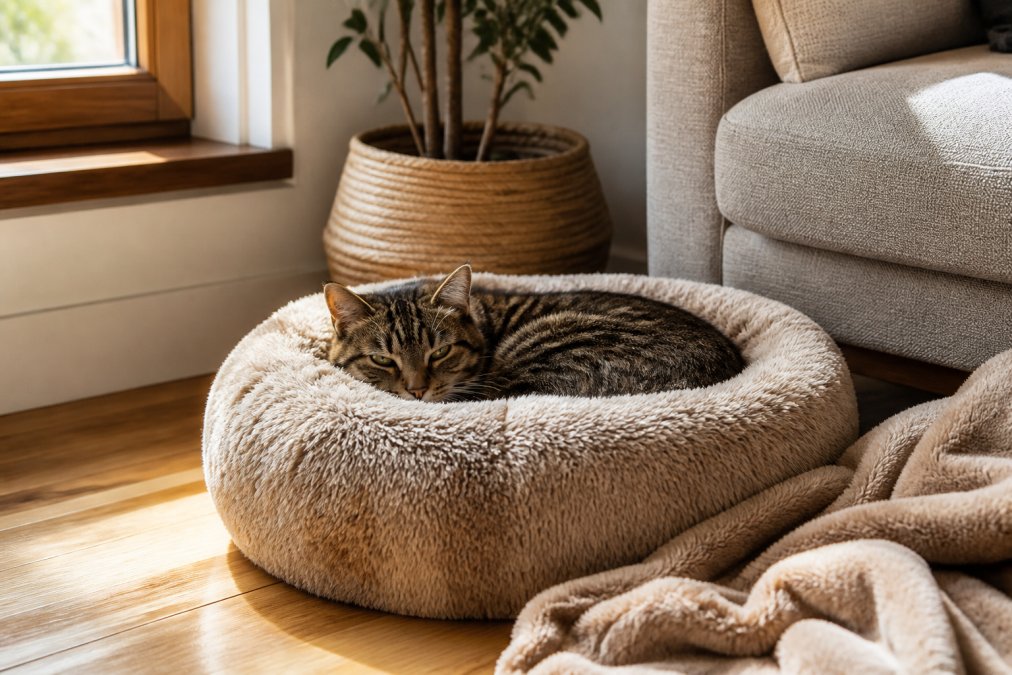
The Proud Pet Shop Calming Donut Bed uses the same principle: its raised rim cradles the head and neck and mimics the sensation of being held, which helps cats settle faster during thunderstorms, fireworks, or stretches of being alone.

Natural Remedies for Cat Anxiety: Pheromones, Supplements, and Enrichment
Natural remedies for cat anxiety fall into three categories: calming pheromones, over-the-counter supplements, and environmental enrichment. None replace a veterinary diagnosis, but together they lower baseline stress so the other steps take hold. What most guides skip is the mechanism behind each one, and that your own stress level is part of the equation.
Pheromones: What They Actually Do
Synthetic pheromone diffusers mimic the facial pheromones cats deposit when they rub their cheeks against furniture, doorframes, and trusted people, marking a space as safe. Plug-ins release the analog continuously for roughly 30 days per refill; sprays work better for spot treatment, a carrier, a vet exam table, a new cat tree (petmd.com). The trade-off: pheromones are species-specific and cats respond differently. Some settle within days; others show no change. They help most during transitions (a move, a new pet, a vet visit) rather than as a permanent fix for chronic anxiety.
Supplements: Read the Label, Then Call Your Vet
Over-the-counter calming chews and drops commonly contain L-theanine (an amino acid found in green tea), chamomile, valerian root, or a milk-protein hydrolysate. L-theanine is the most studied for feline use and generally well tolerated, but "generally" is not "always." Cats metabolize many compounds differently than dogs or people, and some herbal ingredients safe for humans are not safe for cats. Check with your veterinarian before starting any supplement, especially if your cat takes medication, has kidney or liver issues, or is pregnant. Dosage depends on weight, age, and health history, never scale a dog dose down to a cat.
Enrichment: The Most Underrated Remedy
Boredom and anxiety look almost identical in indoor cats, both producing overgrooming, hiding, and disrupted sleep. Puzzle feeders, lick mats, and interactive play give a cat something to do with nervous energy instead of grooming it into a bald patch: a cat that is problem-solving is not scanning the room for threats.
DIY Sensory Enrichment and Interactive Play
DIY sensory enrichment means building stimulation from what you already have: cardboard boxes with treats tucked inside, paper bags to pounce on, and a window perch facing a bird feeder. Rotate the setup every week or two, novelty keeps enrichment effective.
Interactive play should follow a hunt-catch-kill rhythm: drag a wand toy like prey, let your cat catch it, then let it "die." Ten to fifteen minutes, twice a day, is often enough to take the edge off. For solo enrichment, the Proud Pet Shop IQ Treat Puzzle converts snack time into problem-solving with adjustable difficulty. The Proud Pet Shop Slow-Feeding System works the same muscle: textured ridges turn a fast, stressful meal into slow, deliberate licking, which many owners find settling at mealtimes.


The Angle Most Guides Miss: Your Stress Is Your Cat's Stress
Cats are keen readers of human behavior, tracking your tone, posture, routine, and scent. When you are anxious, pacing, raising your voice, changing your schedule unpredictably, your cat often mirrors that arousal. This is not anthropomorphism; it is social referencing, the same mechanism that makes a cat relax when its owner relaxes.
That means some of the most effective "natural remedies" are for you, not your cat. Keep your voice low and movements slow to calm anxious cat stress, and stick to a predictable daily rhythm for meals, play, and quiet time. If you are dealing with a major stressor, a move, a loss, a new baby, expect your cat to pick up on it and give both of you extra structure. Owners who stabilize their own routine often see symptoms ease without changing a single product.
How to Calm a Cat for Travel: Carrier Training and Vet Visits
Calming a cat for travel starts weeks before the trip, not the morning of it. Carrier training, desensitization, and counter-conditioning turn the carrier from a fear trigger into a familiar object.
Leave the carrier out permanently, door open and a soft blanket inside. Toss treats near it, then inside it, and let your cat eat meals beside it. Over days, most cats begin entering on their own, desensitization paired with positive reinforcement, which works far better than forcing a cat in at the last minute.
For vet visits, cover the carrier with a towel in the car, use a pheromone spray on the bedding, and book a quiet appointment time if your clinic offers one. Never open the carrier in the waiting room, and give your cat a quiet room to decompress afterward.
| Step | What to Do | When to Start |
|---|---|---|
| Leave carrier out | Door open, bedding inside | 2-3 weeks before travel |
| Feed near carrier | Meals and treats beside it | Week 1 |
| Feed inside carrier | Bowl just inside the door | Week 2 |
| Short car rides | 5 minutes, then home | Week 3 |
| Full trip | Cover carrier, pheromone spray | Travel day |
Multi-Cat Households and Post-Adoption Transition Anxiety
Territorial stress is the hidden driver behind most "mystery" anxiety in multi-cat homes. When resources are scarce or shared, cats compete constantly, and that low-grade tension shows up as hiding, spraying, overgrooming, or aggression that seems to come out of nowhere. Most general anxiety guides treat the cat as a solo unit. In a multi-cat home, the household is the unit that has to change.
The Resource Math That Actually Works
The rule is simple: one of everything per cat, plus one extra. That means three litter boxes in a two-cat home, not two; three feeding stations in separate rooms, not two bowls side by side; plus multiple water sources, scratching posts, and resting spots at different heights. The "plus one" exists because cats in a tense household still need to choose a resource without crossing another cat's path.
Placement matters as much as count. Litter boxes should not be lined up in a row, that creates a single corridor one cat can guard. Spread them across different rooms with clear sightlines and at least two exit routes each. Feeding stations should be far enough apart that one cat cannot see the other eating. Water bowls should be kept away from food; many cats avoid water placed next to their meals.
Reading the Tension Before It Becomes a Fight
Overt fighting is the late stage. Earlier signals include:
- One cat consistently leaving a room when another enters
- Staring contests that end with one cat walking away stiffly
- Blocking, one cat positioning itself in a doorway, hallway, or on top of a shared perch
- Resource guarding of a specific box, bowl, or sleeping spot
- One cat spending more time under beds, on top of cabinets, or in rooms the other cat rarely uses
If you see these patterns, the household is already under stress. Adding resources at this stage is far easier than repairing a relationship after a real fight.
Post-Adoption Transition Anxiety: The Two-Week Reset
A newly adopted cat needs a single room, not the whole house, for the first week or more, the difference between a cat that settles in days and one that hides for a month. Set up the room with a litter box, food and water on opposite sides, a hiding spot, and a perch. Spend quiet time there without forcing interaction, and let the cat come to you.
When the cat is eating, using the box, and exploring confidently, expand access one room at a time. Slow introduction to resident cats happens through a cracked door or baby gate, with scent swapping first: rub a cloth on one cat's cheeks, let the other smell it, then reverse. Feed both cats on opposite sides of the barrier so they associate each other's scent with something good. Rushed introductions create fear-based aggression that can take months to undo.
When the Household Needs More Than Resources
If tension persists after resource multiplication and a proper introduction period, the next step is a veterinary behaviorist, not a stronger punishment or a spray bottle. Chronic inter-cat stress is linked to urinary issues, overgrooming, and immune suppression, and it rarely resolves on its own (peer-reviewed research). In some cases, managed separation, separate zones with shared scent but no direct contact, is the kindest long-term answer.
When to Call Your Veterinarian About Cat Anxiety
Call your veterinarian when anxiety symptoms last more than a few days, when your cat stops eating or using the litter box, or when self-grooming causes bald patches or skin wounds. These signs can point to feline health problems, not just stress.
Stress-related illness is real in cats. Untreated anxiety is linked to urinary issues, digestive problems, and immune suppression. A veterinarian can rule out pain, thyroid conditions, and other medical causes that mimic anxiety, then discuss behavioral modification or prescription options if needed.
Bring notes: when the behavior started, what changed in the household, and what you've already tried. Specifics speed up diagnosis. If your vet recommends a behaviorist, take the referral; severe cases respond best to professional guidance combined with the environmental changes in this guide.
Conclusion: Patience, Consistency, and the Right Gear
Anxious cats don't reset overnight. The steps in this guide work through repetition: a safe space that never moves, play that happens every day, a carrier that stops being scary because it's always there. Consistency matters more than any single product.
Proudpetshop built its catalog around exactly this kind of daily, durable support, with a 30-day satisfaction guarantee and free shipping on orders over $50. Start with a den-like bed your cat can claim as its own, add a puzzle feeder to redirect nervous energy, and give the routine time to take hold. Browse the Proudpetshop calming and enrichment collection and give your cat the calm, predictable environment it's been asking for.
Frequently Asked Questions
How long does it take for a cat to destress?
Most cats begin settling within 24 to 48 hours once a stress trigger is removed, but full recovery from a major event like a move or new pet can take two to four weeks. The 3-3-3 rule gives a useful timeline: three days to decompress, three weeks to adjust to routine, and three months to feel fully at home. Consistency matters more than speed, so keep feeding, play, and quiet time on a predictable schedule while your cat adjusts.
What are the physical signs of anxiety in cats?
Watch for a tucked tail, flattened ears, dilated pupils, and a crouched posture. Other physical signs include excessive grooming that creates bald patches, appetite changes, litter box avoidance, and stress-related illness like vomiting or diarrhea. Vocalizations such as excessive meowing or growling, plus fear-based aggression when approached, also point to anxiety. Documenting when these behaviors appear helps your veterinarian identify the specific stress triggers at play.
Can pheromones help a stressed cat?
Yes. Synthetic pheromone diffusers and sprays mimic the natural facial pheromones cats leave when they feel safe, which can reduce hiding, spraying, and tension in multi-cat homes. They work best as one part of a broader plan that includes a safe space, predictable routine, and environmental enrichment. Plug a diffuser into the room where your cat spends most of its time, and give it a few days to build up before judging results.
How do I calm my cat during travel or vet visits?
Start carrier training weeks ahead: leave the carrier open at home with treats and a familiar blanket inside so it becomes a normal resting spot. Spray the carrier with a calming pheromone 15 minutes before departure, cover it with a light towel to block visual stress triggers, and play soothing music or white noise during the ride. For severe cases, ask your veterinarian about over-the-counter calming treats or a short-term anti-anxiety option before the trip.