
Table of Contents
- Why a Quiet Nail Grinder for Dogs Changes Grooming
- How to Use a Dog Nail Grinder Without Stress
- Choosing a Dog Nail Grinder for Anxious Dogs
- Decibel Levels, Vibration, and Motor Power Compared
- Cordless vs Corded Grinders: Battery and Convenience
- Maintenance, Grit Degradation, and Replacement Bits
- Conclusion
- Frequently Asked Questions
Last Updated: September 14, 2026
Why a Quiet Nail Grinder for Dogs Changes Grooming
A quiet nail grinder for dogs is a rotary grooming tool built to file nails down gradually with a low-decibel motor and minimal vibration, rather than cutting them with a blade. For dogs that panic at the sound of clippers, that difference decides whether nail trims happen at all. This guide from Proudpetshop breaks down how these tools work, what separates a genuinely quiet model from a marketing claim, and how to keep one running for years.
Here is the part most guides skip: noise, not pain, is usually what ends a nail trim early. A grinder that hums instead of whines removes the trigger before it fires.
Below, we cover technique, motor specs, battery trade-offs, and the maintenance nobody talks about.
How to Use a Dog Nail Grinder Without Stress
Using a dog nail grinder without stress comes down to three things: short sessions, a supported paw, and letting the dog leave before it wants to. Rushing the first few sessions is the single most common reason owners give up on grinding entirely.
Start with the grinder off. Let your dog sniff it, then touch it to a paw for two seconds and stop. Do that for a few days before you ever turn it on.
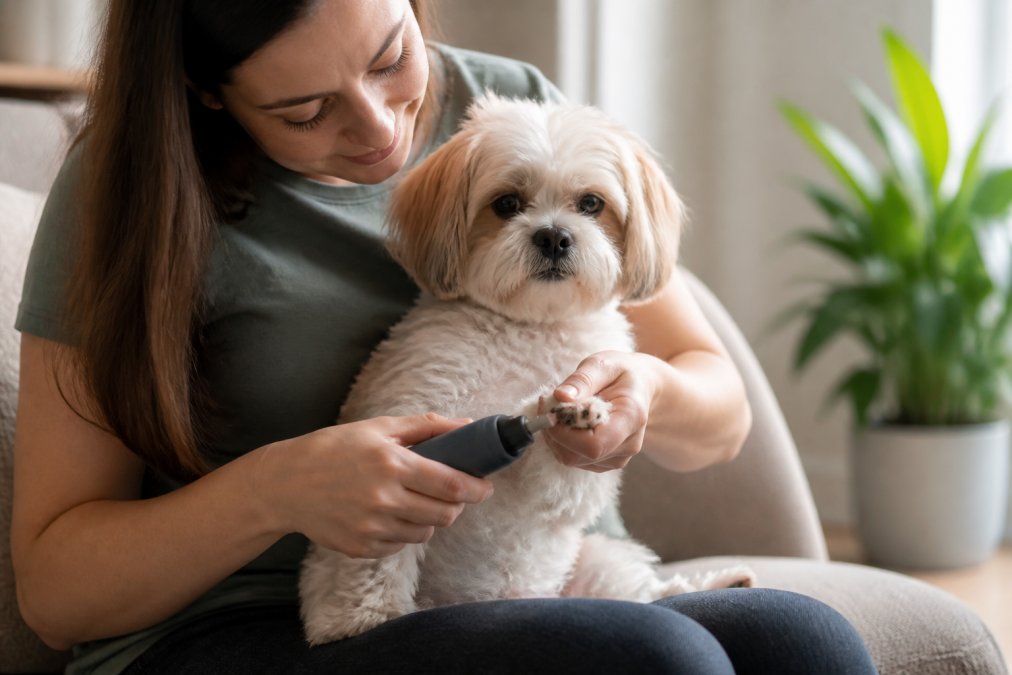
Step-by-Step Grinding Technique
- Charge the grinder fully and pick the lowest multi-speed setting.
- Hold the paw steady against your palm, not in the air.
- Touch the grinding stone to one nail for 2-3 seconds, then lift.
- Work around the nail in short passes rather than holding one spot.
- Stop before you reach the quick, the pink core visible on light nails.
- Reward, release, and end the session even if nails remain.
A common mistake is grinding the whole paw in one sitting. Two nails per session beats a wrestling match every time.
Choosing a Dog Nail Grinder for Anxious Dogs
The best dog nail grinder for anxious dogs is the one your dog tolerates, which usually means low decibel levels, low vibration, and a small head that does not block your view of the nail. Features matter less than fit here.
Look for these before anything else:
- Safety guard or protective cap that stops hair and skin reaching the bit
- Multi-speed settings so you can start slow
- LED illumination to see the quick on dark nails
- Ergonomic design you can hold for ten minutes without cramping
- Rechargeable battery with steady power as it drains
Desensitization is the other half of the equation. Play the grinder sound at low volume during meals for a week. Pair the vibration with treats. By the time you touch a nail, the sound is already boring.
Decibel Levels, Vibration, and Motor Power Compared
Decibel levels, vibration reduction, and motor power pull against each other, and that tension explains most of the difference between grinders. A high-torque motor grinds faster but usually runs louder; a whisper-quiet motor can stall on thick nails. What almost no guide does is tell you how to measure the difference yourself, which is the only way to cut through "ultra-quiet" marketing.
Run Your Own Decibel Test
You do not need a lab. A free sound-level meter app on your phone, held at a fixed distance, gives you comparable numbers across grinders. Here is a repeatable method:
- Work in the quietest room you have, ideally with soft furnishings that absorb echo. Note the ambient reading first, most homes sit around 35-45 dB with no appliances running.
- Hold the phone 12 inches from the grinder, at the same height as the motor housing, not the bit.
- Run the grinder at its lowest speed for 10 seconds and record the peak reading. Repeat at the highest speed.
- Take three readings per speed and average them. Single readings swing wildly with hand position.
- Repeat the whole test with the grinder loaded against a nail. A motor under load is louder than a motor spinning free, and that loaded number is the one your dog actually hears.
A common pattern is a 10-15 dB spread between the quietest and loudest grinders at the same speed setting (pubmed.ncbi.nlm.nih.gov). Because decibels are logarithmic, a 10 dB difference is roughly twice the perceived loudness, which is why two grinders both labeled "quiet" can produce very different reactions (the CDC).
Frequency Matters More Than Volume
A dog's hearing extends well above the human range, so a grinder can sound mild to you and piercing to your dog (Hearing range of the domestic cat). High-pitched whines in the upper frequencies are typically more aversive than a low, steady hum at the same decibel level. When you test, listen for the character of the sound, not just the number: a low hum with no whine is usually the better bet for a noise-sensitive dog.
What Actually Makes a Grinder Quieter
- Motor type and gearing, brushless motors and geared-down designs run smoother and quieter than cheap brushed motors at the same torque.
- Acoustic housing, rubber-isolated motor mounts and sound-dampening shells cut vibration transfer into the handle, which is where dogs feel the buzz.
- Bearing quality, worn or low-grade bearings introduce a high-frequency whine that no housing can hide.
- Bit balance, a bent or unbalanced shaft creates vibration that reads as instability to a dog standing on three legs.
| Priority | What to Look For | Trade-Off |
|---|---|---|
| Noise-sensitive dog | Low loaded decibel reading, acoustic noise-reduction housing | Slower material removal |
| Thick or overgrown nails | High-torque motor, diamond bit | More vibration, more sound |
| Puppies and small breeds | Lowest speed setting, small grinding head | Bit wears faster |
| Multi-dog households | Rechargeable battery, constant power | Heavier body |
Vibration matters as much as sound. A grinder that buzzes through the handle feels unstable to a dog standing on three legs, and that instability reads as danger. If you can feel the vibration in your wrist after ten seconds, your dog can feel it through a paw that is far more sensitive.
Cordless vs Corded Grinders: Battery and Convenience
Cordless convenience wins for most households, provided the battery holds steady power through the session. A grinder that slows as it drains forces you to press harder, which heats the nail and defeats the point.
Corded models never lose power and never need charging, but the cord limits where you work and adds a trip hazard near a nervous dog. For a dog that only tolerates grooming in one specific corner, that constraint is real.
For anxious dogs specifically, cordless is the better call. You can follow the dog instead of dragging the dog to an outlet, and you can stop the moment stress appears without untangling anything.
[Proudpetshop's quiet nail grinder](https://proudpetshop.com/products/proud-pet-shop-quiet-nail-grinder) is built around exactly this use case: an ultra-quiet motor, low vibration, and a compact body that fits in one hand at $28.99. If shedding is the bigger battle at your house, the Deshedding Vacuum Kit handles coat control at $59.99.


Maintenance, Grit Degradation, and Replacement Bits
Grit degradation is the maintenance issue almost nobody covers, and it is why a grinder that worked well in month one feels useless by month six. The abrasive surface on a grinding stone or diamond bit wears smooth with use, and a smooth bit does not cut, it burns. That heat is what makes dogs flinch, and it is entirely preventable.
Why a Dull Bit Gets Louder
Here is the mechanism most guides skip: as the grit flattens, the bit stops removing material efficiently, so you instinctively press harder and run the motor longer. Both increase load on the motor, and a loaded motor runs louder and hotter than a free-spinning one. A worn bit does not just grind worse, it undoes the quiet performance you paid for. Replacing the bit is often the single biggest acoustic upgrade you can make to an older grinder.
Signs Your Bit Needs Replacing
- Grinding takes noticeably longer than it used to
- You smell a faint burning odor during sessions
- The nail surface looks polished rather than filed
- You have to press harder to see any material come off
- The bit looks glazed or shiny instead of gritty
A Cleaning Routine That Preserves Quiet Performance
Clean the head after every session with the brush most kits include. Hair and nail dust pack into the bit and reduce contact area, which forces the motor to work harder. A quick routine keeps the tool running the way it did on day one:
- Power off and let the bit cool completely.
- Brush the bit with the kit brush, working from the base outward so dust does not pack deeper.
- Wipe the housing with a dry cloth, never run water over the motor housing.
- Check the bit for glazing or a bent shaft by spinning it slowly by hand.
- Store the grinder charged and dry, and avoid dropping it, since a bent shaft causes vibration that no amount of technique fixes.
Replacement Cadence
There is no universal hour count, because grit life depends on nail thickness, how often you grind, and how hard you press. A practical rule: replace the bit when a session that used to take five minutes now takes ten, or when you notice the burning smell. Keep a spare bit on hand so a dull one never forces you back to clippers mid-session. Diamond bits generally outlast coated stones, but both degrade, and both are cheap compared to the cost of a dog that learns to hate nail day.
Conclusion
Nail trims fail for reasons that have nothing to do with your dog's temperament. Sound, vibration, and a dull bit do most of the damage, and all three are fixable. Proudpetshop stocks durable grooming and comfort gear built for real households, backed by a 30-day satisfaction guarantee, fast tracked shipping, and free shipping on orders over $50. Get started with Proudpetshop and make nail day something your dog stops dreading.
Frequently Asked Questions
Which dog nail grinder is the quietest?
The quietest models typically run between 40 and 55 decibels, roughly the volume of a refrigerator hum or soft conversation. Look for grinders marketed with low-frequency sound and vibration reduction, like the Proud Pet Shop Quiet Nail Grinder at $28.99, which uses an ultra-quiet motor and minimal vibration to keep sensitive dogs calm during trims.
Is it better to clip or grind dog's nails?
Grinding removes small layers at a time and lets you stop before hitting the quick, which reduces bleeding risk and pain. Clippers cut faster but can split nails or cut too deep if your dog jerks. For anxious dogs or thick nails, a quiet nail grinder for dogs offers more control and a smoother finish, especially when paired with slow, gradual passes.
How do I desensitize my dog to a nail grinder?
Start by turning the grinder on nearby without touching your dog, reward calm behavior, then touch the handle to a paw without grinding. Progress to one nail for two seconds, reward, and stop. Keep sessions under five minutes and repeat daily. A low-vibration, quiet grinder makes this process faster because the sound and feel are less startling.
What features should I look for in a quiet nail grinder?
Prioritize decibel rating under 55 dB, multi-speed settings, a safety guard, and a diamond bit for durability. A rechargeable battery adds cordless convenience, while ergonomic design and LED illumination help with precision. Vibration reduction matters as much as sound; a grinder that buzzes less keeps paws steadier and reduces the chance of nicking the quick.