
Table of Contents
- What Makes Premium Dog Collars Last Longer Than Cheap Alternatives
- Best Materials for Dog Collars: Full-Grain Leather vs. Nylon Webbing
- Hardware Integrity and Stitching Quality: Where Cheap Collars Fail
- Heavy Duty Dog Collars for Large Breeds: Tensile Load and Abrasion Resistance
- The Aging Process: Patina, Suppleness, and Molding to the Neck
- Maintenance and Care: How to Extend Collar Longevity
- When to Replace a Dog Collar: Signs of Material Degradation
- Repairability and Environmental Impact: The Long-Term Value of Premium Gear
- Frequently Asked Questions
Last Updated: September 10, 2026
What Makes Premium Dog Collars Last Longer Than Cheap Alternatives
A dog collar is a load-bearing safety device, not a fashion accessory, and that distinction explains everything about why premium dog collars last longer. Cheap collars fail at the hardware and stitching long before the strap material gives out, while well-built collars hold their structural integrity for years. The difference comes down to three measurable factors: material grade, hardware tensile strength, and construction method.
Most buyers focus on the strap. That's the wrong place to look first.
The Hidden Costs of Replacement Frequency
A collar that costs less upfront but needs replacing every six to twelve months is rarely the cheaper option (avma.org). Beyond the money, there's the safety risk of a collar failing mid-walk, which is exactly when a dog is most likely to bolt. Replacement frequency also means repeatedly re-checking fit, re-tagging ID, and re-acclimating a dog to new hardware. Value-conscious owners who track this over a two or three year window consistently find that a single well-made collar costs less than three or four disposable ones.
Best Materials for Dog Collars: Full-Grain Leather vs. Nylon Webbing
Full-grain leather and high-tenacity nylon webbing are the two materials that actually hold up, and they fail in completely different ways. Full-grain leather is the top layer of the hide with the grain intact, which gives it the highest tensile strength and abrasion resistance of any leather grade (peer-reviewed research). Nylon webbing is a woven synthetic with excellent moisture resistance and a very high strength-to-weight ratio. Neither is universally better; the right choice depends on your dog's lifestyle.
| Material | Tensile Strength | Abrasion Resistance | Moisture Resistance | Best For |
|---|---|---|---|---|
| Full-grain leather | Very high | Very high | Moderate | Everyday wear, aging patina |
| Vegetable-tanned leather | High | High | Moderate | Sensitive dogs, natural materials |
| Nylon webbing | High | High | Excellent | Swimming, wet climates |
| Bonded or split leather | Low | Low | Poor | Short-term use only |
| Synthetic blends | Low | Low | Varies | Budget, non-critical use |
Why Vegetable-Tanned Leather Outperforms Chrome-Tanned
Vegetable-tanned leather is leather cured using plant-based tannins rather than chromium salts, and it tends to age differently than chrome-tanned hides. It develops suppleness over time and molds to the neck rather than cracking at stress points. Chrome-tanned leather is faster and cheaper to produce, but it can dry out and stiffen, which accelerates wear at the buckle and D-ring (peer-reviewed research). For a collar that's meant to be an investment piece, vegetable-tanned is the more durable long-term choice, and it's typically hypoallergenic, which matters for dogs with sensitive skin.
Hardware Integrity and Stitching Quality: Where Cheap Collars Fail
Hardware integrity is the single most common failure point on inexpensive collars, and it's almost always invisible until it breaks. Cast zinc-alloy buckles, thin stamped D-rings, and single-rivet attachments all degrade under repeated tensile load. Buckle fatigue sets in when the metal flexes slightly with every leash pull; over hundreds of walks, that flexing causes micro-cracks that eventually snap. Rust accelerates the process in wet conditions.
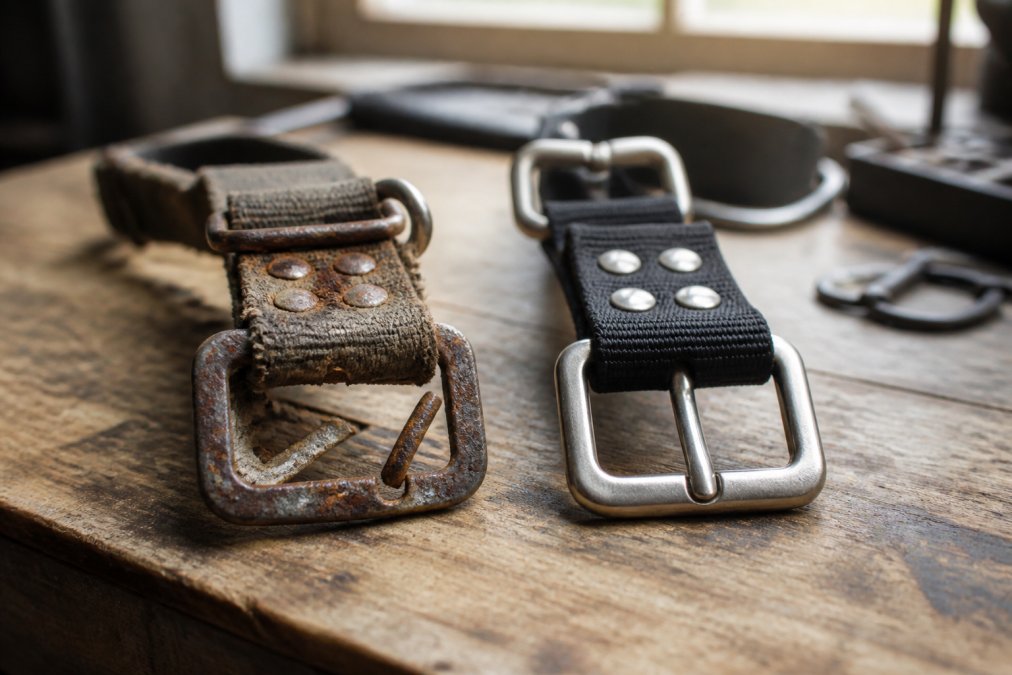
Stitching quality matters just as much. Look for double-row or box-X stitching at every load point, with thread that matches or exceeds the strap's tensile strength. A common mistake is buying a collar with a thick strap and a single line of thin thread; the strap outlasts the seam, and the collar fails anyway.
Heavy Duty Dog Collars for Large Breeds: Tensile Load and Abrasion Resistance
Heavy duty dog collars for large breeds need to be rated for tensile load, not just described as "strong." A large dog pulling hard generates far more force than most owners estimate, and that load concentrates at three points: the D-ring, the buckle, and the stitching that anchors both. Understanding how force travels through a collar is the difference between gear that holds and gear that fails.
How Tensile Load Travels Through a Collar
When a dog lunges, the leash tension enters at the D-ring, transfers into the strap through the D-ring's attachment, and resolves at the buckle and the adjustment holes. Every one of those junctions is a stress concentrator. A wider strap spreads that force across more surface area, which lowers the pressure per square inch on both the material and the dog's neck. A 1.5-inch strap on a 90-pound dog distributes load far more gently than a 1-inch strap on the same dog, and it also resists edge wear longer because there's more material between the edge and the load.
Hardware should be rated well above the dog's body weight, because a hard lunge or a sudden stop can momentarily multiply the static load. Look for welded or solid-cast D-rings rather than thin stamped ones, buckles with a thick tongue and a positive snap, and rivets that pass through a reinforced fold rather than a single layer of strap.
Breed-Specific Wear Patterns
Different dogs destroy collars in different places, and matching the collar to the wear pattern extends its life more than buying the heaviest option on the shelf.
- Deep-chested, heavy-necked breeds (Mastiffs, Rottweilers, Great Danes) stress the buckle and the stitching most. Their mass and pull angle load the buckle tongue and the box-X seam every time they lean into the leash.
- Sighthounds (Greyhounds, Whippets, Salukis) have narrow heads and can back out of a loose collar, so the fit and adjustment mechanism take the wear. A martingale-style or well-fitted buckle collar with a secure keeper matters more than raw strap thickness.
- Water-loving breeds (Labradors, Newfoundlands, Portuguese Water Dogs) drive moisture into the strap and hardware. Rust and mildew, not abrasion, are the failure mode, so stainless or coated hardware and a quick-dry strap win.
- Short-coated breeds show abrasion faster because there's no fur to cushion the strap against the skin. The collar edge rubs directly, so rolled or burnished edges last longer and cause less irritation.
- Dogs that roll, scratch, and swim abrade the strap's outer face and the D-ring's plating. This is where a replaceable hardware setup pays off.
Abrasion Resistance in Practice
A thick-necked dog rubs the collar against fences, car doors, crates, and brush. Thin straps wear through at the edges first, and once the edge frays, the load path is compromised. Full-grain leather resists edge wear well but needs conditioning to stay supple; high-tenacity nylon webbing resists abrasion and moisture but can fray at a cut edge if it isn't heat-sealed. Neither material is immune, so inspect the edges and the D-ring attachment monthly on any dog that pulls.
The Aging Process: Patina, Suppleness, and Molding to the Neck
Patina is the surface sheen and color depth that quality leather develops as oils and waxes migrate through the hide with use. It's a sign of healthy material, not damage. As a full-grain collar ages, it also becomes more supple and molds to the neck, distributing pressure more evenly and reducing rub points. This molding-to-the-neck process is something cheap leather and synthetic straps never achieve; they either stay stiff or break down. Weathering, done gradually and with occasional conditioning, deepens the patina rather than destroying the strap.
Maintenance and Care: How to Extend Collar Longevity
Basic maintenance can add years to a good collar, and it takes minutes per month. Wipe leather with a damp cloth after muddy or wet outings, let it air dry away from direct heat, and condition it lightly a few times a year to keep the fibers supple. Nylon webbing should be hand-washed with mild soap and rinsed thoroughly, since trapped grit grinds against the weave and accelerates abrasion. Inspect hardware at every cleaning: check for rust, wobble in the D-ring, and any loosening at the rivets. Rotating between two collars, one for everyday and one for wet or rugged outings, roughly halves the wear on each.
When to Replace a Dog Collar: Signs of Material Degradation
Replace a dog collar the moment you see structural damage, not cosmetic wear. Deep cracks in the leather, frayed or cut webbing, a D-ring that wobbles or shows rust, a buckle that no longer snaps firmly, or stitching that's pulled loose all mean the collar can no longer be trusted under load. As a rule of thumb, inspect monthly and replace immediately if any load-bearing component is compromised. Scratches and darkening patina are fine; cracks and movement in the metal are not.
Repairability and Environmental Impact: The Long-Term Value of Premium Gear
Premium gear is often repairable, which is where the environmental argument for longevity gets concrete. A quality collar with stitched construction can have its hardware replaced or its stitching re-done, extending its life by years. Cheap collars are typically glued, riveted, or molded in ways that make repair impractical, so they go straight into the trash. Every replacement collar you avoid is one less item manufactured, shipped, and discarded.
A Practical Repair and Conditioning Guide
Most minor wear on a good collar is fixable at home in under an hour. Here's how to handle the common cases:
1. Loose or frayed stitching at a load point. If the thread is pulling but the strap is intact, a cobbler or leatherworker can re-stitch the seam with heavy waxed thread using a saddle stitch, which is stronger than a machine lock stitch because a broken stitch doesn't unravel the whole line. This is the single most common repair and usually the cheapest.
2. A worn or bent D-ring. On a stitched collar, the D-ring is captured by a folded strap. A leatherworker can open the fold, swap in a solid stainless or welded D-ring, and re-stitch. On a riveted collar, you can often drill out the old rivet and set a new one with a rivet setter and a hammer, a five-minute job once you have the tool.
3. Dry, stiff leather. Condition with a leather balm or neatsfoot oil in thin coats, working it in with a cloth and letting it absorb before adding more. Over-oiling softens the leather too much and stretches the strap, so less is more. Condition two to four times a year, more often in dry climates.
4. Frayed nylon webbing. Trim the fray with sharp scissors and seal the cut edge with a lighter to stop it unraveling. If the fray reaches a load point, retire the collar, melted nylon at a stress point is not a repair.
5. Rust on hardware. Surface rust can be removed with fine steel wool and a light oil, but pitting means the metal has lost cross-section and should be replaced. Pitted hardware is a safety issue, not a cosmetic one.
The Environmental Math of Longevity
When a collar lasts five years instead of one, you avoid four manufacturing cycles, four shipping trips, and four items entering the waste stream. Leather and nylon both carry real environmental costs at production, so the greenest collar is usually the one you keep using. Repairing hardware and re-stitching seams keeps the strap, the most material-intensive part, in service far longer than replacing the whole collar.
Long-Term Value
The long-term value of a premium collar isn't just durability; it's fewer purchases, less waste, and a piece of gear that earns its keep. A collar you can re-stitch, re-ring, and re-condition is an asset. A collar you throw away every year is a subscription.
That's also why we built Proudpetshop around durable gear for real households, backed by a 30-day satisfaction guarantee and free shipping on orders over $50. If you're tired of replacing worn-out collars every few months, browse our adventure and safety range and choose gear that holds up.
Frequently Asked Questions
What materials make a dog collar durable?
Full-grain leather and heavy-duty nylon webbing are the most durable materials for dog collars. Full-grain leather offers high tensile strength and develops a patina that resists wear, while nylon webbing provides moisture resistance and abrasion resistance. Look for rivet reinforcement at stress points, solid brass or stainless steel hardware, and tight stitching quality. These features prevent buckle fatigue and material degradation, making the collar last longer.
How often should you replace your dog's collar?
Replace a dog collar when you notice signs of wear and tear such as fraying, cracked leather, rusted hardware, or a loose buckle. For heavy duty dog collars for large breeds, inspect monthly for stretching or weakened stitching. A premium collar with proper maintenance can last several years, while cheap collars may need replacement every 6 to 12 months. Always check for odor, moisture resistance loss, or any structural damage that could compromise pet safety.
Are expensive dog collars worth the extra cost?
Premium dog collars often cost more upfront but provide better long-term value through durability and longevity. They use materials like vegetable-tanned leather and full-grain leather that resist weathering and maintain suppleness. The hardware integrity and stitching quality reduce replacement frequency, saving money over time. Additionally, many premium collars are repairable, extending their life further. For active dogs or large breeds, the investment piece approach is often more economical than repeatedly buying cheap alternatives.
Do premium dog collars provide better safety for pets?
Yes, premium dog collars provide better pet safety due to stronger materials and construction. Heavy duty dog collars for large breeds feature high tensile strength, rivet reinforcement, and secure buckles that withstand sudden pulls. Cheap collars may fail under tensile load, risking escape or injury. Premium collars also offer ergonomic fit and breathability, reducing discomfort and skin irritation. Regular inspection for buckle fatigue and material degradation ensures continued safety.