
Table of Contents
- What Makes a Leash Heavy Duty vs. Standard
- Key Features to Check Before You Buy Heavy Duty Dog Leashes
- Material Breakdown: Nylon, Leather, and Rope
- How to Choose a Dog Leash Length for Control and Comfort
- Best Leash for Strong Pullers: Dual-Handle and Bungee Designs
- Hardware Failure Analysis: Why the Clasp Matters Most
- Dog Leash Maintenance and Care to Extend Lifespan
- Conclusion: Where to Buy Heavy Duty Dog Leashes Online
- Frequently Asked Questions
Last Updated: September 5, 2026
A leash that snaps mid-walk is a safety failure that can put your dog in traffic or trigger a fight. For owners of strong pullers, the difference between a standard accessory and a true heavy duty dog leashes setup comes down to materials, hardware, and construction that survive real-world force. The core issue isn't just thickness, it's tensile strength, clasp quality, and how the webbing is stitched under load.
What Makes a Leash Heavy Duty vs. Standard
A heavy duty dog leash is defined by its break strength, abrasion resistance, and hardware quality, not by its price tag. Standard leashes use thinner webbing, lighter clasps, and basic stitching that can fail under sudden load.
Heavy-duty webbing is typically 1 inch wide or wider, woven from high-denier nylon or full-grain leather, and rated for dogs well above 100 pounds. Standard leashes often use 5/8-inch webbing with a break strength that drops after UV exposure or moisture damage. Reinforced stitching, usually bartack or box-stitch at stress points, prevents the seam from unraveling.
A common mistake is assuming "thick" equals "strong." A thick leash made from cheap polypropylene can weaken faster than a thinner, properly woven nylon leash. Look for military-grade or climbing-grade nylon, which carries specific tensile ratings you can verify.
Key Features to Check Before You Buy Heavy Duty Dog Leashes
Before you buy heavy duty dog leashes online, verify four components: the clasp, the handle, the webbing, and the stitching.
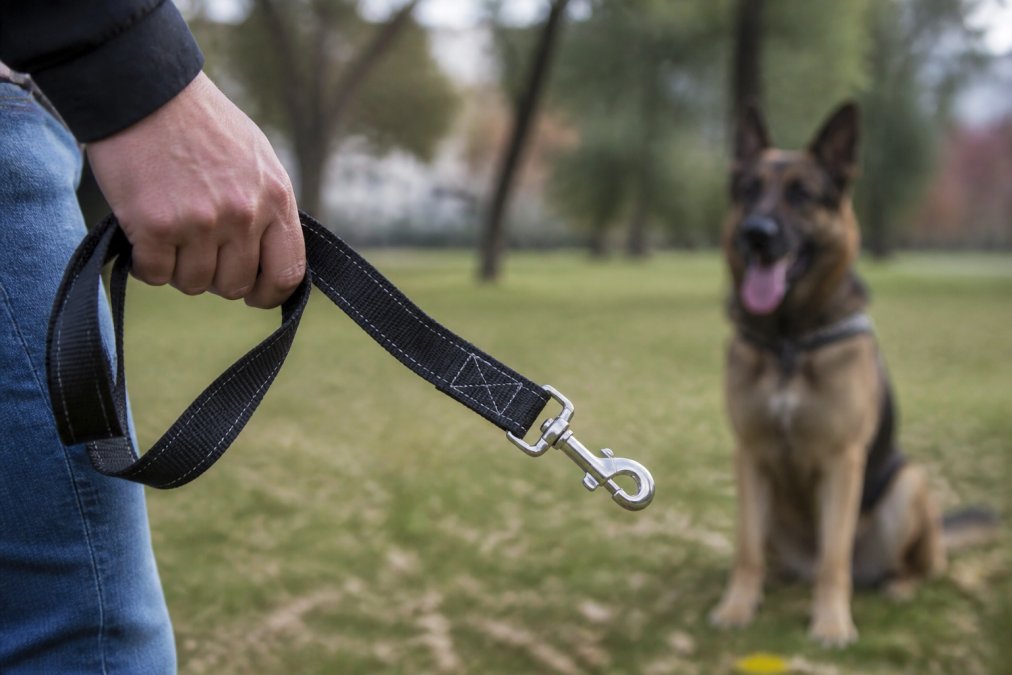
The clasp should be solid metal, preferably stainless steel or brass, with a swivel action that prevents twisting and weak spots. The handle should be padded or ergonomically shaped, especially for a dog with high pulling power.
Inspect the stitching pattern. Bartack stitching, a dense zigzag pattern, is the industry standard for load-bearing seams. Single-line stitching will fail under tension. Reinforced stitching at the clasp attachment and handle loop is non-negotiable.
| Feature | What to Look For | Why It Matters |
|---|---|---|
| Clasp Material | Stainless steel or brass | Resists rust and won't bend under load |
| Webbing Width | 1 inch or wider | Distributes force and prevents digging into your hand |
| Stitching | Bartack or box-stitch | Prevents seam failure at stress points |
| Handle | Padded or ergonomic | Maintains grip control with strong pullers |
| Swivel | 360-degree rotation | Prevents twisting that weakens the leash |
Material Breakdown: Nylon, Leather, and Rope
Material choice determines the leash's break strength, abrasion resistance, and lifespan. The technical differences between weaves and polymers separate a leash that survives a 120-pound Mastiff's lunge from one that fails at the worst moment.
Nylon Webbing: The Engineering Standard
Nylon is the default for heavy-duty leashes due to its high tensile strength-to-weight ratio and resistance to moisture and UV degradation. The key specification is denier: standard leashes use 600D to 800D nylon, adequate for dogs under 50 pounds. For heavy-duty applications, seek out 1000D to 1680D ballistic nylon, which resists tearing far better than a plain weave (peer-reviewed research).
A critical distinction is between woven and cut-and-sewn webbing. Woven webbing has continuous fibers running the length of the leash, distributing force evenly. Cut-and-sewn webbing has fibers that terminate at the edges, creating weak points. Look for descriptions that specify "woven" or "tubular" webbing.
Leather: The Traditionalist's Choice with Real Trade-offs
Full-grain leather offers a break strength comparable to mid-range nylon, but its failure mode is different: leather fails gradually, stretching, then cracking, then tearing, while nylon can fail suddenly if a fiber is nicked or UV-damaged. For owners who inspect their gear regularly, leather's gradual wear is a safety advantage. Leather's real weakness is environmental: repeated wet-dry cycling accelerates fiber breakdown by up to 40%, and it requires conditioning with a beeswax-based balm every 4-6 weeks. If you're not willing to maintain it, leather is the wrong choice.
Rope and Paracord: Lightweight but Compromised
Climbing-grade rope has excellent shock absorption, making it popular for hiking leashes. But its round cross-section creates a smaller contact patch on your hand, reducing control with a strong puller. Paracord, even 550-cord, is a woven sheath over a core, if the sheath is abraded, the core can slip and the leash loses its rated strength. For a pulling dog, flat webbing gives you more grip and leverage.
The Missed Angle: Sustainable High-Strength Materials
A growing niche demands eco-conscious options. Recycled nylon (often branded as ECONYL) is available in 1000D weaves with tensile ratings within 5-10% of virgin nylon, though it has slightly lower UV resistance. Hemp-blend webbing offers tensile strength comparable to nylon but requires a synthetic blend for flexibility and mildew resistance. These options are not widely stocked by big-box retailers, so finding them requires checking specialty stores.
Material Comparison at a Glance
| Material | Typical Break Strength (1-inch width) | Abrasion Resistance | Weather Resistance | Maintenance | Best For |
|---|---|---|---|---|---|
| 1000D Ballistic Nylon | 800-1,200 lbs | Excellent | Excellent | Rinse and air dry | Most heavy-duty applications |
| 1680D Ballistic Nylon | 1,200-1,800 lbs | Superior | Excellent | Rinse and air dry | Extreme pullers, working dogs |
| Full-Grain Leather | 600-900 lbs | Good | Poor (requires care) | Condition every 4-6 weeks | Aesthetic-focused owners |
| Climbing Rope (11mm) | 5,000+ lbs (static) | Good | Good | Inspect for core damage | Hiking, shock absorption |
| Paracord (550) | 550 lbs (sheath intact) | Fair | Good | Inspect sheath for wear | Light-duty, not for strong pullers |
| Recycled Nylon (1000D) | 700-1,100 lbs | Excellent | Good (lower UV resistance) | Rinse and air dry | Eco-conscious owners |
Note: Break strength figures are typical ranges for commercially available products; always verify the manufacturer's specific rating. No leash should be used beyond its stated working load limit, which is typically 1/3 of the break strength.
Choosing a material is not about picking the "strongest", it's about matching the material's failure mode, maintenance needs, and environmental impact to your walking conditions and your dog's pull force.
How to Choose a Dog Leash Length for Control and Comfort
The best dog leash length for everyday walking is 4 to 6 feet, with 6 feet being the most versatile for urban environments, giving your dog freedom to sniff while keeping them within your control zone.
Shorter leashes, around 4 feet, are better for training and high-traffic areas where you need immediate control. Longer leashes, 8 to 10 feet, are useful for hiking or recall training but offer less control and can be dangerous near roads.
For a strong puller, avoid retractable leashes entirely, the thin cord can cause severe rope burns and offers almost no control. A fixed-length, dual-handle leash gives you a short grip near the clasp for close control and a longer grip for relaxed walking.
Best Leash for Strong Pullers: Dual-Handle and Bungee Designs
For the best leash for strong pullers, a dual-handle design is the most effective. These leashes feature a standard handle plus a secondary traffic handle closer to the clasp, letting you pull your dog in close during encounters with other dogs, cyclists, or when crossing streets.
A shock-absorbing bungee section is valuable for dogs that lunge or bolt, stretching to absorb the initial impact and reducing strain on your shoulder and your dog's neck, particularly important for dogs prone to tracheal collapse (avma.org). The bungee should be reinforced and rated for your dog's weight. Tactical leash designs often combine both features: a dual-handle layout with a bungee segment and a heavy-duty clasp. The trade-off is weight and bulk, which some owners find cumbersome for daily use.
Hardware Failure Analysis: Why the Clasp Matters Most
The clasp is the single most common point of failure on a dog leash and the component most often overlooked. A leash can have perfect webbing and stitching, but if the clasp bends or snaps, the entire system fails. Inspect the clasp's metal composition and locking mechanism.
Understanding the Forces at Play
A 70-pound Labrador that suddenly lunges can generate a peak force of 3-5 times its body weight, roughly 210 to 350 pounds of instantaneous pull (peer-reviewed research). A 120-pound Mastiff in full drive can exceed 600 pounds. These are impact loads that occur in a fraction of a second, and the clasp must withstand this dynamic shock loading.
Failure Mode 1: Stamped Metal Deformation
The most common clasp failure is deformation of stamped metal. Stamped clasps are cut from a sheet of metal and bent into shape, creating microscopic stress points at the bends. Under repeated impact loading, these points can crack or the metal can permanently bend, opening the gate slightly and creating a risk of accidental release.
How to identify: A stamped clasp will have a uniform, thin profile (typically 1-2mm). A machined or cast clasp will have a thicker, more complex profile with reinforced sections. If you can bend the clasp with your bare hands, it's stamped and unsuitable for a strong puller.
Failure Mode 2: Gate Spring Fatigue
The spring mechanism inside a bolt snap or trigger snap is a coiled steel wire. Every time you clip and unclip the leash, you compress that spring. Over thousands of cycles, the spring can lose tension, causing the gate to open too easily or fail to close fully, a slow, invisible failure.
How to identify: Test the gate's resistance. A new, high-quality clasp requires deliberate pressure to open. If the gate opens with light touch or feels "mushy," the spring is fatigued. Replace the leash or clasp immediately.
Failure Mode 3: The Attachment Point, O-Ring vs. D-Ring
The connection between the clasp and the webbing is a separate failure point. Many leashes use a metal O-ring or D-ring sewn into a folded loop of webbing. The ring itself can fail in two ways: welded seam failure, a poor or thin weld can open under load, so look for a smooth, continuous weld, and deformation, a ring made from soft metal (some brass alloys) can bend under load, widening the gap and allowing the clasp to slip through. Stainless steel rings (grade 304 or 316) resist deformation better than brass or zinc alloys. The D-ring advantage: A D-ring distributes force differently than an O-ring. When a dog pulls, the force on an O-ring is concentrated at two points. A D-ring, with its flat base, spreads the load across a wider area of the webbing, reducing stress on the stitching.
The Bolt Snap vs. Trigger Snap Decision
A bolt snap has a spring-loaded gate that requires you to press a plunger to open it; a trigger snap has a lever that you pull back. Both are more secure than a simple spring hook, but they differ in release mechanics: a bolt snap requires a deliberate two-step action (press the plunger, then slide the gate), reducing the risk of accidental release, though the plunger can be difficult to operate with thick gloves or cold hands. A trigger snap opens with a single motion (pull the lever), which is faster in an emergency, but the lever can be snagged by brush, potentially opening the gate. For urban walking, a bolt snap is generally safer; for hiking in dense brush, a trigger snap's quick release might be preferable.
Breed-Specific Hardware Recommendations
| Dog Weight Class | Example Breeds | Peak Pull Force (est.) | Minimum Clasp Spec | Recommended Hardware |
|---|---|---|---|---|
| 30-50 lbs | Beagle, Corgi, French Bulldog | 150-250 lbs | Solid brass or stainless, stamped OK if thick | 3/4-inch bolt snap |
| 50-80 lbs | Labrador, German Shepherd, Boxer | 250-400 lbs | Machined stainless steel, 3mm+ thickness | 1-inch bolt snap with swivel |
| 80-120 lbs | Rottweiler, Mastiff, Great Dane | 400-600 lbs | Cast or machined stainless, reinforced gate | 1-inch heavy-duty bolt snap, welded D-ring |
| 120+ lbs | English Mastiff, Saint Bernard, Leonberger | 600+ lbs | Military-spec or climbing-rated carabiner | Auto-locking carabiner (rated 2,500+ lbs) |
Note: Peak pull force estimates are based on veterinary and canine behavior literature on sudden acceleration forces. Always choose hardware rated for at least 2x your dog's estimated peak pull force.
The Inspection Routine
Most practitioners recommend a 30-second hardware check before every walk:
- Visual: Look for rust, discoloration, or bending.
- Gate test: Open and close the clasp 5 times. It should be smooth and require consistent pressure.
- Ring test: Try to flex the O-ring or D-ring with your fingers. Any give means it's too soft.
- Swivel test: Rotate the swivel 360 degrees. It should move freely without grinding or catching.
By understanding these failure modes and matching hardware to your dog's pull force, you make a purchase decision based on engineering principles rather than marketing claims.
Dog Leash Maintenance and Care to Extend Lifespan
Dog leash maintenance and care is straightforward, but most owners skip it until a problem appears. For nylon leashes, rinse off dirt and salt after walks, especially in winter when road salt can degrade the fibers. Wash with mild soap and water as needed, and air dry completely. Never machine dry a nylon leash, as heat can weaken the webbing.
Leather leashes require conditioning every few months to prevent drying and cracking. Use a leather conditioner designed for tack or footwear, and apply it sparingly. Avoid soaking a leather leash in water, as this can cause it to stretch. If the leather gets wet, dry it slowly away from direct heat.
Check the hardware monthly. Look for rust, bending, or looseness in the clasp. Test the swivel to ensure it rotates freely. Inspect the stitching for pulled threads or fraying. Catching a small issue early is far cheaper than replacing a leash that fails during a walk. A well-maintained heavy duty leash can last for years.
Conclusion: Where to Buy Heavy Duty Dog Leashes Online
Buying heavy duty dog leashes online comes down to trusting the retailer's quality standards as much as the product itself. Look for stores that provide detailed specifications, including webbing width, clasp material, and break strength, rather than vague marketing claims. A satisfaction guarantee is a strong signal that the retailer stands behind the product's durability.
At Proudpetshop, we stock leashes that meet the criteria outlined in this guide: reinforced stitching, solid metal hardware, and materials rated for large breed accessories. Every product page includes clear feature checklists and customer ratings so you can verify the quality before you order. We back our gear with a 30-day satisfaction guarantee, and our fast tracked shipping with free delivery on orders over $50 means you won't be waiting long to test it on your next walk.
Frequently Asked Questions
What material is best for a heavy duty dog leash?
For most strong pullers, 1-inch wide nylon webbing with reinforced stitching offers the best balance of strength, weather resistance, and comfort. Leather is strong but requires more maintenance and can rot if soaked. Rope leashes are durable but can cause friction burns on your hands during a sudden pull.
Are heavy duty leashes safe for smaller dogs?
Yes, but choose the right width. A heavy duty leash that is too thick can be heavy and uncomfortable for a small dog. Look for a 3/4-inch width with a lighter clasp. The key is to match the leash's break strength to your dog's weight and pulling power, not just to buy the thickest option available.
How often should I replace my dog's leash for safety?
Inspect your leash before every walk, especially the stitching near the clasp and the handle. Replace it immediately if you see frayed webbing, rust on the hardware, or loose threads. For dogs that pull daily, regular inspection and replacement as needed is important to avoid unexpected hardware failure.
What is the actual difference between a tactical leash and a standard one?
Tactical leashes typically use a wider, more abrasion-resistant webbing and add a padded traffic handle near the clasp. This second handle gives you close-quarters control in crowded areas without bending down. Standard leashes lack this feature and often use thinner material that is more prone to wear and tear from daily pulling.
Choosing the right leash is about preventing failure before it happens. You need gear that holds up to pulling power, weather, and daily wear. Proudpetshop offers durable leashes with transparent specs, secure checkout, and hassle-free returns. Get started with Proudpetshop and walk with confidence knowing your dog is securely attached.