
Table of Contents
- What Separates a Trail-Ready Waterproof Dog Backpack From a Costume
- How to Fit a Dog Backpack So It Stays Put on Rugged Terrain
- How Much Weight Can My Dog Carry? Sizing by Breed and Build
- Small-Dog Biomechanics: Why Most Packs Fail Under 20 Pounds
- Carrying Solutions for Tired Small Dogs on Long Treks
- Dog Hiking Gear Checklist: What Goes in the Pack and What Stays Home
- Conclusion
- Frequently Asked Questions
Last Updated: September 18, 2026
What Separates a Trail-Ready Waterproof Dog Backpack From a Costume
A waterproof dog backpack for hiking lives or dies on one question: does it survive mud, rain, and rock, or fall apart by mile two? Most cheap packs are costume-grade, they look the part but fail the moment your dog pushes through brush or scrambles over wet granite.
The difference comes down to three things: the shell, the seams, and the hardware.
Weather-Resistant Shells, Sealed Zippers, and Durable Hardware
A real trail pack uses a coated ripstop or TPU-laminated shell that sheds water instead of soaking it. Look for sealed or water-resistant zippers, not standard coils that jam with grit. Durable hardware means metal D-rings and quick-release buckles that hold under load, not plastic clips that snap in cold weather.
Ergonomic Fit, Breathable Mesh, and Chafing Prevention
Chafing prevention starts with breathable mesh on the chest and belly panels; a pack that traps heat causes hot spots within an hour. Adjustable straps at four points (chest, girth, and two shoulder points) keep the load centered instead of sliding.
How to Fit a Dog Backpack So It Stays Put on Rugged Terrain
Learning how to fit a dog backpack correctly takes five minutes and prevents almost every problem owners complain about later. The pack sits behind the shoulder blades, never on the neck, with two fingers of slack under every strap.
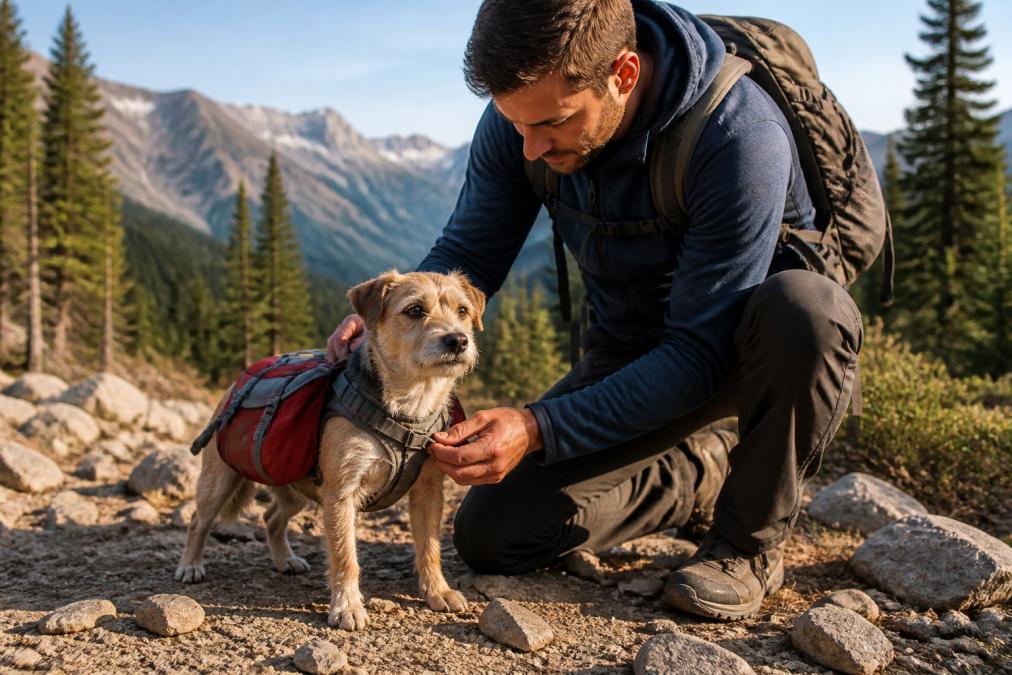
Follow this sequence:
- Place the pack on a standing dog, unloaded
- Tighten the girth strap first, snug but not restrictive
- Adjust the chest strap so it sits high on the sternum
- Check the shoulder straps for even tension on both sides
- Load the pack, then re-check every strap
- Walk your dog 50 yards and watch for rotation or rubbing
How Much Weight Can My Dog Carry? Sizing by Breed and Build
The standard guidance is 10 to 15 percent of body weight comfortably, up to 20 percent for conditioned, larger breeds. A 15-pound dog should carry no more than about 2 pounds; a 60-pound trail dog can handle 6 to 9 pounds once trained.
| Dog Size | Body Weight | Starting Load | Max Load |
|---|---|---|---|
| Small | Under 20 lbs | 1 lb | 2-3 lbs |
| Medium | 20-50 lbs | 2-3 lbs | 5-7 lbs |
| Large | 50-90 lbs | 3-4 lbs | 8-12 lbs |
| Giant | 90+ lbs | 4-5 lbs | 12-15 lbs |
Small-Dog Biomechanics: Why Most Packs Fail Under 20 Pounds
Small dogs are not scaled-down Labradors. They have shorter legs, a lower center of gravity, and far less ground clearance, and every difference changes how a loaded pack behaves. A pack that earns five stars on a 70-pound retriever can be genuinely unsafe on a 12-pound terrier, for mechanical reasons, not cosmetic ones.
Stride Length, Ground Clearance, and the Drag Problem
A small dog's stride is short, often under 12 inches at a brisk trot. When a standard medium pack hangs below the belly line, the bottom edge sits within inches of the ground, catching twigs, snagging roots, and dragging through mud. The dog compensates by shortening its stride further, throwing off gait and burning more energy than the load itself.
Load Transfer Onto Already-Loaded Front Legs
Here is the mechanism most reviews skip: dogs carry roughly 60 percent of body weight on the front limbs, and small breeds already run front-heavy because their heads and chests are proportionally large. Add a top-heavy pack that shifts weight forward, and you stack load onto limbs already doing most of the work.
Back Length and the Sizing Trap
Weight-based sizing charts fail small breeds with long backs. A dachshund and a Jack Russell terrier can weigh the same 15 pounds and need completely different pack lengths. Measure from the withers to the base of the tail, then match that number to the pack's body length, not the weight range.
Temperature Regulation for Low-to-Ground Breeds
Small dogs lose heat faster than large dogs because they have a higher surface-area-to-volume ratio. They also run closer to warm ground, hot rock, and radiant heat off sun-baked trail. A pack with a solid belly panel traps that heat against the torso and turns a summer hike into a heat-stress risk.
Joint Strain and the Case for Lighter Loads
Small breeds are prone to patellar luxation and tracheal collapse, and both worsen under load and pressure. A chest strap riding too high on the throat presses on the trachea on every climb, and a pack that shifts side to side on descents loads the knees unevenly.
Carrying Solutions for Tired Small Dogs on Long Treks
Every small-dog owner hits the same wall: mile six, the dog stops, and you're three miles from the trailhead. Carrying solutions for tired small dogs belong in your pack from the start, not as an afterthought.
Options that work:
- A front-hugging dog carrier backpack distributes weight across your shoulders and keeps your dog secure and close
- An adjustable crossbody pet sling bag works for shorter carries and quick lifts over obstacles
- An elevated outdoor dog bed gives your dog a clean, dry rest stop at lunch
Dog Hiking Gear Checklist: What Goes in the Pack and What Stays Home
A practical dog hiking gear checklist keeps your pack light and your dog safe, but it has to be sized to your dog. Every ounce on a 15-pound dog is a bigger percentage of body weight than the same ounce on a 60-pound dog. Weigh everything before you leave, and treat the checklist as a budget, not a wish list.
Hydration: The Math That Actually Matters
A working rule most trail handlers use is about 1 ounce of water per 10 pounds of body weight per hour of moderate hiking, more in heat or on steep climbs. A 15-pound dog needs roughly 1.5 ounces an hour; a 60-pound dog needs about 6. Carry a collapsible silicone bowl, and offer water every 20 to 30 minutes rather than waiting for the dog to look thirsty.
Paw Care and Footwear
Paw protection earns its place in the pack on hot rock, ice, and long stretches of gravel. Boots sized for small breeds run small, so measure each paw at its widest point while the dog is standing. Break boots in on short walks at home, because a boot that rubs at mile one will rub worse at mile five.
First Aid Basics
A canine first aid kit does not need to be large, but it should be specific. Gauze rolls, self-adhering vet wrap, blunt-tip tweezers for ticks and foxtails, antiseptic wipes, saline for eye flush, and a tick key cover most trail injuries. Add any regular medication, and keep vaccination records and your veterinarian's phone number in a waterproof pouch.
Visibility and Trail Etiquette
Reflective trim or a clip-on visibility light matters on dawn and dusk hikes, and more for small dogs that sit below a driver's or cyclist's sightline. A high-visibility vest in hunting season is not optional in many areas.
What Stays Home
Weigh the loaded pack one more time before you leave the car. If it exceeds the low end of your dog's safe range, leave something behind. The trail will still be there next weekend.
Conclusion
The hard part isn't finding a waterproof dog backpack. It's finding one built for your dog's actual body, not a generic size chart. Getting the fit, the load, and the carrying backup right takes one honest test walk.
Frequently Asked Questions
How much weight should a dog carry in a hiking backpack?
A healthy adult dog can typically carry 10 to 15 percent of its body weight, and that includes the pack itself. A 50-pound dog handles roughly 5 to 7 pounds of total load. Small dogs under 20 pounds should carry closer to 5 percent, or nothing at all. Build up over several short walks before a real hike, and watch for a dropped head, stiff gait, or lagging behind.
Are waterproof dog backpacks necessary for day hikes?
A waterproof dog backpack matters more than most owners expect. Stream crossings, sudden rain, and wet underbrush soak a standard nylon pack within minutes, and a damp load sits heavier on your dog's spine. A weather-resistant shell with sealed zippers keeps food, first aid supplies, and a spare leash dry. Even on a clear forecast, waterproofing protects against dew, mud splashes, and river crossings.
How do I measure my dog for a hiking backpack?
Measure your dog's girth at the widest point behind the front legs, then measure from the base of the neck to the start of the tail for back length. Compare both numbers to the pack's size chart rather than guessing by breed. A correctly fitted pack sits behind the shoulder blades, leaves two fingers of space under each strap, and does not slide when your dog shakes or trots.
Can a dog wear a backpack for long-distance hiking?
Yes, with a gradual build-up. Start with an empty pack on 10-minute walks, add light weight over two to three weeks, and cap the load at 10 to 15 percent of body weight for healthy adults. Check for rubbing at the armpits and belly after every session. Senior dogs, puppies, and flat-faced breeds should carry little or nothing. For multi-day trekking, plan shorter mileage days and inspect paws and skin each evening.