
Table of Contents
- Why Your Dog Eats Like There's No Tomorrow
- The Real Risks of Fast Eating (And When to Call Your Vet)
- How to Slow Down Dog Eating: Step-by-Step
- Best Slow Feeder Bowl for Dogs: What to Look For
- How to Train a Dog to Eat Slower (Without a Bowl)
- DIY Slow Feeder Ideas for Dogs You Can Make Tonight
- When Your Dog Eats Too Fast and Throws Up
- Frequently Asked Questions
Last Updated: October 12, 2026
Why Your Dog Eats Like There's No Tomorrow
If your dog inhales a full bowl of kibble in under a minute, you are not alone. Fast eating is one of the most common feeding complaints among dog owners, and it usually has nothing to do with hunger.
The behavior traces back to instinct: in the wild, a dog that lingered over a meal risked losing it to a faster pack mate.
The good news: learning how to slow down dog eating is one of the easier behavior fixes you can make at home, and it rarely takes more than a few small changes to your routine.
At Proudpetshop, we talk with pet parents every day who are dealing with gulped meals, gas, and the occasional upset stomach. The fix starts with one question: why is your dog eating so fast?
The Instinct Behind the Inhale
Dogs are built to eat quickly and move on.
Competition makes it worse. In a multi-dog household, the fastest eater often gets the most food. Even a dog with no competition may carry that same urgency.
Anxiety plays a role too. Some dogs eat fast because they feel stressed about food access, especially if meals are unpredictable or the bowl gets moved around.
The Real Risks of Fast Eating (And When to Call Your Vet)
Fast eating is not just messy. It can cause real health problems, and in rare cases it becomes an emergency.
The most common issue is aerophagia, or swallowing too much air while eating. That air usually comes back up as gas or a bloated belly.
Regurgitation is another frequent result: food comes back up shortly after eating, often undigested and in a tube shape.
The serious concern is bloat, or gastric dilatation-volvulus, a life-threatening condition where the stomach fills with gas and can twist (Gastric Dilation and Volvulus in Small Animals - Digestive System).
From Gas to Emergency: Reading the Warning Signs
Not every fast eater needs medical attention, but some signs mean it is time to call a professional:
- Repeated vomiting or regurgitation after most meals
- A visibly swollen or tight abdomen
- Pacing, drooling, or restlessness after eating
If you see any of these, stop adjusting the bowl and call your vet.
How to Slow Down Dog Eating: Step-by-Step
Slowing your dog's eating comes down to four moves: portion correctly, split the meal, match the method to your dog, and track whether it is working.
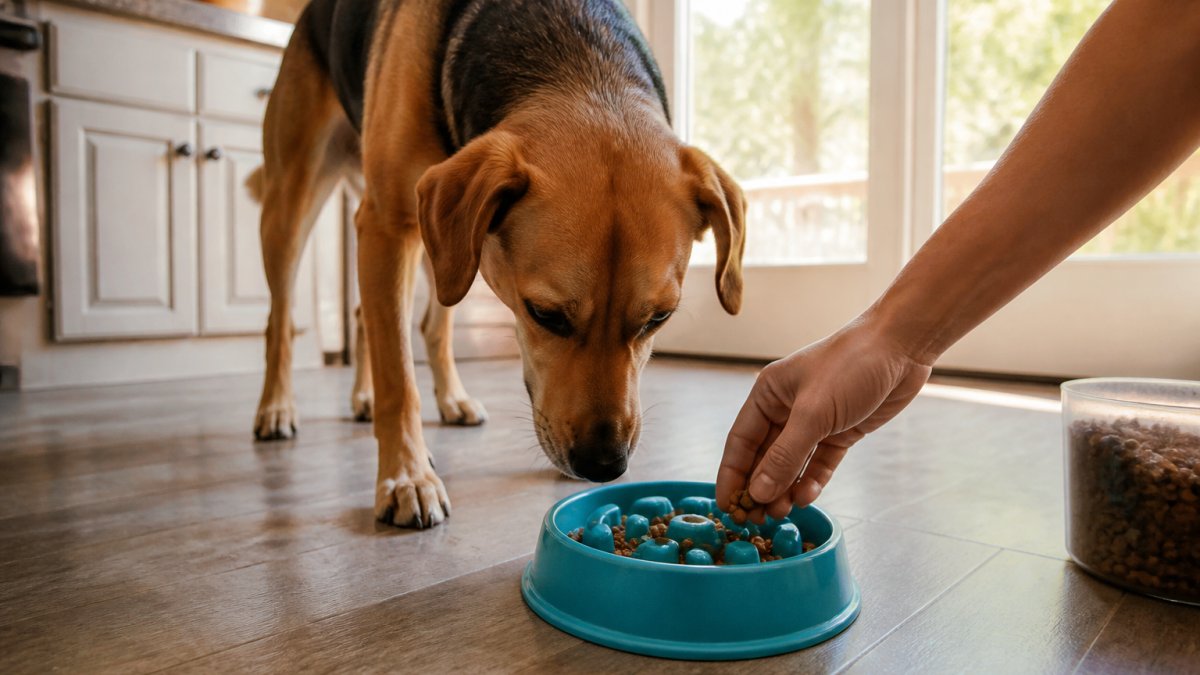
Step 1: Measure the Right Portion
Start with the correct amount of food. Overfeeding makes fast eating worse because there is more to gulp.
Use a measuring cup or kitchen scale, not scoop-by-eye. Check the guidelines on your dog food bag, then adjust for weight, age, and activity level; your vet can give you an exact number.
Smaller portions are easier to manage and less likely to trigger the gulp reflex.
Step 2: Split Meals Into Smaller Portions
Instead of one big meal, feed two or three smaller meals a day. Most adult dogs do well on a twice-daily schedule.
Splitting meals reduces the volume your dog faces at once and gives them more chances to eat calmly throughout the day.
Puppies often do better on three to four small meals than two large ones, and toy breeds and seniors may also do better on three because their stomach capacity is smaller.
Step 3: Match the Method to Your Dog
No single slow-feeder bowl is a universal fix. The right choice depends on your dog's size, age, muzzle shape, and food type.
- Puppies: Use shallow ridges and soft, small kibble. Deep mazes frustrate puppies and can teach them to give up on meals. Split into three to four small feedings.
- Large and deep-chested breeds: These dogs carry the highest risk from gulping. Use a wide, heavy slow-feeder with a non-slip base, and consider splitting meals into three. Keep the bowl on the floor, not raised.
- Dry kibble: Slow-feeder bowls, snuffle mats, and puzzle feeders all work well. Kibble size matters, very small kibble falls through the gaps of some puzzle toys.
Step 4: Measure Whether It Is Working
A method only counts if it changes the meal. Track three things for one week:
- Meal duration. Time each meal with a stopwatch. A dog that ate in 40 seconds should be taking at least two to three minutes with a working method.
- Regurgitation and gas. Note any food coming back up, gulping sounds, or excessive gas after meals.
- Comfort. Watch for signs of frustration, walking away, whining, pawing at the bowl, or refusing to eat. A method that slows eating but stresses the dog is the wrong method.
If meal duration does not improve after a week, the method is too easy; if your dog gives up or seems distressed, it is too hard. Adjust one variable at a time, bowl depth, food type, or portion size, so you can tell what helped.
Proud Pet Shop Sniffing Petal Mat →
Safe Setup and Supervision
Every slow-feeding method adds a small risk a standard bowl does not. Reduce it with a few habits:
- Non-slip base. A bowl that slides lets a dog gulp faster out of frustration. Look for rubber or suction bases, and place the bowl on a mat if your floors are smooth.
- Easy-to-clean materials. Food residue in ridges and fabric folds grows bacteria. Choose dishwasher-safe bowls and machine-washable mats, and clean them at least weekly.
- Supervise new methods. The first few times you use a puzzle feeder, frozen treat, or snuffle mat, stay in the room. Watch for choking, frantic pawing, or a dog trying to swallow a piece whole.
Best Slow Feeder Bowl for Dogs: What to Look For
The best slow feeder bowl for dogs matches your dog's size, muzzle shape, and eating style.
Look for these features:
- Non-slip base so the bowl stays put during eating
- Food-safe material that is easy to clean
- Ridge depth suited to your dog's breed and snout length
We built the Proud Pet Shop Slow-Feeding System as a 3-piece set for exactly this reason.

For dogs who need more of a challenge, the Proud Pet Shop IQ Treat Puzzle adds adjustable difficulty so your dog has to nose and paw food loose.

| Bowl Type | Best For | Slows Eating By |
|---|---|---|
| Standard bowl | Calm eaters | Little to none |
| Slow-feeder bowl | Most fast eaters | Moderate to high |
| Lick mat | Wet food, anxious dogs | Moderate |
| Puzzle feeder | Bored, clever dogs | High |
| Snuffle mat | Foraging instincts | High |
How to Train a Dog to Eat Slower (Without a Bowl)
You can slow your dog down without buying anything new. Training a dog to eat slower is mostly about changing the setup and your own habits, and in a multi-dog home, managing competition.
Try these approaches:
- Hand-feed part of the meal. This forces your dog to eat one piece at a time and builds a calm association with your hands near food.
- Scatter kibble on a towel or mat. Your dog has to sniff out each piece, which stretches a meal from seconds to minutes.
- Use a muffin tin. Drop a few kibble pieces into each cup for a homemade puzzle. Add a tennis ball on top to make it harder.
Feeding in a Multi-Dog Household
Competition is one of the most common reasons a dog gulps, and the one most owners miss. Even dogs that get along fine all day will race each other at the bowl.
A few rules that solve most of it:
- Separate feeding areas. Feed each dog in a different room, behind a gate, or at opposite ends of a hallway with a visual barrier. Out of sight is better than across the room.
- Feed at the same time, in the same order. Dogs learn the routine quickly, and predictability reduces the urgency to guard a meal.
- Pick up bowls when each dog finishes. Leaving food down lets a faster dog finish their own meal and then push a slower dog off theirs.
If separating meals is not practical, feed the fast eater first in a closed room, then feed the slower dog once the first dog is done. It is not ideal, but it removes the race entirely.
When to Stop Training and Call Your Vet
Training solves fast eating from habit or competition, not from a medical problem. Call your vet if your dog:
- Regurgitates or vomits after most meals even with a slow-feeder method
- Has a swollen, hard belly, paces, or retches without producing anything
- Loses weight despite eating normally
Those signs point to something a bowl change cannot fix, and the sooner they are checked, the better.
DIY Slow Feeder Ideas for Dogs You Can Make Tonight
DIY slow feeder ideas for dogs are simple, cheap, and effective. You probably already have what you need at home.
- Muffin tin: Place kibble in each cup, then add a tennis ball on top to block easy access.
- Snuffle towel: Roll kibble into a large towel and let your dog unroll it.
- Cardboard maze: Cut low walls into a shallow box and scatter food between them.
The Proud Pet Shop Sniffing Petal Mat takes the snuffle idea further. You hide kibble between folded felt petals, and your dog has to use their nose to find each piece. It is machine washable, which matters when food touches the surface daily.

When Your Dog Eats Too Fast and Throws Up
If your dog eats too fast and throws up, the most likely cause is regurgitation from eating too quickly: food comes back up soon after the meal, often undigested.
Here is what to do:
- Pick up the bowl and wait 10 to 15 minutes.
- Offer the food again in a smaller amount.
- Use a slow-feeder method for the next meal.
- Watch for repeated episodes or other symptoms.
If your dog throws up often, seems tired, or has a painful belly, call your vet. Repeated regurgitation can lead to weight loss and other problems.
For multi-dog homes, feed each dog in a separate room or behind a gate.
Fast eating is frustrating, but it is one of the most fixable habits in your dog's daily routine.
Frequently Asked Questions
Why does my dog act like she's starving all the time?
Dogs evolved as scavengers, so many eat as if the next meal might not come. This instinct is stronger in breeds like Labradors and Beagles. If your dog is otherwise healthy but inhales food, it's usually behavioral, not medical. However, sudden ravenous appetite paired with weight loss can signal issues like parasites or diabetes. Your vet can rule those out with a simple exam.
Can I train my dog to eat slower without buying anything?
Yes. Hand-feeding one kibble at a time, scattering food across a towel, or using a muffin tin as a DIY puzzle all work. You can also split meals into three or four smaller portions instead of two large ones. The key is making each piece require effort. Most dogs adjust within a week if you stay consistent.
When should I worry about my dog eating too fast?
Call your vet if your dog vomits right after meals, has a swollen or hard belly, retches without producing anything, or seems uncomfortable after eating. These can signal bloat, which is a medical emergency in deep-chested breeds. Occasional gas or hiccups are normal, but repeated regurgitation or abdominal pain needs professional attention.
Does a slow feeder bowl work for wet food?
Yes, but choose one with wider, shallower grooves. Deep puzzle bowls trap wet food and become hard to clean. Lick mats or flat silicone mats with ridges work better for wet food, yogurt, or peanut butter. They encourage licking instead of gulping and are usually dishwasher-safe. Always check that the material is food-grade and BPA-free.